Saturday, January 21, 2012

Theory and Practice


The little book by Wassily Kandinsky "Concerning the Spiritual in Art" was written in 1909 and first published in 1912.
Only eight chapters, the essay is dense, bubbling with ideas. The artist who was also a founder of the movement Der Blaue Reiter was the intellectual of the group.

I read the book, written in Russian and German, in French. The style is outmoded with long-winded sentences but the content is revolutionary. Not only about the spiritual in art, it also lays out a theory of abstract art.

The author discusses how the artist becomes the link between the crowd and the spiritual, and his subsequent loneliness on top of the triangle, with the crowd at the bottom.

In the longest chapter, he describes the theory of colors and shapes. Of course, the artist was not alone in his search, he was influenced by other artists and philosophers. He also inspired generations to come. It is a testimony of the intellectual life at the time. Kandinsky develops a grammar for the artists and brings parallels with music. Synesthesia was one of his favorite theory.

He brings back art to a spiritual function. Art creates a spiritual atmosphere and promotes meditation. Art does not only stimulate the senses but also the soul.


The book is full of great quotes. Here are a few:


"The artist must not only train his eye, but also his soul"


"Is beautiful what proceeds from an inner necessity of the soul. Is beautiful what is inwardly beautiful."


"The artist must have something to say, mastery over forms is not his goal but adaptation of form to its inner meaning."

photographs Wikipedia Commons:


Wassily Kandinsky


"Der Blaue Reiter" Wassily Kandinsky, 1903


"On White II" Wassily Kandinsky, 1923

Sunday, January 15, 2012

Social minimalism

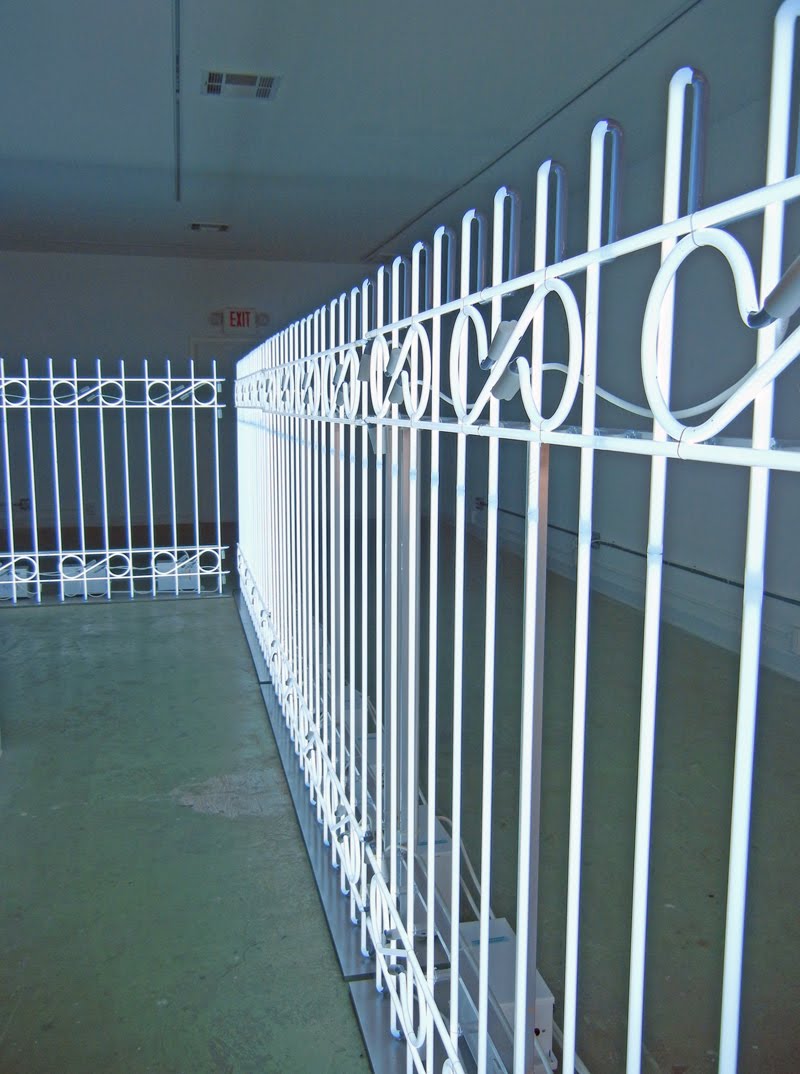
Thanks to the Biennale Prospect.2 in New Orleans, the art galleries invite out of town artists, among them Ivan Navarro, a Chilean artist now living in Brooklyn. The last few days of Prospect.2, I visited the UNO Art Gallery on Saint-Claude Avenue to see the site specific work, a reminder of his installation Fence, 2011, at the New York Armory Show. The message is quite clear, fences are frustrating, divisive, usually ugly, represent authority. Fences are also an invitation to jump over and a challenge to the individual. The decorative fence at the gallery encloses a grey dead space, empty, a luxury in this neighborhood.
It makes me think of the rails along cemeteries, maybe jumping this fence with its pale white light would bring me to paradise. I imagine a world of lost souls and phantoms populating the empty space. Minimalism requires the viewer to get involved!

Looking back, the whole event and its location brought up a deep frustration. The building in the tough neighborhood even on a Friday at noon, is enclosed behind a locked iron door and one can see the cameras on both sides to deter intruders. The Art District in Saint-Claude is an island and I cannot find the purpose of art galleries if they are excluding the locals. What is the accomplishment of the art galleries promoting "art for the few" other than exclusion and eventually gentrification of the neighborhood? The artist's message was obviously not directed to the people who feel the impact of the fence in their lives: migrants, prisoners, political activists... A few like me were able to see the work.
The setting is hypocritical and tarnishes the artist's message.


Ivan Navarro was just featured in the January issue of ARTnews in the article Man of Refraction.


photograph by the author

Friday, January 13, 2012

Side shows


Art Basel Miami Beach Fair is also about all the side shows. A visit of the Wyndwood Art District is a must.
With limited time, one has to be selective. The oldest fair, Art Miami is located in the District, with Red Dot and and Pulse across in temporary tents.


For the occasion, the neighborhood is transformed into a giant parking lot and local artists are creating a festive atmosphere with music and performers. However, the decorations along the streets cannot hide the blight of the neighborhood, a conglomerate of soulless buildings surrounded by overgrown grass. The graffiti which have generated so much publicity for the area can be seen when driving by, they appear rehearsed and lack spontaneity.


The highlight of the day was the visit of the Margulies Collection. Arriving in front of the building, I thought the GPS had gone crazy...but, first surprise, the graceless warehouse with a few wood benches in front, right across a footwear and human hair/beauty supply center, on this abandonned street was it. More was to come going through the door. De Kooning's giant sculpture "Seated Woman" was standing at the entrance, tormented, loud against the white anonymous wall. Being able to measure the sculpture and feel the physical presence of such a work is an experience that no other venue could provide.


The wide space in the main area allowed the display of gigantic sculptures, giving them their full impact, like pieces from Donald Judd, George Segal, Frank Stella, Michelangelo Pistoletto, Tony Smith, which found a volume for their sizes. The second floor, like a mezzanine allowed a skyview of some of the works and more displays like "Home Sweet Home, 2004, from Ronald Moran, "To Be Titled", 2005, from Jacqueline Humphries among others. A sizable area is also reserved for works from local artists, still unknown.


A small fee was collected at the entrance to support a local women shelter.

A great collection which includes 4500 works of art...


photographs by the author:

"Seated Woman" de Kooning, 1969-1981

"Bene Come il Sale" Frank Stella, 1984-85

"Untitled" Donald Judd, 1979

Saturday, January 7, 2012

Beads, twigs, glass, etc...

Like in a museum of anthropology, the tribeless costumes are waiting to dance and sing at the Newcomb Art Gallery on the Tulane campus in New Orleans. The lifeless suits called Soundsuits by the artist become a colorful display and the visitor can imagine the primal scream produced by "Soundsuit", 2006, made of twigs, the joyful Jazz tune from the festive creature made of fabrics or a dark, deep sound from a towering costume which could belong to a secrete society. The display is at home in New Orleans just before Mardi Gras and I am waiting to see the suits dance and hear the music flow. The artist, Nick Cave was trained as a dancer and his background influences his works heavily. The visitor regrets not to be able to see the show and feels frustrated, standing in front of the mute costumes. A video of a performance by the artist would have brought the full dimension to the exhibition.

The main gallery is occupied by the works from Joyce Scott made of beads, wood, porcelain, glass. The medium gives a folk artsy flavor, but the message is deep and even violent. The artist travelled extensively to acquire her techniques, Central America, American Southwest, South America...
Her "Decapitated Tanzania Boy Head", 2009-2011, representing the head of an albino-African boy with white beads, her black-blond females sculpted in wood with their yellow beaded wigs make the point: being different is deadly. The artist also knows how to use irony with her porcelains, disturbing the gentle scenes of countesses and their well-behaved companions, with small sculptures of wooden African goddesses calling these works Still Funny Series. Using ancestral techniques, Joyce Scott has developed her own language keeping the viewer between smile and repulsion.

Off the Beaten Path: Women, Violence & Art is a side show with several works dedicated to the subject. Among them, Susan Plum's Luz y Solidaridad resumes the condition of females in too many countries with these giant brooms designed like long ponytails.

From beads, sequins, glass and more... to very serious subjects.

photographs by the author, from top to bottom:


Nick Cave's display at the Newcomb gallery


"Cobalt Rain", Joyce Scott, 2011


"Luz y Solidaridad" Susan Plum , 2006

Thursday, December 15, 2011

Color is the subject


When every brushstroke matters, creates dynamic, rhythm and flows, when the color impregnates the canvas, color becomes the subject. Anastasia Pelias latest show "Washed (to the sea and other waters) at the Heriard-Cimino Gallery in New Orleans brings us along the muddy, fertile waters of the Nile river to the shores of her ancestors place in Greece with Poseidon (delft blue, violet deep). She masters the technique of dripping with a subtle play of the brush in Louisiana (Chrome yellow, oriental blue) creating a moss-like world in blue, yellow and green.

Oshun, goddess of fresh water is healing with warm yellow to orange colors, Bayou Sauvage is a drip of violet and golden-green and Mississippi, a neon red, angry. The pigments on the canvas are so concentrated, the colors reflect the light, create depth and vibrate.

The works from Anastasia Pelias are a great study about her preferred subject, from the sea to other waters, in the tradition of the Color Field painting. Looking at Pelias works, a quote from Henri Matisse, a master of colors, came to my mind: "Cutting into colors reminds me of the sculptor's direct carvings".

photograph courtesy of the artist

"Louisiana" (chrome yellow, oriental blue), 72x72 inches, 2011

Saturday, December 3, 2011

Bigger Is Better

Sophie Calle, Christian Boltanski, Claude Viallat, Bernard Venet... all the artists are French for this exhibition "Tour de France/Florida: Contemporary Artists from France in Florida's Private Collections" at the Frost Art Museum on the Florida International University campus in Miami. Two large rooms are filled with art, bought by collectors.
A little piece of Boltanski, a little piece of Sophie Calle... It made me reflect about the impact of the size of installations.

Last Summer, I visited the Galerie Rudolphinum in Prague. The exhibition "Undeniably me" featured, among other works, a room in the palace filled with 547 photographs, in black and white, covering the four walls of one room from floor to ceiling. The portraits of the dead were looking at me in the dark room and my eyes, when accustomed to the darkness, could only see the photographs. Physically immersed in Christian Boltanski's work, I got the full impact of his message.

At the FIAC, his installation lining a wall was moving with the anonymous portraits surrounded by small starry lights. But the lonely photograph with one light, on top of boxes at the Frost was lost in a corner. The single portrait makes the person become family, a crowd is overwhelming and evokes destiny, cultures, history.

I also recently visited the installation of Sophie Calle in New Orleans , part of Prospect.2 in one of the Pontalba buildings on Jackson Square. The visit involved the construction of the artist's story and avidly, I followed the path along the exhibition and became a participant. At the Frost, the photograph with accompanying text was just another framed art work.
Idem for Bernard Venet's works, a small sculpture becomes an object to decorate an office or a living-room.

If Christo, whose latest project is to wrap forty miles of the Arkansas river (scheduled in 2014), wraps the rosebush of a collector, it would tarnish his legacy.
The dimension of the work brings its significance.
Size does matter.


photographs by the author:
"Chases High School 8" Christian Boltanski, 1986-1987

"Monument", Christian Boltanski, 1996
http://issuu.com/frostart/docs/tourdefrance

Friday, December 2, 2011

Can art be intoxicating?


About halfway through the visit at the Art Basel Miami Beach fair this year, I felt like intoxicated, it was not by alcohol, but art...and maybe lack of sleep to catch the airplane: more than 200 galleries, 2000 artists. Art fairs are taking a toll on the visitor. The American version of the well-established Swiss Art Basel is celebrating its 10Th anniversary. This year, the galleries have ample space and an area is available for the visitors to rest and even lay on artificial grass for a snooze.

Why visit Art Basel Miami Beach? Rub elbows with the rich and famous? Feel the thrill of power and money? Take a glance at million dollar works? One can come close to a painting from Jean-Michel Basquiat worth 2.8 millions, but it is not one of his iconic graffiti. Farther, a piece from Ai Weiwei is a reminder of the artist and his absence.

Visitors are wandering , groups following guides, taking pictures... no milliardaire in sight. Gatherings happen in front of catchy galleries like L&M with its wallpaper of blue and yellow cows heads or Tony Shafrazi decorated with an installation of stuffed animals (seen above). Some, like The Pace Gallery, stay subdued with a conservative content (as opposed to the display at the recent FIAC in Paris).

This year Kusama's dots are peppered around the fair. Is this sudden fad related to her ongoing exhibition at the Centre Pompidou in Paris?
Chamberlains' small and big sculptures, Tom Wesselmann, Nikki de Saint-Phalle, Fernando Botero, risque works from Linda Benglis, few Joan Mitchell, a small de Kooning, very few Kandinski ... the list goes on. I relish the occasion to be emotionally overloaded by all these works displayed in close proximity. It is exhilarating.

The Beyeler Foundation has an entire booth dedicated to one work from Louise Bourgeois, the sculpture, about communication between individuals or lack of it, entices the visitor to interact with its mirrors and benches, but few take the leap into the sculpture.

I was surprised to see so few South American artists or galleries represent them as opposed to the recent Houston Fine Art Fair, very much in its infancy but inviting galleries from Cuba among others. It seems that the galleries were not taking any risk this year. Overall, the show was big by its size but deceiving by its content.
It feels like Art Basel Miami Beach is about making money, not about promoting artists. Could galleries do both?


photographs by the author:


installation Mike Kelly


"Mr. Kipper" Jean-Michel Basquiat, 1983


Ai Weiwei, 2011


gallery


Jonathan Messe