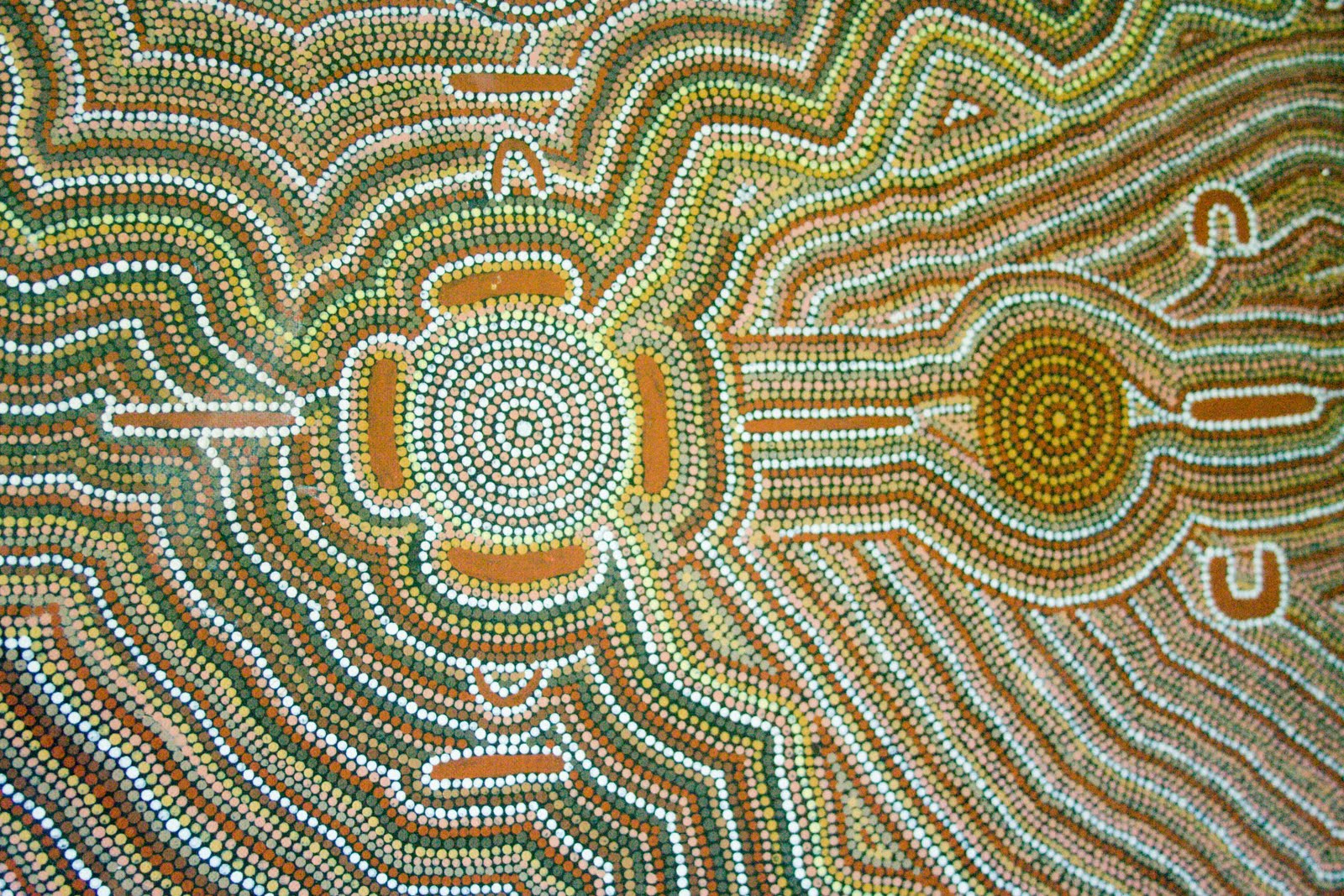
"Marking the Infinite: Contemporary Women Artists from Aboriginal Australia", a travelling exhibition, starts its journey in New Orleans. Australian Aboriginal art born some 40 000 years ago, is also contemporary, with female artists contributing to the art scene. Among them, nine have been selected for this show and their works fill the three galleries at the Newcomb Art Museum, including paintings on canvas, paper or eucalyptus bark, poles and woven installations.
Following the introduction in the reception hall, made of a wall text, a video featuring aboriginal women in the bush and a few books related to Australian Aboriginal art, the walk through the exhibition can be overwhelming due to the number, the variety of works and above all the unpronounceable names of the artists and the remote locations they are from. However, their compelling stories unfold along the visit as one becomes familiar with styles and techniques. On the right, the side gallery is populated by works from two sisters. Gulumbu Yunupingu projects infinity through seriality and her starry skies refer to universality. Nyapanyapa Yunupingu also uses earth pigments on bark or paper and experiments with new media like digital files in one of her compositions while her subject, nature, stays traditional. Carlene West's works, inspired by local legends, are represented by two paintings with their characteristic colors: red, black and white, medley of expressionism with her wide brushstrokes for the background and aboriginal dot technique for the narrative. Her paintings are also found in the main gallery where the walls are lined up with larger compositions like Bush Plum in red (2013) or black (2015) from Angelina Pwerle. With tiny dots covering the whole canvas, the two monochrome paintings depict an abundant harvest of berries and relate to the food gathering role of women. They also take cosmic dimensions when looked at from a few steps back. Regina Pilawuk Wilson, born in 1948, started to paint in 2002 and developed a personal technique inspired by fishnets, resulting in fine multicolored lines fusing to create meditative patterns. Inspired by the secret language of her tribe, Nonggirrnga Marawili 's message is expressed through traditional media with earth pigments on bark. The gallery on the left presents three artists. Wintjiya Napaltjarri, Lena Yarinkura, well-known fiber artist and Yukultji Napangati. Napaltjarri's colored shapes, blue, red or yellow, could be described as biomorphic. They are well established symbols within the tribe, a U shape for example representing ancestral women. The works made with synthetic polymer paint on canvas, could be called series with Women's Ceremonies at Watanuma, 2006, 2007, 2010 and 2012. The characteristic juxtaposed lines from Napangati result in works easily categorized as Op art. Without a place to rest the eyes, in constant motion, the paintings recreate the infinite horizon of the desert where the artist was raised. The exhibition would not be complete without Memorial Poles. Made of eucalyptus trunks, they have a function in the afterlife, guiding the deceased to his spiritual home. Two groups of poles are symmetrically staged in the main gallery
 In the 1980's Australian Aboriginal art was proliferating in the commercial galleries of the capital Canberra, generating a controversy still ongoing. Nevertheless, the art is getting plenty of interest and the Metropolitan Museum of Art held its first exhibition of Australian Aboriginal art by women in 2010.
Are women breaking taboos while finding the place they deserve in the art world? Marawili makes a disclaimer of a sort to the elders of her tribe, stating that: " The Yirritja painting I am doing is coming from the heart and mind. It is not the sacred Madarrpa painting".
I am not an anthropologist and just enjoy the art. The exhibition shows cohesion due to the gender of the artists and the common themes related to their tribal roles. From earth pigments to computer files, their range of media is expanding and their techniques born from centuries of traditions are evolving. The paintings from contemporary artists convey a dimension of infinity and universality we can grasp and they should not be looked at as the remnants of a dying culture but a proof of ongoing, lively communities which have influenced and sustained the artists.

photographs by the author:
"Ganyu (Stars)", 2009, Gulumbu Yunupingu
"Tjitjiti", 2014, Carlene West
Poles and view of the exhibition