Showing posts with label David Yarrow. Show all posts

Saturday, July 18, 2020

Alive and Well


 After a three-month hiatus, galleries in the Arts District are reopening and the traditional First Saturday Art Walk has become a day-long event to accommodate the rules of distancing with a predictable outcome: more time to contemplate, less time to socialize.
My first visit was at Octavia Art Gallery where four artists are featured for the exhibition Conceptual Creations: Collage and Assemblage. The bold red color from the objects on display in the window was an irresistible invitation to walk-in. Why Red from Robert Tannen, a gathering of his latest works, is by itself a show within the exhibition. Microwave, laptop, typewriter, rotary telephone, ..., all candidates for the dumpster, are instead preserved for eternity, embalmed in a bright red monochrome spray paint. Red for love here is for danger, emergency, an alarm about pollution, global warming and the threats they represent to the planet. Recycling is part of the solution, cloth hangers become wall sculptures or get a second life as supports for calligraphic meditative drawings. Also reflecting a Far Eastern influence, Regina Scully's compositions acquire a third dimension with  unknown pieces of objects embedded in her poetical landscapes. The Three Fates, 2020, a sculptural narrative scene, reconnects with a variety of media the artist explored in the past.
Assemblage and collage for Scott Andresen result in dreamy abstract pieces, so perfect they make us forget the industrious processes they underwent, including delicate mending with gold and silver leaf, a technique borrowed from Kintsugi the Japanese art of repairing ceramics applied to sandpaper, Andresen's medium of choice. James Henderson's works are a reflection about passing time with his selection of old photographs and pictures from vintage magazines. The mixed media layering builds a thick texture alluding at the accumulation of memories over the years.
Further on Julia Street, the visit at Callan Contemporary felt like stepping in an enchanted world. The monochrome installations from the ceramic artist Bradley Sabin recreate the magic of nature with swirls of flowers invading the gallery. The lively display keeps changing as the visitor walks back and forth, each unique flower anonymous among the flock.
Art in Doom which opened in March at Jonathan Ferrara Gallery was reviewed in "Premonitory", a post published earlier.
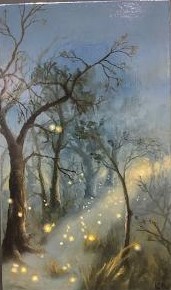
At Arthur Roger Gallery, the animals photographed by David Yarrow appear to awake from a long sleep. Walking by close-up shots of bear, gorilla, lion, confirms that gallery visits are indispensable to connect with the photographer's subjects. With more than a dozen mesmerizing new works, Troy Dugas's show offers another kind of adventure. More than a purely visual experience, his mandalas provide a meditative place to pause and reflect. When I look at Kris Wenschuh's compositions, I always wonder why the value of a painting is related to its size. The classically trained artist keeps producing small surrealist landscapes featuring icebergs, clouds, floating in blue skies, catching a certain light that evokes luminism. Twice Upon a Time, the title of the exhibition is perfectly fitting for a show which includes works from Leslie Staub known for her children's books illustrations.
July is supposed to be a slow month for the galleries... not this year!


photographs by the author:

Robert Tannen "Wood Burning Furnace with Logs", 2020
Kris Wenschuh "Trail of Light", 2020
Bradley Sabin "Coral Flower Wall Installation", 2020




Wednesday, January 31, 2018

Is This Art?


Since its invention in the 1830's, photography has been the subject of an argument now pretty much settled: photography is an art form. This month, three concurrent exhibitions at Arthur Roger Gallery are dedicated to the printed medium with the main show assembling more than twenty recent pictures from the world renowned photographer David Yarrow. A collection of works from Robert Mapplethorpe and George Dureau are facing each other in the adjacent gallery. Portraits and videos from Brent McKeever, a 16-year-old photographer, are found in a homey back space. While the nude portraits from Mapplethorpe and Dureau may still upset some viewers, they passed the test of time and even of law. Mapplethorpe's pictures of penises are now prized as much as those of his suggestive flowers. McKeever's portraits of swim-suited beauties on beaches veer toward fashion photography. What about David Yarrow's images of wild animals?

The picture of a huge elephant facing the entrance is an unusual sight in a fine art gallery. The monochrome show features twenty large-scale photographs hung along the walls of the space, spreading from the street side to the back of the building. Surrounded by elephants, lions, bears, wildlife found in remote places of India, Africa, Northern America, it is a challenge to select one of the beasts to start the visit. Each photograph is accompanied by a lengthy wall text commenting on the pic's circumstances, the subject itself, providing technical details about the shot and of course its title, location and year. The portraits provide a unique view of the animals seen from below, themselves gazing at the viewer. Close-ups convey the idea of huge bodies, so does cropping of heads which appear too big to fit within the frame. To suggest strength, power, wisdom, appendages like tusks become the focal point. The images are usually flattened leaving little to no room for a background. A few photographs offer a glimpse into the fauna's habitat. For these, Yarrow chose to break the rules of composition to make his point. For example, in The Gathering Storm, 2011, the row of elephants stays under the perfect straight line of the horizon defining a small band of land, while the sky occupies most of the space above it. The massive pachyderms appear minuscule at the bottom, like crushed by the heavy clouds, overtaken by the wrath of nature. In 78 Degrees North, 2017, a white bear is walking away, swallowed by the whiteness of its natural environment, the pads of its back paw picturing a black abstract sign. One step further, The Factory, 2017, a photograph of zebra patterns results in pure abstraction. What about colors or lack of it? Let's quote the artist who shared his thoughts about it in an interview: "There are three reasons (to choose black and white): Firstly, it's timeless. Secondly, it's art rather than reality... It just feels aesthetically stronger... Thirdly, a photograph's like a piano. You should be able to use all 88 keys on the piano and go from the rich blacks to the full whites."  In his statement, Yarrow describes his intend to create art. Of course to do so, he had to master the required technical skills and his quest for the perfect shot led him to invent a custom made 14-pound steel box to protect his remote controlled cameras, allowing the unique point of view and perspective. Unable to have his sitter pose for the shot, he manages to "freeze" the moment and like a portrait painter, aims at  immortalizing the soul of his subjects.
One aspect of art, which is thorny but unavoidable, is money. The photographs are printed in limited editions of 12 and bought by collectors, which establishes their status in the art world. So does being hung in art galleries and museums. 

Ultimately, this quote attributed to the great painter Francis Bacon resumes why we are looking at the photographs: "I have always been very interested in photography. I have looked at more photographs than I have paintings. Because their reality is stronger than reality itself."


photographs by the author

David Yarrow's Website to look at his photographs: http://davidyarrow.photography/gallery/wildlife/