Showing posts with label Damien Hirst. Show all posts

Sunday, August 15, 2021

La Vie en Rose


               Who am I to write a review of two ongoing shows from Damien Hirst, the most celebrated YBA (Young British Artists)? Since the end of the eighties, he never ceased to shock the art world and the world in general with his gory pieces and make the news, from accusations of plagiarism to the astonishing price of his works. Not so young anymore, the fifty-six-year-old artist obsessed with death, has surrounded himself with an endless Spring during the pandemic, going back to painting, "the loneliest thing you can do". Thirty of his one hundred and seven compositions of cherry trees in bloom were selected for his Parisian debuts at the Fondation Cartier while Cathedrals Built on Sand at the Gagosian Gallery off the Champs-Elysées features a series of pill cabinets

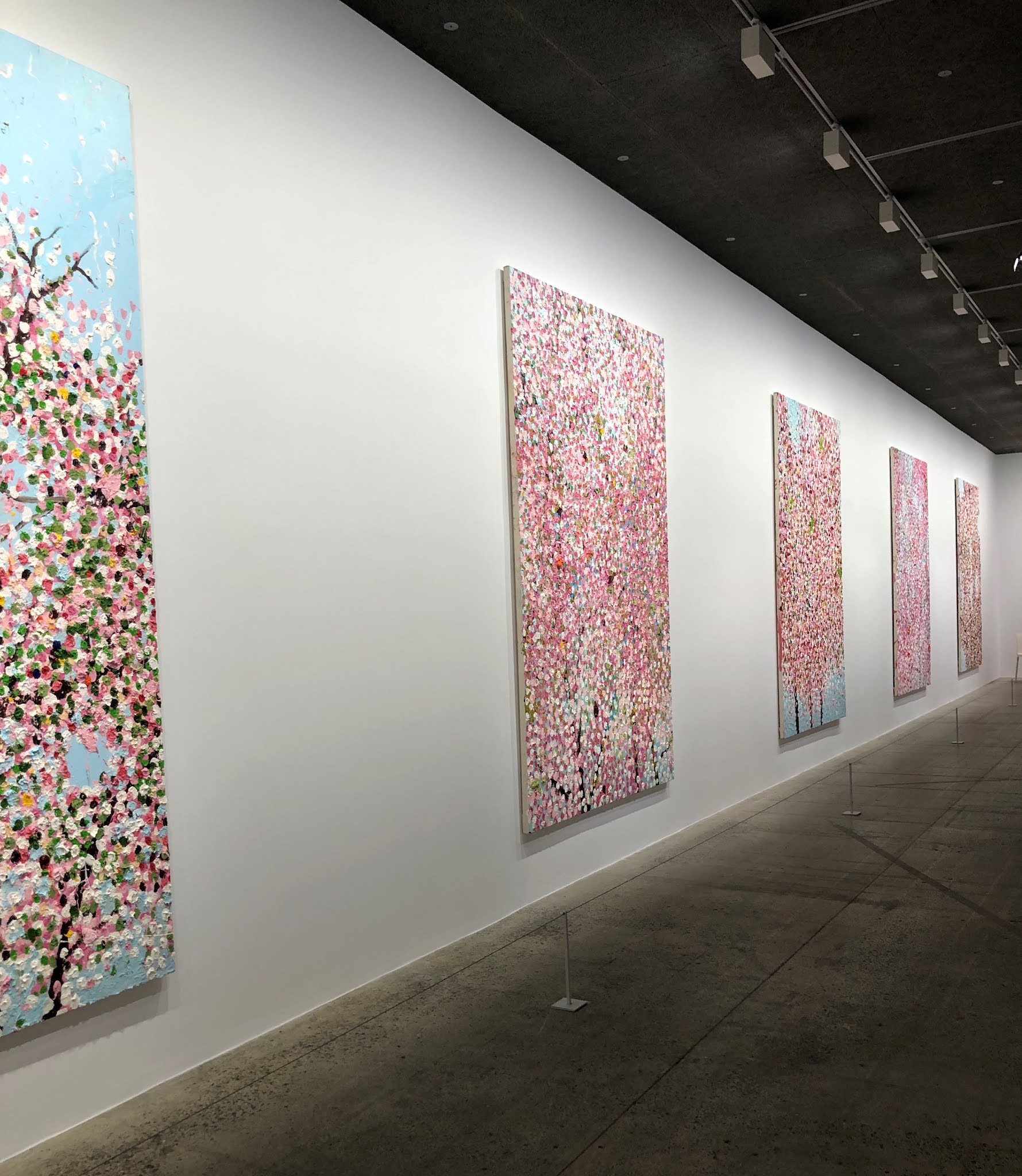
               Walking in Les Cerisiers en Fleurs is breathtaking... literally. The enchanted pink world of cherry trees in bloom soon becomes a claustrophobic congregation of colored spots spread on large canvasses covering the walls of the building's two levels. Greater Love Has No-One Than This Blossom, an outsized assemblage of four panels (quadriptych) consisting of interlaced tree branches with patches of clear blue sky peaking through, a jumble of uneven pink, white, pale yellow, blue to purple dots, a few green leaves, three dabs of red, sparse white drips, describes love as a heavenly prison. Why single out this piece? Because it is the largest and sums up the exhibition. All the paintings are variations on the same theme, parodies of abstract expressionism and pointillism, assigned grandiose titles: Imperial Blossom, Spiritual Day Blossom, Wisdom Blossom, Truth Blossom, God Blossom... and so on. 

               Meanwhile, Gagosian Gallery is filled with mournful landscapes of rows of perfectly aligned genuine or made up colored pills multiplied by their reflection on background mirrors, encased in heavy shiny stainless steel frames. Monochrome or multicolored, large or smaller pieces reflect a broken silhouette of the visitor surrounded by the pop-minimalist compositions lined up along the walls. Prototype for Lies, 1998, the first work of the series introduces the show. Walking through Cathedrals Built on Sand, one can ponder about our dependence on the attractive little fixes but the works bring little more for consideration. 

               From his mechanical spot paintings to his "back to nature" renditions of cherry trees, Damien Hirst embraces his love for color. "I love color. I feel it inside me. It gives me a buzz." However, his obsessive love for series is overshadowed by its commercial endeavor. Andy Warhol's quote comes to mind: "Making money is art and working is art and good business is best art". Going back to the cherry trees series, the "wow" of the first impression due to the abundance and closeness of the works rapidly fades and may not occur when the paintings are dispersed in museums or private collections. The artist has transformed the pink symphony of blooming cherry trees alluding to renewal and the lightness of being, into heavy renditions about the shortness of life.   

A final quote from Damien Hirst: "Art is like medicine-it can heal" Thank you Dr. Hirst.


pics by the author


Saturday, November 13, 2010

"Decadence Now: Vision of Excess"


The title is promising and the exhibition quite ambitious.

Located in the Rudolphinum (Prague, Czech Republic), one of the oldest concert hall, hosting the Czech Philharmonic Orchestra, the Gallery focuses on contemporary art and, for this exhibition, on decadence in art going back over the past 30 years.
Upon crossing a vast hall, climbing a staircase to reach the gallery, the visitor is overwhelmed by the quiet, heavy atmosphere and plunges into the first room, a collection of self-portraits from well known artists like Maplethorpe, Cindy Sherman, Catherine Opie, David Wojnarowicz, Joel-Peter Witkin, Damien Hirst to name a few.
Deformed bodies, inflicted pain, degradation of the self, the photographs are disturbing.
Four more themes are the subject of the exhibition: Excess of the Body: Sex, Excess of the Beauty: Pop, Excess of the Mind: Madness, Excess of the Life: Death.

One feels repulsion, horror, fascination and intense emotions. All taboos are transgressed and the artists have reach a point beyond which there are no limits.
The media used for some works evokes pain , death, like the artist's blood for "Dessin au Sang #1" (1997) from ORLAN, Erwin Olaf' s academic portraits of princesses with blood splashing across their angelic faces or Geza Szollosi's work with "Project Flesh" (2004), which includes a female pelvis in formol.
Religion with "Saint Sebastian" (1978), "Was the Jesus Heterosexual" (2005) from Gilbert and George, "Veronica wipes the Face of Jesus" (2004), the Stations of the Cross Series from David Bailey and Damien Hirst, or pornography with Jeff Koons's "Blow Job-Ice", 1991, are followed by the last room occupied by works related to death.
At some point, I feel saturated. To rekindle the interest, I try humor, but this does not work, the subjects are very serious indeed.
Yes, it is disturbing, remote because in a museum, but close because of the subjects brought up by these works. We can all agree on the quality of the exhibition, bringing together great works.
"Room #13" is an extension to the theme Excess of Beauty, located across the street at the Museum of Decorative Arts and presents decadence in fashion and design. It is definitely weird with a collection of dolls complete with their death certificates.
More decadent exhibitions are taking place, at the Brno house of Arts with works of Joel-Peter Witkin, at the Gallery of West Bohemia in Pilsen with works of Ivan Pinkava, at the DOX gallery in Prague with works of Gilbert and George...

The booklet advertises decadent movie festivals, conferences, concerts, discussions...

Wednesday, April 7, 2010

MFAH

MFAH stands for the Museum of Fine Arts, Houston, which is composed of two buildings and the sculpture garden. The new building hosts two exhibitions from Sargent, "Sargent at The Sea" and "Houston's Sargents", and also watercolors from Prendergast, produced during his two trips to Italy... The succession of portraits and the seas from Sargent did bore me. The watercolors from Prendegast were also abundant, some of them unfinished.


Among the endless enfilade of rooms (especially the rooms dedicated to Europeans paintings and sculptures ), I discovered Frederic Remington, a great Western painter who depicted vivid scenes of the Far West, so harsh, like this corpse hanging of a cliff and the party coming at the rescue or this soldier, falling from his horse, death already in his eyes. The movement, the lighting, make the scenes very real. The rest of the permanent collection is somewhat light in paintings from Impressionist and Modern Art.


The highlight of this visit, for me, was the temporary exhibition titled: "Ruptures and Continuities: Photography Made after 1960 from the MFAH Collection". A diptych by Hatakeyama, "Blast 2005" greets the visitor. It is startling to see the fragments of rocks and the dust flying. One can almost hear the sound of the explosion when looking at the photograph. The exhibition is very well curated, presenting more than 200 hundred photographs from 80 artists. The photographs are grouped in different sections: Self-Performance, Transformation of the City, Directorial Mode and Constructed Environments, New Landscape, and Memory and Archive. Notable for New Orleanians was a photograph from Robert Polidori titled "New Orleans 2006" depicting the desolation of one area in the city. Photographs from Brian Ulrich, William Eggleston, Lewis Baltz and many more were part of the exhibition. An installation from Boltanski "La fete du Pourim", 1989, was included: photographs of Jewish children, aligned along a wall with a rusty biscuit box below each picture, like a small altar, leaving each child with a familiar object. Every household in France had a similar tin box, the pictures on them differed (I can still remember the box at my house). Simple garlands of white light bulbs decorate the installation, like votive candles. A quote from the artist accompanied the exhibit: "A good work of art can never be read in one way. My work is full of contradictions. An artwork is open- it is the spectator looking at the work who makes the piece, using their own background".

An installation from Boltanski was just presented at le "Grand Palais". Another is scheduled to occupy the Park Avenue Armory starting May the 14th.

The other building, with other permanent collections (Islamic, African, Chinese), hosts a unique display of pre-Colombian gold objects. How could the Conquistadores leave so many beautiful pieces!

The works from a prolific artist, Alice Neel were allocated a large space for a temporary exhibition.. She is memorable as a female painter and also because of the subjects she chose to depict: daily scenes from her neighborhood in New York City, political figures or well-known artists.


Unexpected, an installation from Damien Hirst was surprising the visitors in the underground passageway between the two buildings.


photograph by the author