Showing posts with label Eugene Martin. Show all posts

Saturday, February 29, 2020

Listen


Post-war New York City saw the birth of abstract expressionism led by a group of white male artists. Norman Lewis, the only artist of color among them, is now considered the forebearer of African American abstraction. From then on, abstract enriched the vocabulary of artists who had to overcome the indifference, sometimes worse, the rejection not only from the art world but also from their own communities. Two years ago the Ogden Museum of Southern Art premiered a memorable exhibition Four Generations: The Joyner/Giuffrida Collection of Abstract Art. This time, the more intimate display assembles the works of sixteen African American artists, each represented by one piece from the museum's permanent collection. What Music is Within: Black Abstraction from the Permanent Collection complements a solo show Melvin Edwards: Crossroads set in the main gallery on the fifth floor.

Colors hit you when you enter the space. How can such a busy group show fit in the small gallery? A second look reveals the carefully laid out display which includes a large drawing from
Ron Bechet surrounded by wall sculptures from John T. Scott and Kevin Cole facing the entrance, and on the right side, three geometric abstract compositions in conversation with three expressionist paintings across the room. When turning around, the visitor encounters a stunning draped canvas from Sam Gilliam and next to it a smaller "box" in shades of pink constructed by Jeffrey CookClifton Webb's Totem, N.D., completes the show introduced by a wall text, a painting from Horton Humble, the youngest artist, member of Level Art Collective and a sculpture from Martin Payton profiled on the window's light in the hall.

This is a short description of the exhibition which warrants an in-depth look for the occasion to discover less famous artists like Merton Simpson or Moses Hogan who was better known as a pianist, conductor and composer. One can get lost in Forest Party, 1993, from the former, a textured rendition without focal point or look for the spiritual meaning of Turning Wheels, 1984, from the latter. Of course, local artists with their deep-rooted ties to music are well represented. John T. Scott was known to create his work while "jazz thinking" in his studio. His three pieces from the Ritual Cutter  series (1978) hung on the wall evoke instruments of torture, pain, tears, a song filled with sadness, and also of hope with colors bright like the sun. Music is a family affair for Martin Payton, brother of the famed trumpet player Nicholas and his sculptures often bear the name of  musicians, on view here Dexter, 1998, for Dexter Gordon. When I look to Ron Bechet's (related to Sydney) works, I hear Spirituals. Jeffrey Cook was a dancer for a period of time. Sam Gilliam is a fan of  Miles Davis and John Coltrane. Eugene Martin thought about becoming a jazz musician like his father and it shows in his jazzy composition illustrating the correspondence between rhythm and lines, melody and colors. Both Gilliam and Martin were connected in some ways with the Corcoran School of the Arts and Design in Washington, D.C., Robert Reed spent most of his career further North as a teacher at Yale University School of Art and  Arlington Weathers migrated from Guyana. The exhibition stretches not only geographically but also in time, representing fifty years of African American abstract art and its various styles from expressionist to geometric and color field.

Music needs to be heard, visual art needs to be seen and the exhibition is a great occasion to look at pieces of the permanent collection in the context of music. William T. Williams states that he was often asked:"Why are you making abstraction? It's not African American art" and he would answer "Jazz is the most abstract of all music. Music is totally abstract. How can you not say there's a tradition of abstraction."


photographs by the author:

view of the exhibition: 
Robert Reed "San Romano, Monticello, Brick II", 1982
John Barnes "Doe Poppin' II", 2015
Clifton Webb "Totem", N.D.

Eugene Martin "Geometric Abstract", 1999

Sam Gilliam "Drape Work", 1970


Friday, June 15, 2012

Southern Exposure


The Art of Eugene Martin: A Great Concept, the latest exhibition at the Ohr-O'Keefe Museum of Art in Biloxi, MS, is all colors, so it seems when walking from the main building to the Gallery of African American Art.
Facing the entrance, the largest piece, The Fall of Icarus, 1998, acrylic on canvas, attracts the eyes like a magnet. Technically an iconic piece for the artist with its sharp bright colored, geometrical lines and shapes surrounding a dynamic subject of milder tones and blurry contours, it is an unusually dramatic theme for the painter who is known for his humorous, light, whimsical pieces. Furthermore, unless pressured by museums or galleries, he rarely gave a title to his works to avoid distraction and allow the viewer to see freely. The exhibition's checklist on the catalogue can attest of that with only eight titled works out of thirty-eight.
Starting on the left side of the vast room, a series of four bamboo reed stick pen drawings, made in the early 80's represent a technique used by the artist who produced calligraphic works full of expressions and movements with thin and thick lines. The creatures born from the artist's imagination, surrealist, from another planet, with usually happy and benign expressions, tell several stories when looked at with attention. A similar technique is used with different media for other works like A Great Concept, 1987, which represents a benevolent aquatic monster or the ten colored drawings on the right wall. Made at different periods, from 1970's to 1990's, one of them is about an insect devouring a dog, and several smaller birds ready to devour the insect... this is what I saw. The soft colors, pale orange, light brown, olive green, are in contrast with the bright colors of the acrylic paintings made in 1999-2001. These are pure geometric abstraction, lines, and colors give the mood to the painting, sometimes harmonic, sometimes dissonant. There is always music and rhythm with a rupture, a disturbance, a blurred colored surprise added to the painting, bringing a new dynamic to it and an element of surprise.

With his skills at drawing and painting, the artist uses his imagination to stimulate the viewer. It is like a good book you read and read again, the works become familiar but stay new.
The exhibition can be visited in any order, each piece  tells its own story. What is guaranteed is that more you look, more you see, this is what I like about Eugene Martin's works. 


"Too Slippery", 1981
"Mean and Green", 2000 
"Untitled", acrylic on canvas, 2000

Saturday, May 28, 2011

artist's studio


The visit of the artist's studio is always a privilege and a few weeks ago, I was able to drive to Lafayette, LA, and spend some time looking at Eugene J. Martin's work at his home.


The presence of the artist (July 24, 1938- January 1, 2005) is still felt in the house situated in a quiet neighborhood. The artist's works are pouring out of the studio and invading the house with their colors.


Overwhelmed at first, I looked at the paintings, drawings, collages and was amazed by their quality. One would expect some trials, "doodles", "left overs". The works appear to be created effortlessly, already composed by the artist before being laid on the canvas, smaller during hard times, on paper, bigger during fat times, on canvas, without hesitation, like brain and hand were one. The studio is left intact, quiet with paintings, neatly organized, drawings, stacks of CDs with the artist's preferred music and his ashes on a desk.


It is eerie, but a conversation with Suzanne, his wife, who can recall many anecdotes about the artist, brings me back to reality. The painter lived for his art. Rarely distracted, he would paint almost daily and creation was his mission. He was totally immersed in his work, translating his internal happiness.


He was initially living in Washington, DC, then Lafayette, LA, and was never seeking the limelight ... he did not have time. Some artists live to promote themselves, Eugene Martin was just too busy working.


I recently viewed two exhibitions: "Beyond Black" at the LSU Museum of Art in Baton Rouge and "Dancing String Bean: Paintings and Drawings from Eugene Martin" at the New Orleans African American Museum.


During this visit, I discovered Eugene Martin's collages, made with pieces of his own works rearranged for another message. This is where the "discarded" works find a second life. Collages are most of the time one level, feel second-hand, kind of lazy compositions. Eugene Martin's collages are different. They are visually and intellectually challenging: new perspectives, depth and three-dimensional works.


Suzanne has published several books about the artist whose works are the result of his drive, his self discipline, his creativity. His art is so much him that the artist is still present.


Like remembering a song, Eugene Martin's works are now alive in my head with their colors and shapes. There is no better way to know an artist than to visit his (her) sanctuary.

Saturday, April 23, 2011

...and more at the NOAAM

I read about Margaret Taylor-Burroughs (1917-2011) and knew of her activities geared toward developing art and art venues for African-American artists. Through her writings, she kept promoting her cause and her dedication came to fruition with the opening of the DuSable Museum of African American History in Chicago.


She, herself, was an artist and it is very appropriate to have her works displayed at the New Orleans African American Museum. Recently, I visited the exhibition composed of linoleum cuts, woodcuts and a few paintings.

The (mainly) portraits are describing subjects with empty, frozen expressions lacking spontaneity. The artist studied the muscles generating these expressions, outlining them with simple, stylistic lines rendering them emotionless. No joy exudes from these works. Even the young subjects playing hop scotch are "behaving". It becomes an imaginary world in which children are wearing bows on their heads, are never dirty and can stay motionless. It reminds me of the illustrations from my childhood books written as teaching tools.

Her intend was to liberate, to express her cultural identity. She stayed mute and conformist, afraid of "letting it go" in her works. It did not materialize in her art, but as a woman of African-American descent, she was a pioneer.


The museum is bringing interesting artists and Eugene Martin's works are displayed in the hall of the main building as reported in a previous blog. Paintings from local schoolchildren occupy an annex. They are worth a thousand words.


no photographs were allowed

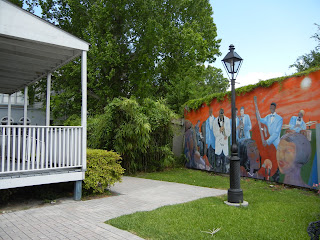
photograph of the courtyard, NOAAM, by the author

Saturday, April 9, 2011

"Dancing String Bean" and more at the NOAAM


The French Quarter Fest is in full swing and the Treme is quiet today, soaking in the afternoon sun.

On Governor Nichols Street, the NOAAM (New Orleans African American Museum) presents a new exhibition featuring works from Eugene Martin (1938-2005), titled "Dancing String Bean: Paintings and Drawings by Eugene Martin".


The hall is lightened by the colors of several paintings, two of larger size, "The Happy Bartender" and "The Duchess of Texas", both 1994 and on the other side, four paintings, smaller but with the same construction: a background made of colors delineated by sharp lines building a frame and fluid shapes to describe the subject in the center and tell a story. Violet and brown are sometimes used to bring drama (Untitled 2000), but the message is usually happy with a touch of irony.

Then, I concentrated on the drawings, lined up carefully along the walls. The earlier ones, made with ink and bamboo sticks on paper, with weird little personages, cousins of "Ubu", like in "Avoiding Rush Hour" with an upside down moon. The drawings come to maturity with the next set. One of them gives the title to the exhibition.

When looking at these, the viewer, unknowingly, is engaged in the process of seing. The artist is using a well-known optical illusion (cognitive type) described by Joseph Jastrow who drew the famous "Rabbit or Duck?" (1899). Black or white, white or black, the viewer can choose or rather his/her brain. But this becomes too scientific, let yourself enjoy the subjects about happiness , love, dance, .... Just look again...The technique of the drawings is very clean and gracious in its simplicity.


Paintings from the artist can also be viewed in Baton-Rouge, at the Shaw Center for the Art during the exhibition titled "Beyond Black: Ed Clark, Eugene Martin and John T. Scott". The works are more challenging, with the same vivid colors but a sophisticated message. The same irony flavors the works from different periods: whimsical, playful, happy!

I am still discovering the prolific artist. My only regret about the exhibition is the small space ( used at its best by the curator) allowed for the show.


The energy of the colors and the subjects of Eugene Martin bring joy and happiness. Leaving the museum, I can hear a faint music. My imagination? Eugene Martin's works are jazzing.


NOAAM, photograph by the author

all other photographs, courtesy Marie Vinouze, curator of the exhibition.

"The Duchess of Texas", 1994

"Dancing String Bean"

The exhibition at the NOAAM

Sunday, February 20, 2011

Abstract art in Baton Rouge, LA

Baton Rouge this week-end?


The LSU Museum of Art presents three abstract artists, from African-American descent, John T. Scott, Eugene Martin and Edward Clark. It is a great occasion to visit the Shaw Center for the Arts, a sober six-storied building located along the Mississippi river, downtown Baton Rouge. It is a quiet day in an otherwise busy venue, home to the Baton-Rouge Symphony, the LSU School of Art Gallery, the LSU Museum of Art, the Manship Theater (325 seats), classrooms and amenities such as a sushi restaurant on the rooftop.

The place is eerie (early Saturday) but I feel privileged to be here, alone among all these works. After a short introduction with enlightening comments about the artists and abstract art in the African-American community, the exhibition progresses with paintings and sculptures.


The giant canvasses from Edward Clark occupy most of the first and second room, bringing colors and movement to a point of romanticism, rendering abstract landscapes impressionistic, like "Louisiana Red" 2004, red sky, dark swamps, and infinite pale waters reflecting a peaceful , ethereal glow with the four elements air-fire, water and earth interdependent in the painting.

This is followed by "Luminous Turbulence", 2002, pinks and greys, "The Wave" 2006, blues and browns with the brush leaving deep crevasses on the canvas like the lines used to date trees, telling the history of the landscape.

Ed Clark is known for his "push broom" technique, applying the color on the canvass with a broom, bringing spontaneity and a physical dimension to his paintings. He can be qualified as a member of the American action painting movement.

Occasionally, he gives some relief to the canvass by using dry pigments, clay or soil from the countryside he is depicting, like in "The Crescent", 2006.

Smaller paintings, from the 60's and 70's, have a characteristic oval shape. Mainly related to voyages made by the artist, they evoke places with colours, and also bring memories of smells and sounds. The painter travelled extensively and produced the "Bahia Series", 1988, pink, violet , blue, the "Yucatan Series", 1976, turquoise, violet and pale blue, or the "Southern Light", 1978, green, black, blue. I found these paintings less spontaneous. The oval shape freezes the dynamic of the works.

The artist is well represented with 8 giant canvasses, 5 paintings in the oval series, and smaller works. For me, the "Wasted Landscape", 1961, seen above, is the most powerful of the large canvasses with its violent colors and message.


John T. Scott, a son from New Orleans, well known for his kinetic sculptures, is painting and sculpting music with his "Jazz thinking."
The works on display are mainly sculptures, like "Diddle Bow #1", 1983. The "Diddle Bow Series" was inspired by the African warriors who were using the hunting bows to make music after the fight. " Ritual Cutter 1&2", 1978, features two instruments of torture, in bright orange colour and "Dancing at the Crossroads", 1996 occupies a whole wall. The colours are a mixture of Mardi Gras and African exuberance. One can read a story, but the work does not use the space well, hybrid, between a wall decoration and a sculpture.
My preferred works are half a dozen sculptures from the "Circle Dance Series", light, gracious, of small sizes, made in patinated bronze which gives them an eternal look. They are creating rhythm in space with their circles of dance, strings and thin hammers. Like strange instruments, they could be played. "Boarded Back Window", 2001, "Kloee's Dream", "Zydeco Two Steps" with the lines of a dancer enhanced by the play with the shadows.
Three "Ethiopian Graffiti" complete the display.
The exhibition ignores his woodcut prints, but it is another story, and they would not fit in this colored display.

The third artist, Eugene Martin, was born in Washington, DC and later in life, moved to Louisiana. His paintings are a mixture of abstract and figurative. The painter never sided for a style and cubism, surrealism, color field techniques can be found in the same work. In a way, this makes him unique.
The colours are bold, sometimes just gaudy. His satirical abstract pieces send a cartoonish message, but in a sophisticated way, confusing the viewer.

The artist wrote: " They are opposing forces in all living things. My work reflect this and stirs up a contrast of emotions."


This exhibition is very rich and helps me understand these three artists, inspired by their roots, including colors and themes.
They were pioneers using the new abstract language, building their own voice. They will keep being heard.
The gallery's space is well used, and the abundance of works does not translate into overload. They are carefully displayed, each in its best light, without infringing on the next.
My eyes filled with colours, my next visit is the roof of the Shaw Center to enjoy the timid Spring sun and look at the lazy Mississippi.


1. "Wasted Landscape" 1961, Edward Clark

2. "Ethiopian Graffiti #3", John T. Scott

3. " Untitled" 2000, Eugene Martin

4. View from the top floor of the Shaw Center for the Arts

photographs 1, 2, 3, courtesy of the LSU Museum of Art
photograph 4 by the author