Showing posts with label NOMA. Show all posts

Monday, October 20, 2014

Ed Clark at Prospect.3


Edward Clark was born in 1926 in the Storyville section of New Orleans. After living a few years in Baton Rouge, he moved with his family to Chicago.

In 1943, at the age of 17, he left high school and enlisted in the Air Force during the height of WWII. Upon his return, he studied at the Art Institute of Chicago from 1947 till 1951 and the following year at L' Académie de la Grande Chaumière in Paris. While abroad, he was profoundly influenced by the tachist Nicolas de Staël. His early works are characterized by his unique push-broom technique and the monumental scale of his paintings.
After spending five years in Paris, he came back to the United States and lived in New York City where in 1957 he exposed a shaped canvas at the Brata Gallery, an innovation at the time. The first known of the sort was made in 1968 during his sojourn in France. He experimented with different techniques during his career like working on paper with dry pigments, inspired by the "pouring sand" technique of the Pueblo tribe of the American Southwest.

Now 88 years old, he was recently featured in a New York Times articles and states: "No matter what  I do, there's not a day that I am not an artist."
During Prospect.3, his work can be seen at the NOMA.


"Louisiana Red", 2004, Ed Clark

(photograph by the author)

Tuesday, December 18, 2012

New Dimensions

 Common objects are becoming art in the latest exhibition Lifelike, brought by the Walker Art Museum to the NOMA. Size, medium, give them a new dimension, literally, and a new status as symbols of our time.
Fifty five artists are represented and in an attempt to organize the works, the curator arranged them into five themes: "Common Objects", "The Uncanny", "Realism into Abstraction", "Handmade Sleight of Hands" and "Special Effects: The Real as Spectacle".
The visitor is greeted by "I Am Amazed", 1971, from Edward Ruscha, and just in the first room, will meet a now classic work from Andy Warhol, "Yellow Brillo Box and White Brillo Box", 1964,
a giant "Paper Bag", 1968, "Legal Pad Sheet", 1967 from Alex Hay, "Eraser", 1967, from Vija Celmins and next to each other  "Cardbird Box II", 1971 from Robert Rauschenberg and "Bread", 1969, from Jasper Jones. Robert Bechtle, a photo realist painter permanently displayed at the K&B Plaza Building on Saint-Charles, is well represented with several works.

Among the plethora of works, some bring emotions and provoke thoughts like "Nomad", 2001, from Gavin Turk featuring a sleeping bag, shaped by the body of the  wanderer or across it, "Newspaper", 1992, from Robert Gobert, a pile of newspapers ready to be delivered, a morning ritual soon to be history like the bottle of milk left daily at the door.
I felt like a voyeur looking at "Crouching Boy in Mirror", 1999-2000, from Ron Mueck. We surprise the boy, modern Narcissus, contemplating his body in the mirror. I find " Bremen Towne" from Keith Edmier, 2006-2007, disturbing. It represents an American dream turned into a nightmare: a kitchen, equipped with cabinetry, stove, sink, colored in a dirty vulgar yellow. It is an exact replica of the kitchen from the artist's childhood home. Jud Nelson's trash bag in marble, "Hefty 2-Ply" is a masterpiece of high and low art. Plastic becomes marble, trash becomes a symbol of our society.

 Well-known artists should bring big crowds and the list includes: Chuck Close with a giant self-portrait, Gerhard Richter, Ai  Weiwei. The latest is represented by a mason jar three-quarter filled with a sample of the 100 millions of the sunflower seeds which were spread on the floor at the Tate Modern, creating an infinite landscape. Size does matter as discussed in a previous blog, and the idea gets lost in this small version. 

The viewer must look carefully to see "Weeds" (2005-2009) from Yoshihiro Suda, or a fly on the wall "Untitled" 2010 from Tom Friedman. .I never thought that a plastic bag could be a piece of art. But the checkered bag worth a few dollars behind a black line at the museum has now the status of art work. What is the price of  "Refugee", 2007, from Susan Collis? It is the traditional, international plastic bag carried by migrants, displaced populations, a symbol of loss. It usually holds the  belongings and dreams of the new nomads. Other works related to the same subject include the luggage from Kaz Oshiro or "Still Life", 2009, from Ugo Rondinone, pieces of cardboard left along the wall, ready for a move.

The last room is taken over by the giant work from Robert Therrien, "No Title (Folding Table and Chairs)", 2007. Visitors are scrambling to avoid the guard and have their picture taken. It becomes a game. Children are running around the display, fairytales become reality at the museum. 
Upon leaving the exhibition, I thought about Duchamp, his works would fit just fine.


photographs by the author:
grandstaircase at the NOMA
"Sunset Street", Robert Bechtle, 1984 (at K&B building)
"Refugee", Susan Collis, 2007    

Sunday, August 26, 2012

Under The Spell in New Orleans

Ralston Crawford (1906-1978) is not the first visitor who moved permanently to New Orleans. He is even buried at St. Louis Cemetery. The artist, well-known for his urban and  industrial paintings, discovered the Crescent City and under the spell, recorded with his camera the microcosm around him. The exhibition " Ralston Crawford and Jazz" at the New Orleans Museum of Art presents an extensive collection of his work. The catchy title is an understatement, the photographs and paintings treat a much broader range of subjects.

Hundreds of photographs are regrouped into themes:
 music, portraits, cemeteries, New Orleans streets. At first, paintings, lithographs, inks on paper, appear randomly scattered among them, but a closer look shows a careful selection to illustrate the influence of the photographs on the paintings and vice versa. The painter, considered a precisionist, was also a photographer ...or the photographer was also a painter, one finds the same "eye" in the construction of the scenes. With the lines created by shadows in bright sun bathed streets, he builds a geometric background to frame the subjects: Mardi Gras bands, funeral parades, crowds, portraits... 
A few examples give a glimpse in his technique. The portrait of Bill Matthews, 1955, is a lesson in composition. The arms of the trombonist smoking a cigarette, draw a triangle with the table and the face is a circle falling along the slope of his left arm. Most of the photographs are built around simple shapes suggested by a pillar, telephone poles, a drapery... Waldon "Frog" Joseph, trombone and Joe Thomas, clarinet is another example with the instruments arranged in parallel oblique lines in the center of the photograph. The musicians are accessory to the composition with the clarinettist's face melting in the trombone's shadow. The subjects are seldom looking at the camera and even the bodies turn away from it as featured in the photograph of two dancers.  If their looks are caught , they remain expressionless like the absent stare of a sick woman on a gurney or in the shadows like the eyes of the "Woman with Hands on the Hips" 1950-60's. The musician Jerome Green is caught with his eyes closed.  
All the photographs are black and white. What about the paintings and lithographs? The palette is limited to earth tones, flat blue, grey, with occasional black and white to depict lifeless, cold, emotionless landscapes.   
A complement to the exhibition, a selection of photographs from the Hogan Jazz Archive at Tulane University confirms the historical legacy of Crawford's work: New Orleans 1950's-60', Louis Armstrong's birthplace, Old Clubs, Big 25, Dew Drop Inn, Blue Lamp Bar, Golden Leaf Hotel, Mulberry Grocery Store... 

Interestingly, his heartless industrial landscapes, his photographs show the same lack of emotions, an emptiness leading to expectations. Lines and shapes from buildings, instruments, musicians or crowds build a tense scene set before or after the action. 
Five films are also projected, for more than one hour, great studies in light and shadows.
At the end of the exhibition , a whole room is dedicated to geometric abstract lithographs showing the same preoccupation with shapes to create tension.
The text at the beginning of the exhibition made an attempt to justify the title, trying to apply the definition of Jazz (improvisation, polyphony, syncopation) to Crawford's work. I could not find the connection but discovered an artist's vision, a lesson in catching the unseen and untold.


no photographs were allowed at the NOMA
photographs by the author
banner at the NOMA's entrance

"Under The Third Avenue El" (The Brewery), Ralston Crawford, 1934
Montgomery Museum of Art

Friday, April 6, 2012

From Folk Art to Abstract Expressionism

Controversy or age does not phase down Thornton Dial who is back on the museums tour. His latest exhibition takes place at the New Orleans Museum of Art.


The artist's message is punchy. The first room, somber with darker works like "The Last Day of Martin Luther King", 1992 or bright screaming yellow and red like "Blood and Meat. Survival of the World", 1992, gives the flavor of the exhibition. Several works are directly related to African American history, among them "High and Wide ( Carrying the Rats to the Man)", 2002 and "Green Pastures: The Birds That Didn't Learn How to Fly", 2008, sober but equally powerful. The giant canvasses, covered with thick paint and material found around the farm: carpets, goat hides, metal barbed wire, ropes, old cars parts...whether related to Dial's experience on the farm like "Billy Goat Hill" 2000 or current events like Martin Luther King's death are telling vivid stories.

A few sculptures appear to be the result of an adventure with the material and have little aesthetic qualities.


Overall, the works are engaged, inspired by events or controversial subjects. The artist is not afraid to tackle women's rights with "Trophies (Doll Factory)", 2000. Derision, tragedy, humor, political or simple emotions, the artist's scope of language is wide. The message appears less genuine in some of the later works like "Driving to the End of the World", 2004, a series of five works related to the global oil crisis, geopolitics of the middle East and the fate of the world ecology, according to the comments next to the works. Let's not forget, the artist is illiterate.

References like "Expressionist brush stroke of color filled with rich allegories" are overreaching and distract the visitor. The artist has been compared to Pollock, Rauschenberg, Basquiat... The first two artists were prominent in the 40's and 50's and the comparison with Basquiat's works is a stretch.


What should be emphasized is the artist's drive, his energy translated in these magisterial compositions and his uniqueness. His primal and universal message sinks under the pseudo-intellectual comments delivered to the visitor.
Thornton Dial can see shapes, colors and transcend objects and surroundings. He is inhabited by his heritage, driven by some ancestral, universal creativity which he transcribes with little intellectual input which makes it so powerful.The documentary "Mr Dial has Something to Say" is about the rehabilitation of Mr. Arnett, the collector who brought Thornton Dial and others, from Alabama to the world. The recuperation of the artist's work for political or financial purposes is shameless but...it is a wicked world. Thornton Dial appears witty, full of humor and common sense with a dose of skepticism.


To reassure the art world, his works have to be labelled: not folk art or abstract expressionism, I would chose the term coined by the French artist Jean Dubuffet, " art brut or raw art".

photographs by the author
"High and Wide (Carrying the Rats to the Man), 2002
"Construction of the Victory", 1997

Tuesday, June 21, 2011

Mainstream Street Art

One year ago, Swoon crashed the 53rd Venice Biennale with her eco-friendly boat. This was a memorable event in the street artist's career. Known for her disdain for authority and institutions, she was the only female artist featured in Bansky's movie " Exit Through the Gift Shop".
This Summer, her installation, a giant sea monster, inhabits the Great Hall at the NOMA. It is called Thalassa after the Greek goddess of the sea.


Swoon, who moved from Florida to New York City, has made her name by transforming neighborhoods, working in the shadow and creating events with her installations.
This time, her work is an amalgam of New Orleans cliches : a female, colored, prostitute from Storyville, also a siren with sea creatures for decoration, scary black tentacles spreading over the Great Hall. The subject has a dramatic expression and tense pose, looking at the sky, which contrasts with the playful, multicolored, lower piece, the bottom-womb of the creature.The artist has claimed long ago her inspiration from German Expressionism, discovered during a prolonged stay in Prague, and Indonesian shadow puppetry for her lacy cutouts.


The work is made to entertain and hopefully will bring crowds this Summer at the NOMA, but it lacks spontaneity.


To look at this installation, I consulted my inner child and found it was not dramatic enough, did not bring the little chill of fear, knowing it is a dream.
One year ago, an article in ARTnews, described her art, and I found this quote from the artist who was rebelling against "the feeling that you were supposed to create work that has its end place, a life in an institution or a collector's home." This work cannot fly beyond a Summer piece, for the museum.


Where are graffiti, provocative works, real monsters? A street artist, gone on the right side of the law, on the wrong side of the art.


photographs by the author

"Thalassa", Swoon

Wednesday, June 15, 2011

Ancestors of Modern Art


Why talk about the latest exhibition at the NOMA? " Ancestors of Congo Square: African Art in the New Orleans Museum of Art" reaches far beyond New Orleans, local history and African art.
This blog is about modern and contemporary art, and African art is the ancestor of modern and contemporary art. Looking at the sculptures, one cannot avoid thinking of Modigliani, Brancusi, Picasso, Braque and so many others. At the beginning of the century, the artists in Paris were visiting Le Musée d'Ethnographie du Trocadero (called later Musée de l'Homme) whose collections have been transferred to Le Musée du Quai Branly. The artists deciphered the art and gave their full significance to the pieces, reflections of far away civilizations. The public kept treating them as curios.
Cubism was born, Surrealism followed, and collectors like John and Dominique De Menil understood the connection as testified by the permanent exhibition at "The Menil Collection".


Picasso integrated African art in his famous painting "Les Demoiselles d'Avignon" (1907) with two of the subjects wearing African masks.

Of course, African art keeps inspiring numerous artists including African American artists like Romare Bearden. I am not sure that Lee Bontecou would claim her inspiration came from African art, but I could not avoid thinking about these two works pictured above. One was at the NOMA, and I came across Lee Bontecou's work at the Art Institute of Chicago a few days later. African art has become part of our heritage, our artistic language.


The exhibition itself is composed of about 100 works, sculptures and artifacts from different regions mainly from West Africa.


With maps, few comments, the exhibition has an old flavor and reminds me...of the visit at "Le Musee de L'Homme" (a small version). The videos are projected on very small screens, at a time when we can watch great educational programs on giant screens at home.

The audience looking for expertise will feel frustrated by some missing links, approximate dates, or very short descriptions of the works, their origins, their history. Maybe the curator could have brought a surprise here and there, like a reference to a local piece, a local artist?


The display feels remote, African art should be displayed as alive.
Abstract is never far, and the style is very modern... or modern artists have taken deep inspiration in African art.


100 works of art, a great introduction to African art, the exhibition should not be missed.


When the sculpture transcends the individual, when art reaches its deepest meanings and transcends a society. photographs by the author


Top left: Ngbe Society Lodge Emblem, Nigeria

Top right: "Untitled", Lee Bontecou, 1960

Face Mask, Mossi Peoples, Burkina Faso

La Femme aux Yeux Bleus" Modigliani, 1918

Face Mask, Ezzamgbo lgbo Peoples, Nigeria

Fertility Figures, Assante Peoples, Ghana

Friday, January 21, 2011

ants, fire and controversy

After a tour of the permanent collections commented by NOMA's Director Emeritus, looking at Chinese potteries, paintings, sculptures and listening to the history of the museum's collections, the crowd moved to the auditorium to view David Wojnarowicz's video "Fire in My Belly" recently banned from an exhibition at the National Portrait Gallery. The controversy still lingers at the Smithsonian...politicians versus artists.

I felt privileged to be able to watch the entire silent video (approximately a half hour) at the local museum in New Orleans. The visitors in Washington D.C. are not allowed to look at the short 4 minutes 11 seconds version. I was also curious to see the crowd's reactions. Some people left early, visibly upset, my neighbor was making painful sounds during the roosters fight, but overall the room was very quiet, almost too quiet, one could feel some tension.

The raw video was of poor quality at times. The silent version gives all the weight to the pictures, gruesome. A scene succeeds to another, but there is some progression to the story which usually ends up in death, like in the combat of roosters. The rapid succesion of pictures creates an emotional overload, one has not completely absorbed a scene and is hit with the next.

During a half hour, the spectator is saturated with death, tragedy. The message is grim, without hope.

The edited four minutes version (with 11 seconds of controversy) is especially moving. Touched by the images, disgusted at times, I felt like the artist wanted me to participate to his suffering. The artist made me more receptive.
I found the video very powerful, difficult to watch, unpleasant at times.

The controversy has drawn the attention to, but also away from the artist's work. Interesting exhibitions bring up controversy. Desacralisation? Censure? It is important to recalibrate these words, adapt their meaning with the evolving values of our society. Last Summer, visitors had to be eighteen years old to look at Larry Clark' photographs at the Musee d'Art Moderne de la Ville de Paris, but in Prague fifteen years old could visit the exhibition "Decadence Now".


Would I have watched the video if not banned? Most likely not.( It would not have been on the big screen at NOMA!)


view video

Sunday, January 9, 2011

dissonance and abstraction


At the NOMA's (New Orleans Museum of Art) bookstore, I came upon another treasure for a few dollars. My latest find is a book titled Schoenberg, Kandinsky , and the Blue Rider, published for the exhibition of the same name which took place at the Jewish Museum in NYC from October 24, 2003 till February 12, 2004.

Paintings from Arnold Schoenberg, Wassily Kandinsky and artists from the Blue Rider were exposed together, recreating the group's exhibitions before WWI.

One century ago, the 2Nd of January 1911, new compositions from Schoenberg were played in Munich. In the audience, Kandinsky and Franz Marc were listening...and Kandinsky was drawing. At the time, he was exploring synaesthesia ( the idea that senses were interrelated) and translated the music with colors in Composition III.

The 2Nd of January was followed by a fruitful relationship between the painter and the composer, who first exchanged letters and eventually met.

Along the five essays written by different authors, the reader will learn about the birth of abstraction in that part of the world, the personal lives of Schoenberg and Kandinsky and their inspirations.
Schoenberg himself was a painter. Trained by Gerstl, he was selling portraits at times to supplement his income. He produced oils and drawings for several years before WWI and after a few exhibitions decided that he was just an amateur. He concentrated on his musical career. Kandinsky was an admirer of his works and was painting the music of Schoenberg , who brought discordance, generating energy, creating thoughts, movements. A new era was born: abstraction and dissonance.

The book also describes the birth of the Blue Rider movement, its first exhibition and the publication of the Almanac.

The intellectual effervescence of the time and place was abruptly interrupted by four years of a brutish war. Franz Marc joined the Imperial Army and was killed in 1916, Kandinsky moved back to Russia and Schoenberg to Austria where shortly after the war, he was exposed to the anti- Jewish atmosphere. He moved to the States and Kandinsky eventually to Paris.


The two artists exchanges were very fertile. The book is a testimony to this. Each chapter addresses a different aspect of the relationship and its lasting influence on the art in the 20Th century, bringing a synergy, a simultaneous musical and visual revolution.


The book includes 61 plates reproducing the works presented at the exhibition in NYC, a detailed biography of Schoenberg and Kandinsky, numerous references, and a CD with the entire pieces played at the concert the 2Nd of January 1911, including Second String Quartet in F-Sharp Minor, op.10, Three Piano Pieces, 0p 11, Lieder, opp. 2 and 6.

The Centre Pompidou had a major retrospective of Kandinsky's works in 2009.
Schoenberg's concert? I listened to the recording and discovered that I could see colors too.

Link to the recording of one of the "Three Piano Pieces, op.11" played that evening in Munich


http://www.youtube.com/watch?v=xrjg3jzP2uI
1."Der Blue Rider", Kandinsky, 1903
2."Composition VII", 1913
3."Impression III" (Concert), 1911
(1 and 2 public domaine, 3 Flickr sharing)

Friday, September 24, 2010

Love in the Garden


With its title and the invitation's photograph, what a program for the yearly event at the Sydney and Walda Besthoff Sculpture Garden.


As a member of the New Orleans Museum of Art, I get invitations to balls, dances with local bands, movies, and now yoga sessions, Tai Chi and Chi Kung (?) in the galleries. Museums are creating programs, some of them I find questionable , to bring patrons.


This evening, I chose to attend the function. It is the occasion to look at the sculptures in the light of the flickering torches against the dark background of the night.

The music from the band and the culinary surprises provided by the finest restaurants in New Orleans make the visit very enjoyable.


The sculptures are taking another dimension and some become islands of lights, others become phantoms in the bushes. Their shadows mingle with the trees, and the garden becomes a new adventure.

The giant spider from Louise Bourgeois is trying to build a web around one of the tables and Segal's bench glows under the light.
I would not miss a walk in the Sculpture Garden at night... I do not think that I will attend the yoga session at the Museum.


photographs by the author


Thursday, July 8, 2010

(FOLK) ART

The exhibition at NOMA titled "Swamp Tours: Exploring the Louisiana Contemporary Collections" made me reflect on the subject of Art versus Folk Art.

It is a medley of works bringing together "unusual and unexpected acquisitions" from the NOMA.
The artists represented include David Butler, Clementine Hunter, Lynda Benglis, Noel Rockmore, Ida Kohlmeyer, Jeffery Cook... and more. There is art and folk art. Well, where do we draw the line?
I tried to find the elements of folk art, is it its utilitarian, decorative? Is it it's reflection of more primitive mythology and fears? Does it represent a smaller community?

Art work is intellectually driven, significant, representing a society, a civilization.

It is also the viewer.


It is a fascinating subject and I am not to write a thesis,... just thinking... This exhibition is very interesting indeed , sometimes whimsical. A flavor you would not find anywhere else, complete with the gourmet turtle soup I had for lunch at the museum's cafe.


photographs by the author

Sunday, June 27, 2010

Forty

This Summer, the NOMA presents 40 artists with two characteristics in common, they are women and from Louisiana. The works cover the period from 1965 till 2010. The two rooms dedicated to this exhibition appear cramped, filled with sculptures and paintings.
There is art for every taste, Surrealist, Realist, Abstract... from known and not so well known artists.

The exhibit is interesting because of its diversity, which also makes it difficult to absorb.


Among all the artists, I noticed the work from Jesselyn Benson Zurik (1916), "the Madonna of the Chair", 1980. It is an interesting minimalist sculpture but it is already a late work for the Minimalist movement.


Another original work from Ida Kohlmeyer retains the attention. "Mythic Throne", 1986, combines painting and sculpture. One can find a flavor of New Orleans but also an early combination of high and low art which made Takashi Murakami well known in the 90s till the present.


Rayne Bedsole is represented by a collage of a silhouette againts a dark background. Her works make me dream. I especially like her boats, symbols of voyages, including the ultimate voyage. Her use of symbolism blends the Mythology of different cultures to create works telling the universal story of Mankind.


One of the limitations of such exhibition is that it presents a very narrow window of some artists career. For example, Lynda Benglis, a prolific artist, who expressed herself with strong messages to fight for women's representation, deserves a better display than one sculpture.


Of course, one of Lin Emery 's kinetic sculpture "River Tree" was at the center of the room. Her metal sculptures, with nature as the subject, are well-known in New Orleans.


Even with some informations about the artists printed next to the works, this exhibition stays superficial. Using a musical term, the works are too discordant to be appreciated in such closeness. One can ask the goal of the curator: to show a great number of women artists in Louisiana? Unfortunately, it just resembles another end of the year College or art school exhibition.


photographs by the author

Wednesday, May 5, 2010

Painting the Blues


The Blues in New Orleans is played, sung. This month at the NOMA, "Beyond the Blues" is the title of the exhibition showing the paintings from the Amistad Research Center " specialized in the history of African-American and other minority ethnic groups".


One hundred and fifty works have been selected from a rich collection and are displayed in several rooms organized in five categories: Inhabiting our world, Believing in Divinity, Toussaint L'Ouverture, Living in the Moment and Seeing with Candor. I chose to wander from room to room and enjoy the paintings from known or unknown painters. I was discovering most of them.

The works cover more than 120 years from the late nineteenth century painters and early twentieth century like Edward Bannister and Ossawa Tanner who were exposed to European influence and studied there, to the painters from the "New Negro Movement" in the 20s and 30s followed by more modern painters like Vincent Smith from Brooklyn represented by "Annie Lou loves Bill" done in 1960. In this painting he mixes collage and graffiti on a rough red background. It was standing out among the other artists, most of them represented by non controversial subjects, depicting winter like Driskell with "Winter Landscape" 1974, "Triborough Bridge" from Aaron Douglas, "Carnival" from Keith Morrison 1966, with Caribbean colors.

Sam Middleton is the closest to Jazz, I thought, with his spontaneous colors, lines, movements, splashes, represented in "Still Life" 1970 and "Beyond the Blues".

For the women, Clementine Hunter, whose work is considered "Folk Art", was present in a corner. I found the sculpture "Target" from Elizabeth Catlett very powerful, with the bronze head of an Afro-American male in the sight of a gun.

Other painters were inspired by the naive style from Haiti, like Ellis Wilson with his famous "Funeral Procession", 1954.

The star of the show was Jacob Lawrence with his series on the life of Toussaint L'Ouverture and Haiti's history.
Forty one paintings, gouache on paper, from Jacob Lawrence, a painter, story-teller. It made me think of the" images d'Epinal", the colors were darker with stylized shapes. Each painting is depicting a chapter of Haiti's history. In parallel, it tells the story of Toussaint L'Ouverture's life. He was the leader of the slaves revolt and eventually became a General. He was imprisoned by the French and died one year later of a "broken heart". A medley of cubism, naive art creates flat paintings using the color to create some perspective. The painter himself stated that the colors came from his childhood, Harlem where he was born and raised. He was 21 years old when he painted this series.

The revolt of the Amistadt is also depicted by Lawrence Jacob. My preferred version is from Romare Barden made from a mixture of collage and painting : a map of Africa, a boat and the face of an African slave with red, black and other bright colors.


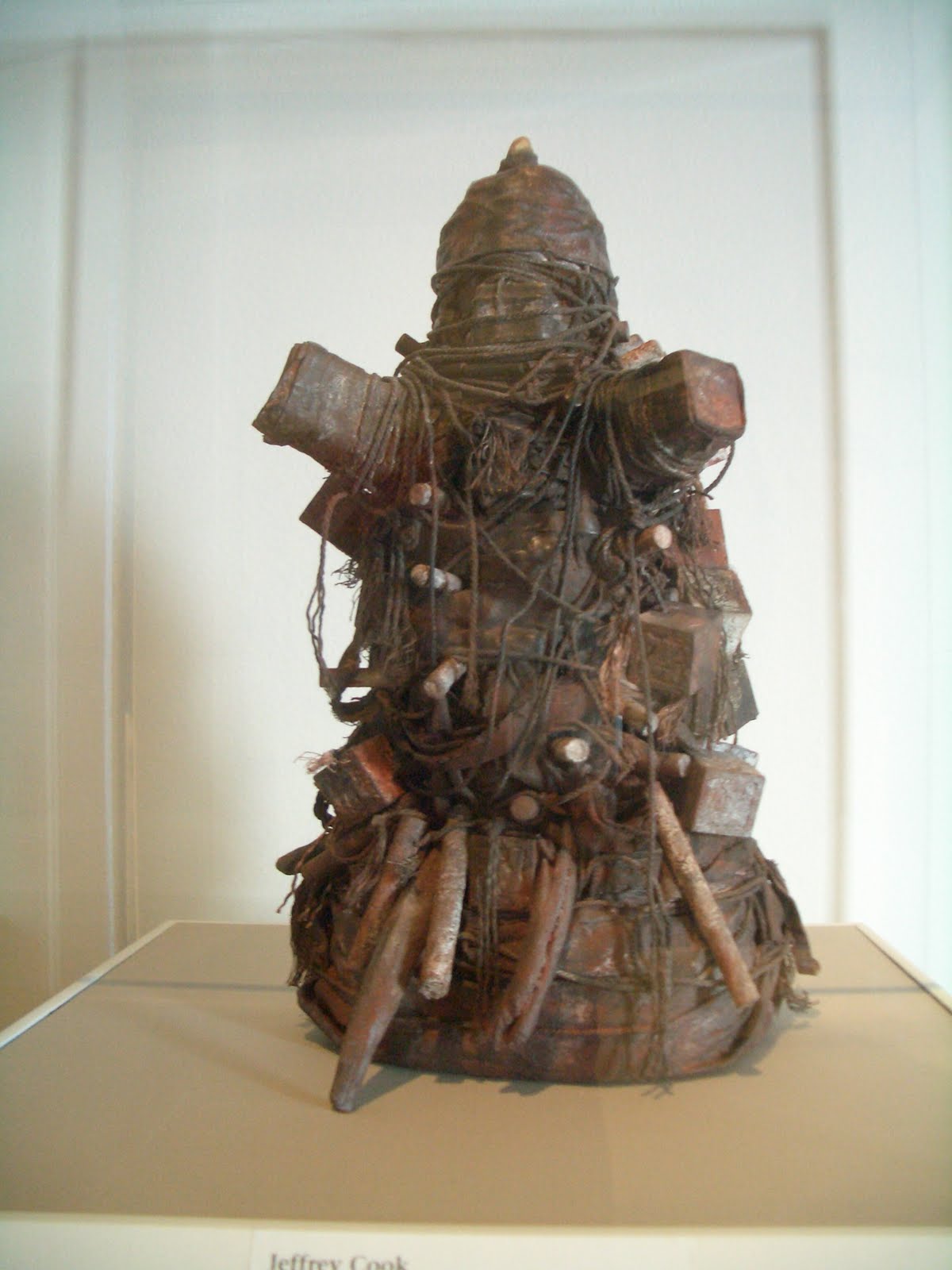
Of course , two sons from New Orleans should be mentioned, Jeffrey Cook who went back to his African roots to create the sculpture called "Dogon Box" 1996 inspired by the sculptures from Mali, and John Scott (1940-2007) with "Closest to Blues and Jazz". He made this statement:"what I have been trying to do...in my art is make a piece that would be similar to what African-American musicians have done with gospels, and blues and jazz, so that when you hear it , it wraps around your soul."


photograph NOMA from the author

General Toussaint L'Ouverture: danforthmuseum.org

Sunday, March 21, 2010

Spring and Sculpture Garden


After being closed for a few months, the Sculpture Garden at the NOMA reopened yesterday. Braving unusually cold temperatures and wind , I walked through the garden, sat in the pale sun, enjoying the visit one more time.


The sculptures are displayed along the paths, under the centuries-old oaks, and become part of the scenery like this sculpture from Arman sitting in the middle of the artificial lake. It is called "Pablo Casal's Obelisk"


"Three Figures and Four Benches" from George Segal integrates also the surroundings. The sculpture is so realistic that I felt like talking to the personages sitting on the bench.


Many well known artists are represented , like Oldenburg/Van Bruggen, Jean Michel Othoniel, Allan McCollum, Louise Bourgeois, Jean-Robert Ipousteguy, Rene Magritte, and others.

The walk always brings new thoughts and impressions, depending on the seasons or the mood of the viewer.
"Spider" Louise Bourgeois

This is a free visit which should not be missed when staying in New Orleans.

photographs by the author

Saturday, January 16, 2010

New Orleans, Cuba

" Si Cuba" is a succession of coordinated events taking place in New Orleans from January till March.

From art exhibits at the New OrleansMuseum of Art or local galleries, book discussions at local coffee shops, poetry readings, Cuban culture is present everywhere in New Orleans... or Cubans are speaking about the culture, the country they miss.

Today the New Orleans Museum of Art was hosting a special event to introduce ten new works from Luis Cruz Azaceta in its white marbled Great Hall.


On the second floor of the Museum, five artists living in Cuba were presented under the hospice of " Polaridad Complementaria: Recent Works From Cuba" with a painting from Douglas Perez Castro, a lace of highways over the shadow of a metropolis, was the cover of the invitation. Abel Barosso had one of his pieces, seen above and three photographers were also included. It was a very low key affair, and the visitor had to find his/her way through several rooms hosting permanent collections before discovering this special exhibit.

The main artist, Luis Cruz Azaceta migrated to the United States in 1960 at the age of 18, and for the past 17 years has been living in New Orleans. He is well known locally and his works have been displayed at several galleries in the Art District.

I find his technique and his message crude and cannot feel any emotion when looking at the aggressive colors combined with harsh lines. The paintings are flat panels with simple messages, clear, but at one level. The little personage trying to find his way out of the maze is the painter and stays the painter who cannot bring us beyond his personal history.

Upon leaving the Museum, I took a look back: thirty visitors all wearing black standing in the majestic white marble Great Hall. Lining the walls, out of place, were Azaceta's paintings. It struck me: like murals, they would bring color to some poor neighborhood in Cuba...but no hope.


bottom photograph from the Arthur Roger Gallery's website

top photograph is a reproduction from the catalog

Saturday, January 2, 2010

Degas in the news

Degas is in the news

Degas has deep roots in New Orleans. His mother was from a rich Creole family and his two brothers raised in France, migrated to New Orleans to seek fortune in the family business.

He spent five months in New Orleans, from October 1872 till March the following year. He was the first and only French Impressionist painter to visit the New World. His family portraits have been the main legacy of this trip. He visited his two brothers and his extended Creole family, whose wealth and subsequent losses was made in cotton trading. One of the painting : "A Cotton Office in New Orleans" is well known and was bought by the Museum of the City of Pau in Southwest of France. Another painting represents his sister-in-law "Portrait of Estelle Musson" and can be viewed at the New Orleans Museum of Art.

This trip was a turning point in his career. It convinced Degas, then thirty-eight years old, that one can only paint what one knows well. Upon his return, he concentrated on the subjects which made him famous later.

He considered New Orleans an exotic place but did not appear to have taken advantage of this in his works. One speculation is that he was unable to enjoy the outdoors due to his eye ailment. He could not tolerate the brightness of the sky.

The book "Degas in New Orleans: a French impressionist in America" gives an extensive review of his trip and discusses the aftermath.

It includes interesting essays relating to Degas and his family, the cotton market, New Orleans society.

The paintings are inspiring contemporary artists, and I found a video on You Tube from songwriter Ronny Elliot, which is worth watching.


http://www.passion4art.com/articles/french_impress.htm