Showing posts with label Gagosian Gallery. Show all posts

Sunday, August 15, 2021

La Vie en Rose


               Who am I to write a review of two ongoing shows from Damien Hirst, the most celebrated YBA (Young British Artists)? Since the end of the eighties, he never ceased to shock the art world and the world in general with his gory pieces and make the news, from accusations of plagiarism to the astonishing price of his works. Not so young anymore, the fifty-six-year-old artist obsessed with death, has surrounded himself with an endless Spring during the pandemic, going back to painting, "the loneliest thing you can do". Thirty of his one hundred and seven compositions of cherry trees in bloom were selected for his Parisian debuts at the Fondation Cartier while Cathedrals Built on Sand at the Gagosian Gallery off the Champs-Elysées features a series of pill cabinets

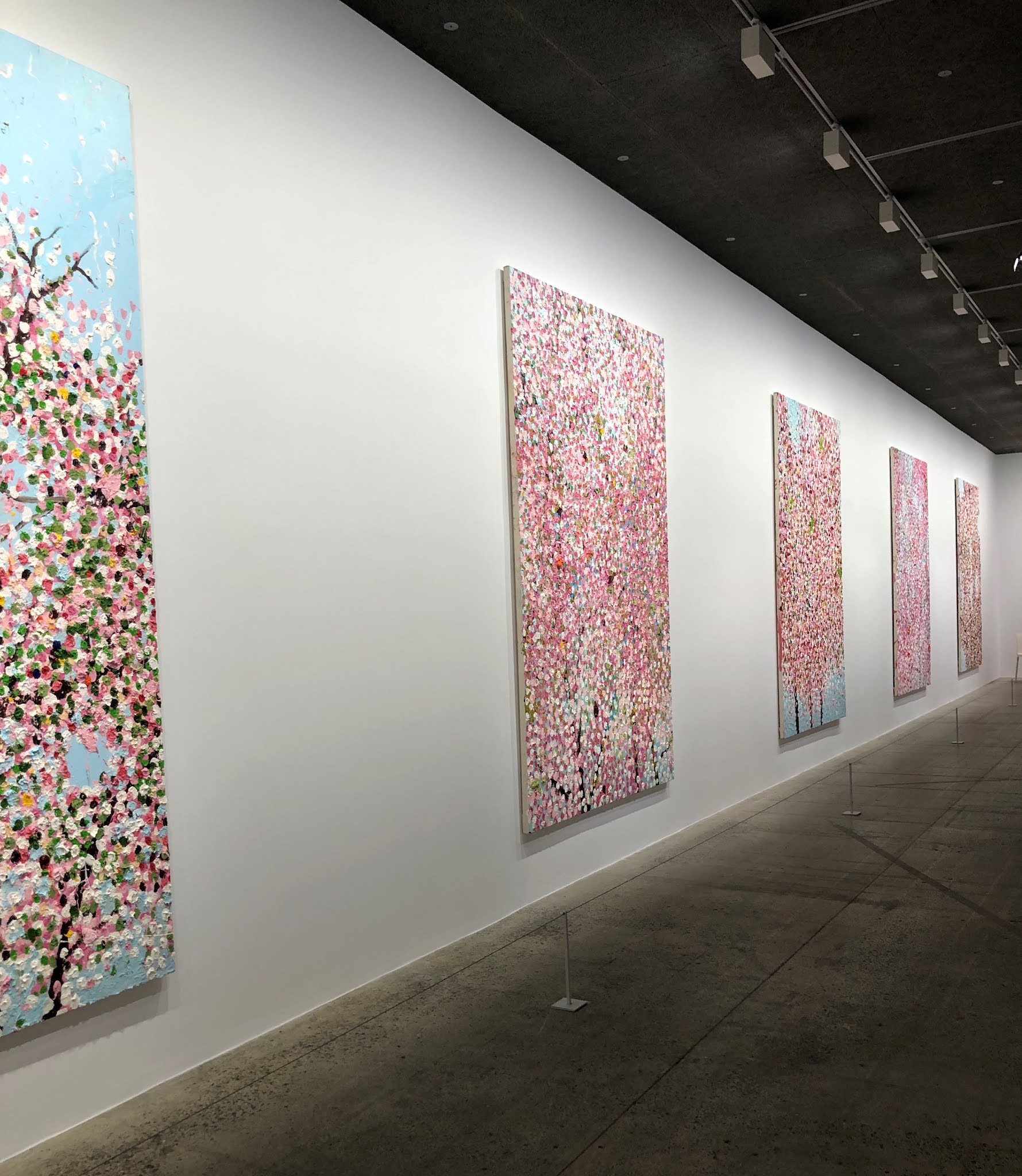
               Walking in Les Cerisiers en Fleurs is breathtaking... literally. The enchanted pink world of cherry trees in bloom soon becomes a claustrophobic congregation of colored spots spread on large canvasses covering the walls of the building's two levels. Greater Love Has No-One Than This Blossom, an outsized assemblage of four panels (quadriptych) consisting of interlaced tree branches with patches of clear blue sky peaking through, a jumble of uneven pink, white, pale yellow, blue to purple dots, a few green leaves, three dabs of red, sparse white drips, describes love as a heavenly prison. Why single out this piece? Because it is the largest and sums up the exhibition. All the paintings are variations on the same theme, parodies of abstract expressionism and pointillism, assigned grandiose titles: Imperial Blossom, Spiritual Day Blossom, Wisdom Blossom, Truth Blossom, God Blossom... and so on. 

               Meanwhile, Gagosian Gallery is filled with mournful landscapes of rows of perfectly aligned genuine or made up colored pills multiplied by their reflection on background mirrors, encased in heavy shiny stainless steel frames. Monochrome or multicolored, large or smaller pieces reflect a broken silhouette of the visitor surrounded by the pop-minimalist compositions lined up along the walls. Prototype for Lies, 1998, the first work of the series introduces the show. Walking through Cathedrals Built on Sand, one can ponder about our dependence on the attractive little fixes but the works bring little more for consideration. 

               From his mechanical spot paintings to his "back to nature" renditions of cherry trees, Damien Hirst embraces his love for color. "I love color. I feel it inside me. It gives me a buzz." However, his obsessive love for series is overshadowed by its commercial endeavor. Andy Warhol's quote comes to mind: "Making money is art and working is art and good business is best art". Going back to the cherry trees series, the "wow" of the first impression due to the abundance and closeness of the works rapidly fades and may not occur when the paintings are dispersed in museums or private collections. The artist has transformed the pink symphony of blooming cherry trees alluding to renewal and the lightness of being, into heavy renditions about the shortness of life.   

A final quote from Damien Hirst: "Art is like medicine-it can heal" Thank you Dr. Hirst.


pics by the author


Saturday, January 2, 2016

New Perspectives, Jacqueline Humphreys at the CAC


Jacqueline Humphries, a native New Orleanian now living in New York City is back in town with her latest exhibition at the Contemporary Art Center. The artist is showing exclusively new works, created for the twenty-first century, including large abstract compositions on the first floor and a collection of her black-light paintings on the second floor.
The home-made metallic pigment mixed from aluminum powder results in Humphries's shiny silver signature found in the five paintings downstairs. Generously applied in the background of Alpha, Alpha1 and Alpha4, the "non-color" blends with green, violet or pale blue hues, while rows of black dots fill the foreground. Delicate abstract black drawings float between the two layers, bringing a narrative to otherwise monotonous compositions. The action is initiated by the viewer who activates the works when walking by. The shifting reflection of the light on the silvery coat brings life to the paintings, and the calligraphic patterns become alive with the changing perspectives. Two paintings complete the display, large canvases with the same silvery effect but more abstract expressionist than pop with their sharp lines scratched in the paint. The same concept is involved in the layout of the black-light paintings displayed in the Lupin Gallery upstairs, however the technique differs. This time, ultraviolet light activates fluorescent paint, producing psychedelic colors glowing in the dark. An awkward atmosphere fills the gallery due to the mixed message sent by the conventional display of works aligned under the spotlights and the playful brash colors fit for a Kenny Scharf's Cosmic Cavern.
The combination of Pop art, Op art, Minimalism, Abstract Expressionism in Humphries's works results in a confused message and the mixture of low and high art remains stale, lacking energy and fun.  Humphries's attempt to catch the light with the festive medium falls short of its goal with the large black dots hindering a possible visual adventure. In 2009, Humphries stated in an interview that "Post modernism is supposed to be all about appropriation and cynicism... why not appropriate an attitude of seriousness." Seriousness is taking over her black-light paintings lined up along the walls and transforms them in a conventional display of flashy works.
In the post modern era, visual artists are faced with a question: is this the end of painting? The exhibition at the Gagosian Gallery in London in 2013 The Show Is Over, gathered artists looking for an answer. Humphries experimenting with new media found her language but delivers a message that stays superficial.


photographs by the author:

"Alpha3", 2014
"Untitled", 2014
"Untitled", 2015


Sunday, November 17, 2013

Painting? What Next?


A trip to London should include a visit of famous art galleries like Serpentine, White Cube, Gagosian... each has several locations. It could take a few days!

Crises are the occasion to reassess and hopefully move forward. In the art world, photography, perceived as a threat by painters, allowed them to get beyond the exact reproduction of the subject and move on to abstract and conceptual art. But what is next? Is this the end of painting?
The exhibition  The Show is Over at the Gagosian Gallery on Britannia Street in London is a gathering of artists preoccupied with the subject. The question arose as early as the end of WWII with Francis Picabia's last paintings born from the nihilism engendered by the war or the Buchi (holes) and Tagli (slashes) from Lucio Fontana.
The end of painting is celebrated by vast white rooms filled with canvasses covered by different media including chewing gum, urine or colors like grey, black and every piece chosen for the exhibition brings another argument to the conversation.
A monochrome grey painting from Gerhard Richter, a flat minimalist black work from Richard Serra, an expressionist black and white painting from Christopher Wool or the ultimate, Piero Manzoni's Achromes made with cotton and gravel are included with two fiery paintings from Yves Klein, consuming themselves in front of our eyes ( a side of Klein I was not familiar with, made in 1962 with scorched cardboard and pigments) .
The material varies. Andy Warhol spread urine on copper foil or diamond dust on canvas, Nate Lowman, sugar and dirt,  Gregor Hildebrandt, casette and tapes, Adam McEwen, chewing gum, Dan Colen, tar and feathers. There are no rules to describe the end of painting. Thirty five artists are involved in the show and the period covers more than half a century. The discussion still goes on, but what is interesting, the artists did stick with the format, all the works can be hung on the walls. This is kind of reassuring.
The show is mastering the subject and the quiet atmosphere was conducive to a great visit.

The question is lingering and the parallel with music cannot be overlooked. Atonal? Abstract? What is next? One hopes that the anxiety generated by this crisis will foster creativity.
The show is over when everything has been told and there is nothing else to say. Not yet.


no photographs were allowed

"Attese", Lucio Fontana, 1961, Flickr photo sharing
"hippity flippity" (tar and feathers), Dan Colen, 2012, photograph by Rob McKeever, Gagosian Gallery