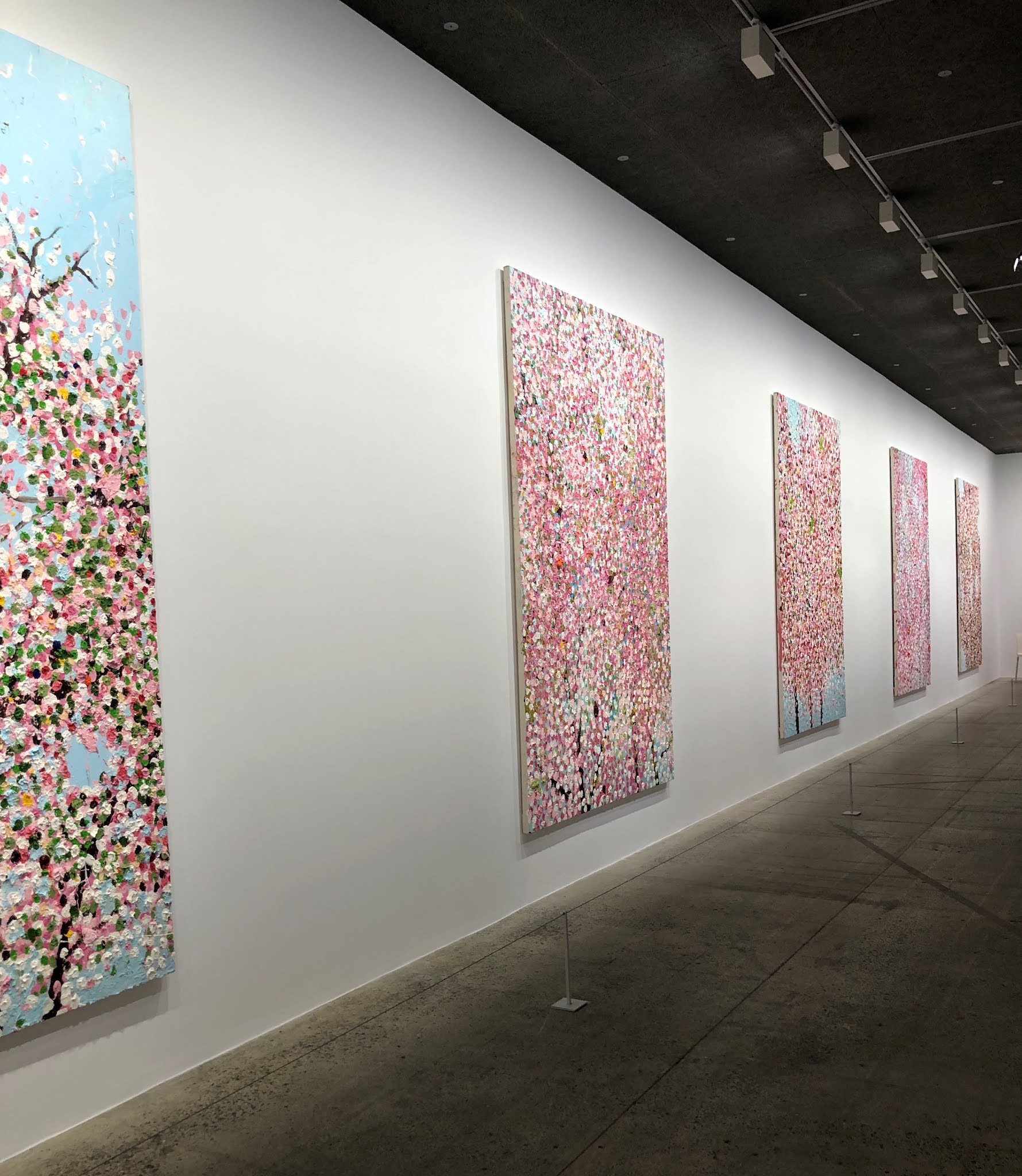
Who am I to write a review of two ongoing shows from Damien Hirst, the most celebrated YBA (Young British Artists)? Since the end of the eighties, he never ceased to shock the art world and the world in general with his gory pieces and make the news, from accusations of plagiarism to the astonishing price of his works. Not so young anymore, the fifty-six-year-old artist obsessed with death, has surrounded himself with an endless Spring during the pandemic, going back to painting, "the loneliest thing you can do". Thirty of his one hundred and seven compositions of cherry trees in bloom were selected for his Parisian debuts at the Fondation Cartier while Cathedrals Built on Sand at the Gagosian Gallery off the Champs-Elysées features a series of pill cabinets.
Walking in Les Cerisiers en Fleurs is breathtaking... literally. The enchanted pink world of cherry trees in bloom soon becomes a claustrophobic congregation of colored spots spread on large canvasses covering the walls of the building's two levels. Greater Love Has No-One Than This Blossom, an outsized assemblage of four panels (quadriptych) consisting of interlaced tree branches with patches of clear blue sky peaking through, a jumble of uneven pink, white, pale yellow, blue to purple dots, a few green leaves, three dabs of red, sparse white drips, describes love as a heavenly prison. Why single out this piece? Because it is the largest and sums up the exhibition. All the paintings are variations on the same theme, parodies of abstract expressionism and pointillism, assigned grandiose titles: Imperial Blossom, Spiritual Day Blossom, Wisdom Blossom, Truth Blossom, God Blossom... and so on.
Meanwhile, Gagosian Gallery is filled with mournful landscapes of rows of perfectly aligned genuine or made up colored pills multiplied by their reflection on background mirrors, encased in heavy shiny stainless steel frames. Monochrome or multicolored, large or smaller pieces reflect a broken silhouette of the visitor surrounded by the pop-minimalist compositions lined up along the walls. Prototype for Lies, 1998, the first work of the series introduces the show. Walking through Cathedrals Built on Sand, one can ponder about our dependence on the attractive little fixes but the works bring little more for consideration.
From his mechanical spot paintings to his "back to nature" renditions of cherry trees, Damien Hirst embraces his love for color. "I love color. I feel it inside me. It gives me a buzz." However, his obsessive love for series is overshadowed by its commercial endeavor. Andy Warhol's quote comes to mind: "Making money is art and working is art and good business is best art". Going back to the cherry trees series, the "wow" of the first impression due to the abundance and closeness of the works rapidly fades and may not occur when the paintings are dispersed in museums or private collections. The artist has transformed the pink symphony of blooming cherry trees alluding to renewal and the lightness of being, into heavy renditions about the shortness of life.
A final quote from Damien Hirst: "Art is like medicine-it can heal" Thank you Dr. Hirst.
pics by the author