Saturday, May 28, 2011

artist's studio


The visit of the artist's studio is always a privilege and a few weeks ago, I was able to drive to Lafayette, LA, and spend some time looking at Eugene J. Martin's work at his home.


The presence of the artist (July 24, 1938- January 1, 2005) is still felt in the house situated in a quiet neighborhood. The artist's works are pouring out of the studio and invading the house with their colors.


Overwhelmed at first, I looked at the paintings, drawings, collages and was amazed by their quality. One would expect some trials, "doodles", "left overs". The works appear to be created effortlessly, already composed by the artist before being laid on the canvas, smaller during hard times, on paper, bigger during fat times, on canvas, without hesitation, like brain and hand were one. The studio is left intact, quiet with paintings, neatly organized, drawings, stacks of CDs with the artist's preferred music and his ashes on a desk.


It is eerie, but a conversation with Suzanne, his wife, who can recall many anecdotes about the artist, brings me back to reality. The painter lived for his art. Rarely distracted, he would paint almost daily and creation was his mission. He was totally immersed in his work, translating his internal happiness.


He was initially living in Washington, DC, then Lafayette, LA, and was never seeking the limelight ... he did not have time. Some artists live to promote themselves, Eugene Martin was just too busy working.


I recently viewed two exhibitions: "Beyond Black" at the LSU Museum of Art in Baton Rouge and "Dancing String Bean: Paintings and Drawings from Eugene Martin" at the New Orleans African American Museum.


During this visit, I discovered Eugene Martin's collages, made with pieces of his own works rearranged for another message. This is where the "discarded" works find a second life. Collages are most of the time one level, feel second-hand, kind of lazy compositions. Eugene Martin's collages are different. They are visually and intellectually challenging: new perspectives, depth and three-dimensional works.


Suzanne has published several books about the artist whose works are the result of his drive, his self discipline, his creativity. His art is so much him that the artist is still present.


Like remembering a song, Eugene Martin's works are now alive in my head with their colors and shapes. There is no better way to know an artist than to visit his (her) sanctuary.


Sunday, May 22, 2011

letters, quotes, discussions and more

" Theories of Modern Art: A Source Book by Artists and Critics" by Hershel B. Chipp with contributions by Peter Selz and Joshua C. Taylor, University of California Press.


Should I start with the last chapter on Contemporary Art or read again Chapter VII on "Art and Politics" or chapter V on "Futurism"? This book can be read from the first to the last page or as needed.

The crumpled book cover is a testimony of my repeated visits. I read it at swimming pools, in airplanes (or airports waiting for airplanes), doctors waiting rooms... The material is so dense that I can spend just fifteen minutes and find material for reflection , like quotes from artists, letters, articles, speeches, critics...
It could appear fragmented but the material is presented in a structured manner with nine chapters, each independent with a well-defined subject: Postimpressionism, Symbolism and other Subjectivist Tendencies, Fauvism and Expressionism, Cubism, Futurism, Neo-Plasticism and Constructivism, Dada Surrealism and Scuola Metafisica, Art and Politics, Contemporary Art.
The list of contents at the beginning facilitates a search with a short detailed preview and a referral to the page's number.

The illustrations are only in black and white and give a scholarly touch to the book.

A detailed bibliography related to each chapter, a list of illustrations and the index bring more useful informations.


Beyond entertainment, it is an essential.


photographs by the author:


"The Look of Amber", Yves Tanguy, 1929

" Muse I", Constantin Brancusi, 1909-10

Sunday, May 1, 2011

Eco art?


Nature is the only subject of the exhibition taking place at the Ogden Museum of Southern Arts titled "One World, Two Artists: John Alexander and Walter Anderson". Two figurative artists with their own twist, painting the Gulf Coast as we like to think about it. The two artists do not have much in common. John Alexander uses oil on canvass, heavily applied with reds, blacks, dark and bright colors, bringing drama and a flavor of expressionism in his best compositions like the two represented here.

In contrast, Walter Inglis Anderson's pastel watercolors tell the story of a lost paradise. The painter lived in Ocean Springs, MS, and the local museum, called after his name displays Anderson's work around the year. The painter, sculptor, ceramist, potter, writer lived with nature and represents the soul of the Gulf Coast with his unique style. His travels are reflected in some of his water colors, referring to Egyptian friezes. The exhibition brings a personal touch with pages from his diary and ink drawings.
Of course, I am biased...I love the work from Walter Anderson. Are we predisposed to prefer what we recognize? On these week-ends, when I am passing-by the museum of art in Ocean Springs, I walk through to take a peak at the display of Anderson's paintings and marvel.


photographs by the author
entrance of the exhibition


"There is a Bluebird on My Shoulder", 1985 John Alexander


"Herons in Heat", 1987, John Alexander


"Redwings, Crabs, Frogs", 1945, Walter Anderson


"Father Mississippi", 1953, Walter Anderson


"Horizontal Pelican", 1945, Walter Anderson

Saturday, April 23, 2011

...and more at the NOAAM

I read about Margaret Taylor-Burroughs (1917-2011) and knew of her activities geared toward developing art and art venues for African-American artists. Through her writings, she kept promoting her cause and her dedication came to fruition with the opening of the DuSable Museum of African American History in Chicago.


She, herself, was an artist and it is very appropriate to have her works displayed at the New Orleans African American Museum. Recently, I visited the exhibition composed of linoleum cuts, woodcuts and a few paintings.

The (mainly) portraits are describing subjects with empty, frozen expressions lacking spontaneity. The artist studied the muscles generating these expressions, outlining them with simple, stylistic lines rendering them emotionless. No joy exudes from these works. Even the young subjects playing hop scotch are "behaving". It becomes an imaginary world in which children are wearing bows on their heads, are never dirty and can stay motionless. It reminds me of the illustrations from my childhood books written as teaching tools.

Her intend was to liberate, to express her cultural identity. She stayed mute and conformist, afraid of "letting it go" in her works. It did not materialize in her art, but as a woman of African-American descent, she was a pioneer.


The museum is bringing interesting artists and Eugene Martin's works are displayed in the hall of the main building as reported in a previous blog. Paintings from local schoolchildren occupy an annex. They are worth a thousand words.


no photographs were allowed

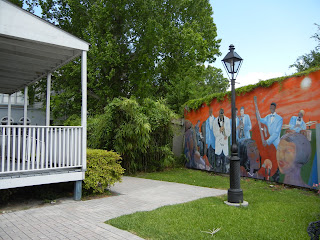
photograph of the courtyard, NOAAM, by the author

Tuesday, April 19, 2011

Scholarly artist


The Knoxville Museum of Art presents "Ziaoze Xie: Amplified Moments", the first exhibition of the artist in the United States. Xiaoze Xie ( Shau-zuh She-ay) is born in Guandong, China , in 1966 and belongs to the "Tiananmen Square generation." He is presently a professor of Art and Art History at Standford.


The background of Xiaoze Xie may explain his fascination for the written media. " Books because of my horror at the destruction of books by the Red Guard during the Cultural Revolution" states the artist in an article published in 2009. The exhibition plunges the visitor in the artist's world with several dark paintings of medium size. They all have a common subject: books, newspapers, abandonned. Some of the works are paintings from his Library Series ( MET Library, 2009, The MOMA Library, 2005, Shangai #1...). With a dreamlike realism, they bring a flavor of silent decay.


More books follow in the next work Untitled (Being and Nothingness #1), 10 square paintings arranged in a bigger grid-like installation, representing red shadows of books from well-known authors like Marx, Sartre, Nietzsche... glowing on the black background (burning?).


Contrasting with these is an "Apocalypse Now" style of fiery rendition of downtown Baghdad, during the invasion in 2003 with Fragmentation Series. A closer look shows a mixture of newspaper clips on the left side and the story of the event, painted in layers, burning of official buildings, lines of tanks, weapons, and a layer of local citizens crushed in between. The painting is like a postcard but purposely blurry, like a memory.

The next series of paintings with a heavy political undertone is also related to the Iraq war. It is a gallery of portraits in black and white: Dick Chesney, Donald Rumsfeld, the Bush Cabinet... These are the low point of the exhibition, with their weak message and doubtful impact.


For once, the work I found the most interesting and profound was a video. I often feel that videos are just an excuse to rest for a while, a pretext for a brake. In front of this black and white video, there was no seat. Approximately ten minutes in length, it is about the everyday crowd, you and me in public transportation, anonymous faces, and hands, a lot of hands young and old holding newspapers. The headlines are about wars, disasters, our daily consumption of news. They come and go, horrific but the anonymous person goes on with life, undisturbed. Tomorrow will bring fresh news. The succession of pictures, the collision of events provoke drama and reflexion.The end is poetic and sad with a page of the newspaper floating in the wind and falling on the dirty steps of a subway.


I keep my preferred work for the last " Order (The Red Guards), 1999" : It is a giant scroll -like canvass, depicting a library but old and dusty, with books on shelves, of course in black and white, the books fall from the shelves and at the bottom, closer to the viewer they become dust. Blood-red metal squares like spikes are planted in the wall following a regular pattern.


Among these 30 paintings, drawings and installation, Ziaoze Xie's message is the strongest when related to his cultural heritage. The artist's nostalgia for printed media appears anachronistic when the headlines are about another Chinese artist from an older generation (Ai Weiwei) using social medias to be heard.


photographs were not allowed


photographs from Flickr


Saturday, April 9, 2011

"Dancing String Bean" and more at the NOAAM


The French Quarter Fest is in full swing and the Treme is quiet today, soaking in the afternoon sun.

On Governor Nichols Street, the NOAAM (New Orleans African American Museum) presents a new exhibition featuring works from Eugene Martin (1938-2005), titled "Dancing String Bean: Paintings and Drawings by Eugene Martin".


The hall is lightened by the colors of several paintings, two of larger size, "The Happy Bartender" and "The Duchess of Texas", both 1994 and on the other side, four paintings, smaller but with the same construction: a background made of colors delineated by sharp lines building a frame and fluid shapes to describe the subject in the center and tell a story. Violet and brown are sometimes used to bring drama (Untitled 2000), but the message is usually happy with a touch of irony.

Then, I concentrated on the drawings, lined up carefully along the walls. The earlier ones, made with ink and bamboo sticks on paper, with weird little personages, cousins of "Ubu", like in "Avoiding Rush Hour" with an upside down moon. The drawings come to maturity with the next set. One of them gives the title to the exhibition.

When looking at these, the viewer, unknowingly, is engaged in the process of seing. The artist is using a well-known optical illusion (cognitive type) described by Joseph Jastrow who drew the famous "Rabbit or Duck?" (1899). Black or white, white or black, the viewer can choose or rather his/her brain. But this becomes too scientific, let yourself enjoy the subjects about happiness , love, dance, .... Just look again...The technique of the drawings is very clean and gracious in its simplicity.


Paintings from the artist can also be viewed in Baton-Rouge, at the Shaw Center for the Art during the exhibition titled "Beyond Black: Ed Clark, Eugene Martin and John T. Scott". The works are more challenging, with the same vivid colors but a sophisticated message. The same irony flavors the works from different periods: whimsical, playful, happy!

I am still discovering the prolific artist. My only regret about the exhibition is the small space ( used at its best by the curator) allowed for the show.


The energy of the colors and the subjects of Eugene Martin bring joy and happiness. Leaving the museum, I can hear a faint music. My imagination? Eugene Martin's works are jazzing.


NOAAM, photograph by the author

all other photographs, courtesy Marie Vinouze, curator of the exhibition.

"The Duchess of Texas", 1994

"Dancing String Bean"

The exhibition at the NOAAM

Sunday, April 3, 2011

Social on Julia Street


Last evening, on Julia, there was art and people were invited to jam. A Spring tradition, "Jammin' on Julia" is well advertised. The crowd is thinner each year and showed little enthusiasm yesterday...Why? Food and music are at the rendez-vous, what about art? Le Mieux Gallery was presenting two artists. Nathan Durfee with "Moments Behind the Eyes", characterized by his anachronistic personages, with their heads in a bubble, isolated and dreamlike. The technique is a mixture of realism interrupted by pixelated areas and naive. The result is disconcerting. Kathryn Hunter is the other featured artist, with bright colored cuttings. "Confluence" is about animal and human relationships. The Jonathan Ferrarra Gallery and Arthur Roger Gallery did not bother to bring a new show, and I had already spent plenty of time a month ago looking at the new works of Dawn Dedeaux. Paul Campbell's works were displayed at the Heriard-Cimino Gallery. "Koosh" is a series of paintings made with paint-soaked koosh balls and strings saturated in paint. The result is described as "a delicate dance of formal composition and spontaneous chaos." I felt like the repetitive act with random results produced flat works, decorative at best. Finally, I visited Gallery Bienvenu presenting its yearly show of Raine Bedsole's works. The boats with their mystery and symbolism create a strong impression on me. Unfortunately, the mass production of the boats, in all sizes to accommodate buyers, and different colors to match interiors, weakens the message.They are becoming repetitive and meaningless. What about new works? One of the space has become a "Spa" where the visitor can let his/her inner talent flow. The well aligned canvasses were waiting for customers. Artists and gallerists beware, there is no art without viewers.


photographs by the author from top to bottom:


"Ethan Was Studying and Had no Time To Save the Planet" Nathan Durfee


"Stormed" Kathryn Hunter


Rayne Bedsole