Saturday, June 11, 2022

Thirty Seconds


The long line of visitors to see One With Eternity: Yayoi Kusama in the Hirshhorn Collection at the Hirshhorn makes me wonder. What are they looking for? A taste of eternity? An artsy surrounding for another selfie? After a two-year wait to open, the abbreviated version of the previous exhibition Yayoi Kusama: Infinity Mirrors in 2017 is significant due to the selection of works which feature the artist's iconic symbols including phalluses, dots, pumpkin, and span her practice with two infinity rooms recently acquired by the museum.

Born in Japan, Yayoi Kusama lived through a traumatic childhood and relates her art to the psychological traumas she was exposed to as a child. She moved to New York City in the early sixties where she enlivened the art scene with her provocative happenings, writings, photographs, installations, overall being fashionably outrageous among her peers, with wit, determination and passion. Upon her return to Japan in the seventies, her fame dwindled while she checked herself into a facility for mentally ill persons permanently. However, she never stopped working in her studio located nearby and since the eighties her career has flourished, bringing her international recognition. Now in her nineties, she is still active as an artist.  
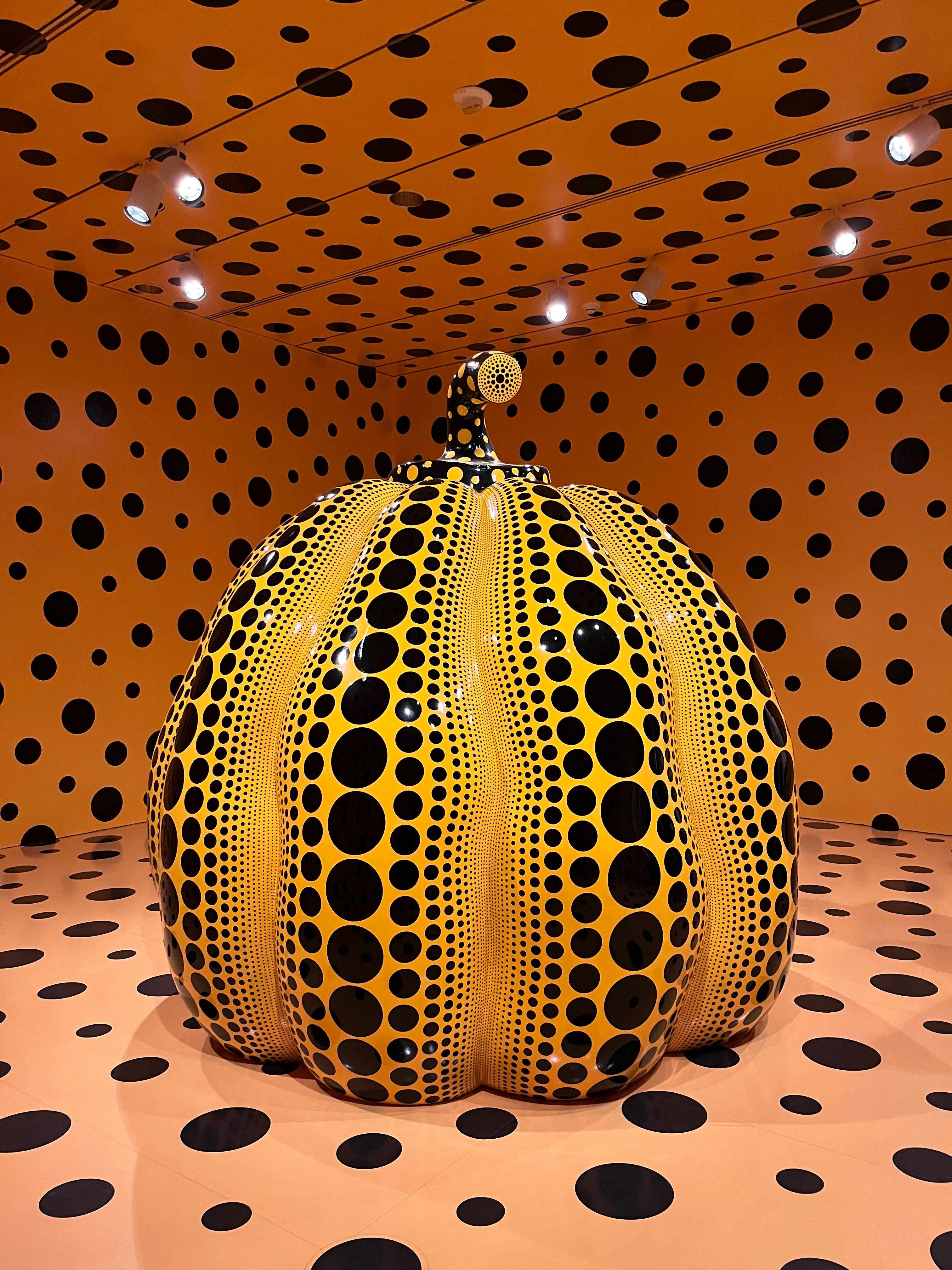
The first work, Pumpkin, 2016, is more than an outsized yellow gourd with a patterned black dotted exoskeleton sitting comfortably on its wide saggy base. It is a quiet presence in the middle of a square orange colored room including floor and ceiling, decorated with dizzying black dots of various sizes. The fiberglass sculpture coated with enamel, symbol of serenity amidst an hallucinatory world filled with black dots, hints at the artist's longing, and ultimately represents an ideal self-portrait. 

Chatting, looking at their cell phone while waiting to enter Infinity Mirror Room-Phalli's Field, 1965/2017, visitors seem to ignore the rousing poem from Kusama addressed "To the Whole World" and the texts about the artist and her works spread on the red walls of an antechamber-like space. With the last line still in my mind ("Revolutionist of the world by Art"), I walk in the installation: door closes... thirty seconds. The guard has a chronometer. Floating on a thick carpet of white phalli decorated with red dots like corals on a seabed, hundreds of me reflect in the mirrors, getting smaller and smaller until they fade in a black spot, lost in the void of infinity. Surrounded by "myselves" I try to capture this intense stolen moment which I expect to be otherworldly, transcendent, sublime. Time for one or two unavoidable selfies and... out. Still somewhat discombobulated, I regain my footing back in line, ready for the next room. 

"Infinity Mirrored Room- My Heart is Dancing into the Universe", 2018, offers a walk through a small dark space filled with black paper lanterns illuminated by colored lights shining through translucent holes. Immersed in waves of blue, violet, red, orange, yellow, green,... a cacophony of colors glowing through dots of all sizes, I feel like experiencing a psychedelic nightmare or looking at a broken kaleidoscope. I hesitate to take a step forward, confused, my rods and cones in disarray, even the floor reflecting the lights appears uneven. Two minutes... time is up. Close to an attack of claustrophobia, I leave the kinetic light show and reach the last room where a metallic dark coat covered with plastic roses set on a hanger is the only piece on a white wall. The monochrome sculpture, a sort of relic, evokes Kusama's episodes of hallucinations. The anticlimactic finale to the short exhibition is not the end of the visit which reverberates long after. 


In line with the flow of visitors there is little time to meditate! Getting a whiff of infinity at best, the viewer transformed into a consumer may feel frustrated but Kusama's work reaches beyond the museum. Inspired by her relentless fight with mental disease which has taken over her life, art has become the mean to conquer and share her fears, hallucinations, obsessions, and transcends a trivial design, a dot, to create a world of infinity and spirituality.  Her practice reaches a large audience attracted by its pop art side and/or its otherworldly aspect. One of my unforgettable visit was at Musée des Beaux-Arts de Nancy in the East of France where Fireflies on the Water, 2002, is a permanent installation. Without time constraint, alone, immersed in the quiet infinity mirrored room I connected with the artist who stated: "I felt as I had begun to self-obliterate, to revolve in the infinity of endless time and the absoluteness of space, and be reduced to nothingness."  


photographs by the author:

"Pumpkin", 2016

"Infinity Mirror Room-My Heart is Dancing into the Universe", 2018

"Infinity Mirror Room-Phalli's Field", 1965/2017


Sunday, August 15, 2021

La Vie en Rose


               Who am I to write a review of two ongoing shows from Damien Hirst, the most celebrated YBA (Young British Artists)? Since the end of the eighties, he never ceased to shock the art world and the world in general with his gory pieces and make the news, from accusations of plagiarism to the astonishing price of his works. Not so young anymore, the fifty-six-year-old artist obsessed with death, has surrounded himself with an endless Spring during the pandemic, going back to painting, "the loneliest thing you can do". Thirty of his one hundred and seven compositions of cherry trees in bloom were selected for his Parisian debuts at the Fondation Cartier while Cathedrals Built on Sand at the Gagosian Gallery off the Champs-Elysées features a series of pill cabinets

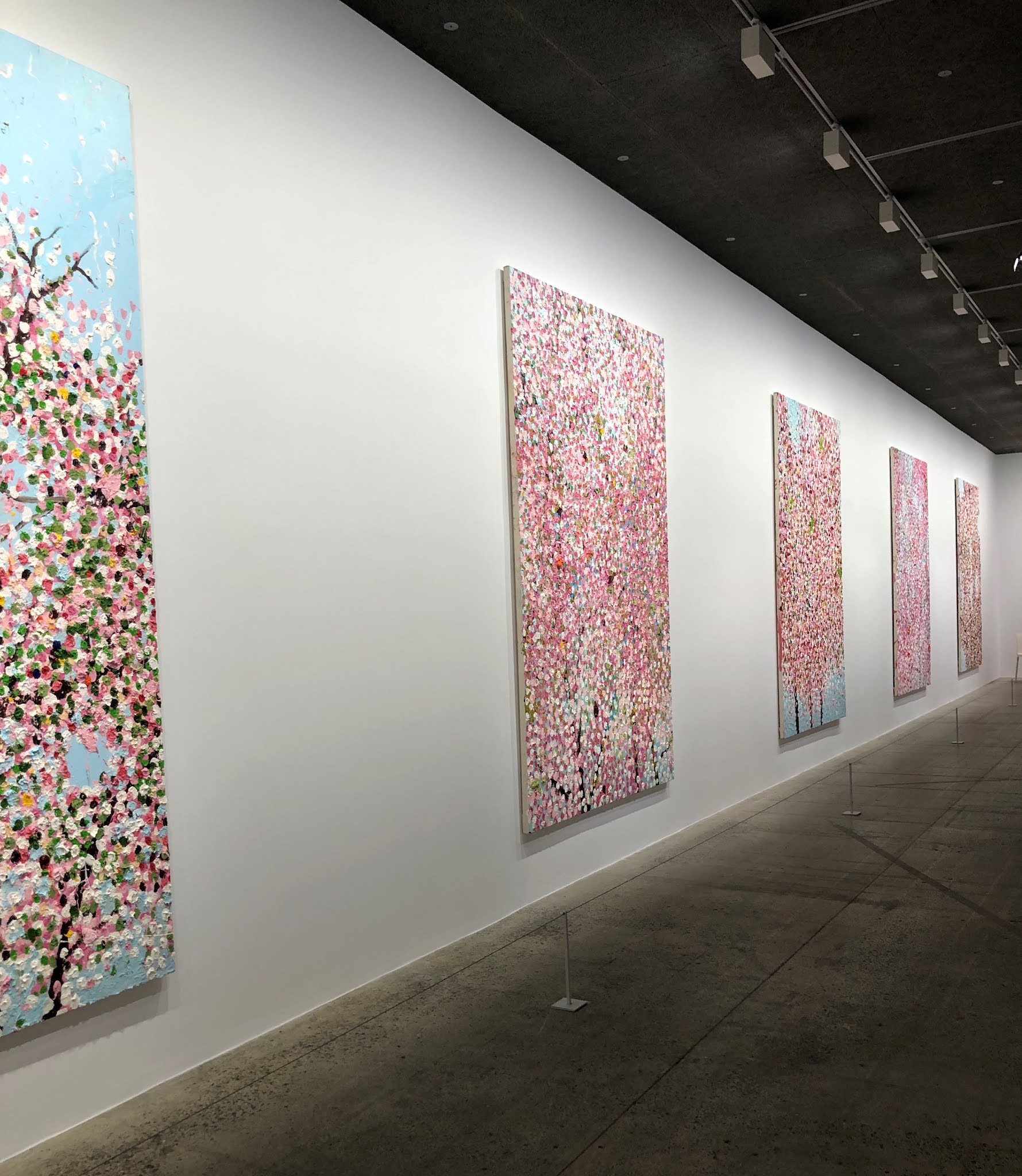
               Walking in Les Cerisiers en Fleurs is breathtaking... literally. The enchanted pink world of cherry trees in bloom soon becomes a claustrophobic congregation of colored spots spread on large canvasses covering the walls of the building's two levels. Greater Love Has No-One Than This Blossom, an outsized assemblage of four panels (quadriptych) consisting of interlaced tree branches with patches of clear blue sky peaking through, a jumble of uneven pink, white, pale yellow, blue to purple dots, a few green leaves, three dabs of red, sparse white drips, describes love as a heavenly prison. Why single out this piece? Because it is the largest and sums up the exhibition. All the paintings are variations on the same theme, parodies of abstract expressionism and pointillism, assigned grandiose titles: Imperial Blossom, Spiritual Day Blossom, Wisdom Blossom, Truth Blossom, God Blossom... and so on. 

               Meanwhile, Gagosian Gallery is filled with mournful landscapes of rows of perfectly aligned genuine or made up colored pills multiplied by their reflection on background mirrors, encased in heavy shiny stainless steel frames. Monochrome or multicolored, large or smaller pieces reflect a broken silhouette of the visitor surrounded by the pop-minimalist compositions lined up along the walls. Prototype for Lies, 1998, the first work of the series introduces the show. Walking through Cathedrals Built on Sand, one can ponder about our dependence on the attractive little fixes but the works bring little more for consideration. 

               From his mechanical spot paintings to his "back to nature" renditions of cherry trees, Damien Hirst embraces his love for color. "I love color. I feel it inside me. It gives me a buzz." However, his obsessive love for series is overshadowed by its commercial endeavor. Andy Warhol's quote comes to mind: "Making money is art and working is art and good business is best art". Going back to the cherry trees series, the "wow" of the first impression due to the abundance and closeness of the works rapidly fades and may not occur when the paintings are dispersed in museums or private collections. The artist has transformed the pink symphony of blooming cherry trees alluding to renewal and the lightness of being, into heavy renditions about the shortness of life.   

A final quote from Damien Hirst: "Art is like medicine-it can heal" Thank you Dr. Hirst.


pics by the author


Monday, July 5, 2021

Meet the Artist at the AcA


Reflection on the past? Prelude to a new beginning? A mid-career retrospective can be daunting for the artist, for the visitor too, often exposed to lengthy wall texts and a line up of works deemed relevant to the artist's career, displayed chronologically. None of this for Stephanie Patton: Comfort Zone 1993 - 2021, a lively, fun show, radiating the multi-talented artist's warm and caring personality. Born in New Orleans, she graduated with a Bachelor of Fine Arts in painting from the University of Louisiana at Lafayette and moved North to receive a Master of Fine Arts in photography from the School of the Art Institute of Chicago. She then spent some time in New York City and studied vocal and comedic performance at the New SchoolUpright Citizens Brigade and Gotham Writers' Workshop. In 2001 Patton's Southern roots brought her back to Lafayette where she is teaching and pursuing her international career. The exhibition curated by Jaik Faulk at the Acadiana Center for the Arts reflects the artist's eclectic background and includes sculptures, paintings, iconic wall pieces, photographs, videos and installations. 

A pair of bronzed shoes set on a mirrored pedestal stands out in the middle of the vast main gallery partitioned for the show. The grandmother's empty shoes transformed into a keepsake like baby booties, allude to the process of reversion to infancy in old age. We can even look at ourselves while contemplating the piece! Like a memento mori, it also reminds us of the inevitability of death. Bronzed SAS Shoes, 2008, leads to two intimate spaces where, going back in time, we can get acquainted with the artist's alter ego, Renella Rose Champagne. A kitschy installation, a video of the artist performing as a (struggling country) singer, a photograph of Olympia-Patton (fully clothed) or disguised as a clown, are among a collection of items aligned along the walls. Advertisements for purses, shoes, compact discs, undergarments, magnets for refrigerators... Renella embraces pop. Like the girl next door she dreams of a traditional wedding and revels in the month-long preparations, documents lists of guests, collects newspaper clips and photographs. Boisterous, exuberant, bubbly, describe the creative energy of the artist, and the selected pieces exude her self-deprecatory humor which leaves us smiling. 

What better transition to Patton's next period than Toasty Warm Inside, 2008, a full-length luminous self-portrait? It seems that about ten years ago her career took a turn with new conceptual works. The spacious display allows to contemplate meditative pieces, monochrome white landscapes made of vinyl filled with batting like Revolve, 2019. Quilting evokes a domestic life, love being a required ingredient to perform the labor intensive task. Fluffy like clouds, soft like blankets, the soothing pieces are an invitation to rest and heal our minds. Another "series" involves mattress as a media for calligraphically perfect designs of interjections found throughout the show: Us, 2021, Join, 2020, You (Blue), 2020, can be interpreted according to context or mood. "You" can evoke a tender whisper in one's ear or an outburst of anger.

Mostly inspired by idioms found in her grandmother's mail catalog, Patton's videos complete the review of thirty years of her career. Making lemonade from lemons in Heal, 2011, walking on eggshells for Diffuse, 2008, or ripping off band-aids from her face in Conquer, 2013, Patton manages to interpret popular maxims through conceptual ideas, with a twist of humor. The flawless videos confirm the artist's attention to detail and her talent as a performer.
Dream, 2011, a video about "memory, death and the afterlife" in which the artist sings the famous song "Dream a Little Dream of Me" and a bird view of the show from the mezzanine complete the visit. 

Comfort zone filled with wit and loving care.


 Photograph by the author

Friday, April 30, 2021

iPad Painter


The Museum of Fine Arts Houston features two masters at once for its first contemporary art exhibition since reopening: Vincent van Gogh and David Hockney. Who has not seen "a van Gogh" or at least a reproduction? Hockney on the other hand, best known for his paintings of swimming pools inspired by California's lifestyle, has reached a more selective audience of connoisseurs in the United States. The show is the occasion to see the works from the artist whose 80's birthday was celebrated with a five-month-long comprehensive retrospective at The Centre Pompidou in 2017.  Hockney-van Gogh: The Joy of Nature which premiered at the Van Gogh Museum in Amsterdam, highlights the Dutch painter's influence on Hockney and their shared love of nature. Paintings, drawings and other works are displayed in a succession of rooms, each focused on a theme: landscapes, trees, the arrival of Spring, the four seasons, and in the last room, new perspectives. 


Back to his native Yorkshire in 2004 after spending more than two decades in California, Hockney began to paint 'en plein air'. His landscapes of Woldgate fill the first room, intermingled with a few carefully selected scenes from Van Gogh, to highlight the similarities between the paintings. Fields, forests, roads, skies, horizons, subject, style, perspective, colors, show the correspondence. The comparison goes on with close-ups of trees, followed by a display of seasonal scenes from both artists. The Arrival of Spring in 2013, a collection of twenty-five charcoal drawings emphasizes the delicate process of representing nature: first looking then rendering 'every bit of grass', and showcases Hockney's draftsmanship. Watercolors complete the display which as we progress features less paintings from Van Gogh and becomes a one man show with works noticeably larger and more experimental including the famous iPad drawings. To meet the challenge brought up by the size of his oil paintings, Hockney divides huge canvasses like The Arrival of Spring in Woldgate, East Yorkshire in 2011, into  thirty-two smaller units assembled like a grid and prints his iPad drawings on four sheets of paper. The resulting landscapes are an invitation to walk in the forest, under the trees, on the path, and savor the precious gift of nature. Hockney's passion for images brings him to look through the lens of a camera or better nine at once on a monitor installed on a moving vehicle to record the forest's seasonal changes in Woldgate. The bench in the middle of the room offers a place to rest while watching The Four Seasons, Woldgate Woods, 2010-2011, a dizzying synchronized projection of thirty-six videos, nine per season and per wall, offering different views of the same scenery. After this visual overdrive, walking through the show's conclusion is underwhelming, from the blinding orange of the walls to only three pieces which highlight Hockney's search for new perspectives during his sixty-year career with In the Studio, December 2017, featuring the artist surrounded by 3D renditions of his works for a grand finale. 


Of course, setting the works of the two artists in the same room highlights the similarities between them, and also their differences: heavy brush and garish colors for Hockney who favors a naive style. It appears also that size does not matter regarding a work's content. Van Gogh's landscapes offer more than a visual feast with to quote the artist: "that flat landscape in which there was nothing but.......... the infinite... eternity." Over the years, it feels like Hockney the artist who keeps experimenting with new technologies to enrich his practice in his pursuit of ways to describe space, is becoming Hockney the neophile. This should not become his legacy. The exhibition focuses on a period less than a decade of a long career which is ongoing. Van Gogh was 37 years old when he died, a pauper. At 83 years old Hockney just discovered Normandy in France (where he can smoke) and announced two upcoming exhibitions, 116 iPad drawings/paintings for the reopening of  the Royal Academy of Arts in London  and one involving a 288-foot-long tapestry in Paris. Prices of his works are skyrocketing.
Will David Hockney be remembered for his iPad drawings? 


photographs by the author:

"The Arrival of Spring in Woldgate, East Yorkshire in 2011", David Hockney

"Tree Trunks in the Grass, April 1890", Vincent Van Gogh

"May Blossom on the Roman Road", 2009, David Hockney


Wednesday, March 31, 2021

Action at the AcA


Slammed!! Sensationalism and Culture in the Squared Circle is a catchy title for an exhibition. The punchy word refers to the art of wrestling and the squared circle to the ring in which it takes place. Set at the Acadiana Center for the Arts, the group show co-curated by Jaik Faulk, visual arts director of the AcA and Ben Hickey, curator of the Hilliard University Art Museum, assembles the works from more than thirty artists who answered an open call. The selected works are displayed in the main gallery of the venue and include paintings, drawings, videos, photographs and installations.


Back to the seventies, the world of wrestling is in full swing, so are motorcycle gangs. Streetfighters: Ninjas, 2016, a video from Generic Arts Solution is a great introduction to the show with two mechanized centaurs (the artists) disappearing in a cloud of fiery smoke accompanied by a soundtrack  of engines, screeching tires and brakes. The machine, two conjoined motorcycles, is also displayed close by. The main gallery is a wide open space filled with a lavish display of art works related to the theme of the exhibition, each artist represented by several carefully selected works. The four oils on canvas from John Isiah Walton made in 2018, especially relevant to the topic, appear to have been inspired by the show's title and vice-versa. The paintings feature colorful wrestlers in a ring surrounded by a black background. This is a short description of the narrative pieces. Their titles provide a cue to the depicted scenes like Super Dome F5 which, according to the artist, is about "The Undertaker's shocking defeat at the hands of Brock Lesnar at WrestleMania XXX", or The Perfect Plex, for Suplex an offensive move with several variations. The visual recording of  these famous moments provide a way to build a collective memory of the sport and create a bond among the fans. I have to confess I am not one of them. Clueless about the art of wrestling, I look at the works from another angle. Catching the free fall of a blond haired wrestler in Wrestle Mania 2k or a scream of victory in Sharp Shooter, the artist offers the best view with his close-ups allowing to seize the pinnacle of the move, the fleeting moment that makes history. The contrast between white mats, fighters underlined by the blue halo from the spotlights and a dark invisible crowd, brings a spiritual dimension to the competition. Colors become a tool to express the tense atmosphere, underlying the loneliness of the fighters and their status as heroes in the squared circle, surrounded by unseen spectators but so present in the shadows that we can imagine hearing their cheers and jeers. Beyond figurative, the artist's technique with his vigorous brush and vivid colors, translates the physicality of the encounter. 

Walton assimilates all the attributes of neo-expressionism for his inimitable style and proceeds to apply it to render raw, brut scenes about a "world of power and display" best seen through his eyes. 


photographs by the author:

"Sharp Shooter"

"Wrestle Mania 2k"

Sunday, February 28, 2021

Sculpting Glass


 A new show at Arthur Roger Gallery features two sculptors working with glass. Gene Koss and Stephen Paul Day have little else in common with the former related to the glass movement and the latter labeled as a post or metamodernist. However, categorizing their practice limits the impact of their idiosyncratic work revealed in the display of two massive sculptures complemented by a dozen of smaller ones for Gene Koss and a number of delicate pieces for Stephen Paul Day, making for a busy visit. 


 Toil,
 2019-2020, a Brobdingnagian sculpture visible from the street fills the entire front gallery. The machine born from the artist's imagination is reminiscent of heavy farm equipment, alluding to his upbringing in rural Wisconsin. Koss who started the Tulane University glass program, is known for his monumental public sculptures made of glass and steel. Looking back at his 45-year career, his practice reaches a climactic stage with this piece so huge that it requires some steps back to see it wholly. Walking around the mastodon helps connect with our inner child, overwhelmed by its dimensions, filled with awe. In the same room, shape and components (spring, fulcrum, wheel , fork) of a model, Bridge Series #2, 2010give a cue to the artist's inspiration for its giant clone. Crystalline, pure, soothing, decorative, refreshing, ..., so many qualifiers come to mind when looking at the two-sided  sculptures displayed along the rear gallery. They feature colored particles floating in glass like nebulae in a transparent sky or swirls in frozen water. Among the blue marine, turquoise, cobalt green, pale yellow, red COVID-19, 2020, stands out, like a device ready to explode. The Ridge Road Climb series  provides an escape, a way to connect with nature from our desk or our living room. The clear rough surface of the man-made "mineral" evokes waves, precipices, glaciers, mountains, cascades, frozen lakes and more to the wandering mind. The closing piece Furrow, 2020, made of glass and steel, indestructible, stands like a final statement from the modern Vulcan.  


It takes a completely different mindset to visit the show from Stephen Paul Day Now She Sings, Now She Sobs, Now She Sings, in the adjacent gallery bathed in pink, black and white, the three colors of  twenty five or so sculptures laid on a white table or pedestals. This time the visitor is not  overwhelmed by the size of the works but by their number (all made in 2020).  Bicephalic closed compositions like Lu Lu, Les Jumelles Roses, or pieces with embedded black and white photographs and/or pipes instead of anatomic parts, all require some time to absorb their narrative. Some sculptures offer a clear message like The Chain Done Broke, others are more cryptic like Eve. The content of the miniature apothecary jars set in a display reminiscent of cabinets of curiosities relates to New Orleans's history: warped images of iconic buildings, trinkets, mementos, old photographs, objects, notes, plants, exude a whiff of nostalgia about times gone, some good, some bad. Heart of New Orleans, a frieze made with mirrors framed by the words "Now She Sings", "Now She Sobs" like a mantra, sums up a show which is not only about the city but has become an homage to the great pianist Chick Corea who just passed. 

New Orleans, the city infused in music during good times and bad times, celebrations and funerals.       


photographs by the author: 
                                      Gene Koss "Ridge Road Climb (GKOS 0424)", 2020
           Stephen Paul Day "Sirène", 2020  
                                                             Stephen Paul Day " Heart of New Orleans" (detail), 2020                              


Friday, January 22, 2021

After the Tempest


The death of painting was predicted a long time ago, when photography was born. Since then, visual art has flourished and controversies about abstract art are now history. Installations, videos, performances, are multiplying. Meanwhile, figurative painters too often are ignored by the art scene, at the exception of a few stars. They represent a whole gamut of styles from realism to impressionism and everything in between, and beyond. One of these artists,  Kathryn Keller is presently showing some of her recent works for Beautiful Isolation, the latest exhibition at LeMieux Galleries.  


Each gallery has a unique lay-out and walking in LeMieux for my monthly tour, I look to the right to find the show's title above the display of a major piece, and walk to the left to see the works from the featured artist. This time, I was drawn to three oil paintings aligned on the wall. Fallen trees occupy the whole foreground in the first one, and leave little space for a blue sky and a lush vegetation in the two others. The post-hurricane Laura scenes sum up the disaster better than words. Walking back and forth, they become alive, the trees shimmering in the sunlight. A closer look at the canvas reveals delicate touches of white paint on the dark trunks for the effect. From her outdoor studio the artist reflects on life, resilience, and connects with nature to alleviate her grief following the disaster. 

Painting indoor, she chooses watercolor still lifes to share more intimate scenes. The object (lipstick, scissors, bottle...) reaches a new status under the eye of the artist. During isolation, mundane tasks become important rituals and domestic life fills our world. She depicts bliss in Bleakhouse 11.17.19, 2020, a composition featuring a living room with fireplace, dog, books about her favorite artists Milton Avery and Winslow Homer, revealing her sanctuary in the time of pandemic.  

For her first exhibition at LeMieux Galleries, the sixty-eight-year old artist selected a dozen pieces to reflect upon the recent disasters' impact on nature and our lives. While terms like plein air painting, figurative, watercolors, still lifes, can sound old-fashioned, they relate to artistic ways of expression that have never been out of fashion.

The paintings convey an inner tranquility, a permanence that is soothing, especially in times of turmoil.


 photograph by the author

"Aftermath Hurricane Laura 10.17.20", 2020