Showing posts with label Jonathan Ferrara Gallery. Show all posts

Saturday, July 18, 2020

Alive and Well


 After a three-month hiatus, galleries in the Arts District are reopening and the traditional First Saturday Art Walk has become a day-long event to accommodate the rules of distancing with a predictable outcome: more time to contemplate, less time to socialize.
My first visit was at Octavia Art Gallery where four artists are featured for the exhibition Conceptual Creations: Collage and Assemblage. The bold red color from the objects on display in the window was an irresistible invitation to walk-in. Why Red from Robert Tannen, a gathering of his latest works, is by itself a show within the exhibition. Microwave, laptop, typewriter, rotary telephone, ..., all candidates for the dumpster, are instead preserved for eternity, embalmed in a bright red monochrome spray paint. Red for love here is for danger, emergency, an alarm about pollution, global warming and the threats they represent to the planet. Recycling is part of the solution, cloth hangers become wall sculptures or get a second life as supports for calligraphic meditative drawings. Also reflecting a Far Eastern influence, Regina Scully's compositions acquire a third dimension with  unknown pieces of objects embedded in her poetical landscapes. The Three Fates, 2020, a sculptural narrative scene, reconnects with a variety of media the artist explored in the past.
Assemblage and collage for Scott Andresen result in dreamy abstract pieces, so perfect they make us forget the industrious processes they underwent, including delicate mending with gold and silver leaf, a technique borrowed from Kintsugi the Japanese art of repairing ceramics applied to sandpaper, Andresen's medium of choice. James Henderson's works are a reflection about passing time with his selection of old photographs and pictures from vintage magazines. The mixed media layering builds a thick texture alluding at the accumulation of memories over the years.
Further on Julia Street, the visit at Callan Contemporary felt like stepping in an enchanted world. The monochrome installations from the ceramic artist Bradley Sabin recreate the magic of nature with swirls of flowers invading the gallery. The lively display keeps changing as the visitor walks back and forth, each unique flower anonymous among the flock.
Art in Doom which opened in March at Jonathan Ferrara Gallery was reviewed in "Premonitory", a post published earlier.
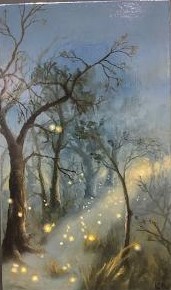
At Arthur Roger Gallery, the animals photographed by David Yarrow appear to awake from a long sleep. Walking by close-up shots of bear, gorilla, lion, confirms that gallery visits are indispensable to connect with the photographer's subjects. With more than a dozen mesmerizing new works, Troy Dugas's show offers another kind of adventure. More than a purely visual experience, his mandalas provide a meditative place to pause and reflect. When I look at Kris Wenschuh's compositions, I always wonder why the value of a painting is related to its size. The classically trained artist keeps producing small surrealist landscapes featuring icebergs, clouds, floating in blue skies, catching a certain light that evokes luminism. Twice Upon a Time, the title of the exhibition is perfectly fitting for a show which includes works from Leslie Staub known for her children's books illustrations.
July is supposed to be a slow month for the galleries... not this year!


photographs by the author:

Robert Tannen "Wood Burning Furnace with Logs", 2020
Kris Wenschuh "Trail of Light", 2020
Bradley Sabin "Coral Flower Wall Installation", 2020


Tuesday, March 31, 2020

Premonitory?


 As the New Orleans Museum of Art was making preparations for Art in Bloom, a yearly Spring event, Jonathan Ferrara Gallery opened Art in Doom: A Springtime Group Exhibition. The slightly derisory title became premonitory overnight in light of the COVID-19 pandemic. Shortly after my visit, the gallery had to close to the public. The works can now be viewed on its Website and through its busy social media. The exhibition curated by Matthew Weldon Showman features paintings, sculptures and ceramics from five artists.

Assembling more than thirty pieces in the front gallery, the display is easy to navigate through a virtual path created by sculptures on pedestals. Paintings filled with bouquets of flowers and joyous scenes of revelries provide a springy flavor to the show ... until doom seeps in, starting with Tiffany Calvert's works born from seventeenth-century Dutch floral still lifes. They are made of inkjet prints of masterpieces revamped through the combination of several processes described as "gridding, fragmentation, image reversal, painting over" resulting in "digital glitches and scrambled transmission". The final compositions provide a new aesthetic experience enriched by their references to art history going back to the glorious days of figurative painting, abstraction, photography , digital art and appropriation. Are the islands of black color obliterating the pictures an allusion to the death of painting?
At the entrance, one of the sculptures of Beth Carter illustrates her practice which also includes charcoal drawings. Broken Carnival, 2017, is an equestrian statue traditionally dedicated to rulers or warriors, this time, the naked rider appears powerless, slumped on his three headed, six legged draped ride, in disarray, fallen hero led by a fantastic creature. Rag Donkey, 2015, another work strategically placed in the gallery, is the hybrid sculpture of a man with the head of a donkey overtaken by a small crowned humanoid standing on his shoulders. The same message of strength and weakness, power and helplessness, is found in the remaining four bronze sculptures and underscores the new status of manhood depicted through  a dreamy world of fairy tales with uncertain endings.
The third woman artist, Nora See, tackles current socio-political subjects in her latest works. Her depiction of a blacked-out fetus or a man in full suit curled in a uterus is blunt and unsettling. Her redesigned map of the United States speaks for itself.
Peter Olson combines photography and ceramic in his highly decorated vessels. The circles of images produce a lively dance of historical and mythological characters intermingled with decorative bands, and include plenty of skulls and skeletons like in a memento mori. No ashes are found in the urns but more images emerge, like an overflow of life.
Last but not least is William Woodward, a guardian of academic painting who composes rich narrative tableaux. His skills in incorporating several stories in one painting are most likely born from his interest in murals: "Murals are works of art that decorate walls and tell a story." So are his three pieces about the seven deadly sins displayed in the gallery.

The title Art in Doom is eerily prescient and provides a thread to the exhibition assembling five artists of diverse backgrounds who through different media express a common angst at the state of humankind. Their works provide an occasion to pause and reflect but let's not delve too deep in gloomy thoughts. Celebrations, mourning, New Orleans knows how to do this in style... it's all about life.


photographs by the author:

Tiffany Calvert "#316", 2018
Beth Carter "Broken Carnival", 2017
view of the exhibition 

Sunday, January 8, 2017

Variations


"Abstract art... is a universal language, and dwells in the realm of music with equivalent emotion. Its melody is attuned to the receptive eye as music is to the ear." This quote attributed to the painter Abraham Walkowitz, defines the course taken by the abstract artist Anastasia Pelias. Following her collaboration with the Jazz musician Nicholas Payton, her latest compositions are inspired by her favorite female vocalists. For the exhibition "Sisters", fourteen of her paintings are filling the entire space at the Jonathan Ferrara Gallery, immersing the visitor into her new body of works.

There is a  feeling of drama when first surrounded by the large square paintings made of black drawings and drippings on a white background. Variations for each work are brought up by touches of vibrant colors. Meandering along the creases of the textured Arches paper, the drips, like a thin veil, give fluidity and lightness to the paintings while thick drawings made with oil sticks provide focal points, subjects and action. Some evoke silhouettes, like in "Laura" or "Nina", but the paintings stay abstract. Each projects a distinct aura generated by emotions triggered by the music. The titles, first name of the singers, allude to the closeness built over time while listening to our preferred musicians. "Sisters" suggests lasting, unbreakable bonds.

While most of the artist's past compositions have been about color, this time, she chooses achromatic black on white and grey, as a common language. In Pelias's Mediterranean culture, black is about death and mourning, but in her latest paintings, black becomes a tool for expression through drips or drawings, suggesting an East Asian influence. Pelias has mastered the technique of drip painting and like Jazz musicians improvise freely after years of practice, she allows herself to be spontaneous in her gesture, letting the emotions flow. A gallery visit is essential to view "Sisters". Size, texture, adventure of the drips, vigor of the lines, nuances of the colors, are missed when looking at the paintings on a screen. While the show can be overwhelming at first, one can choose to discover a singer at a time.
These works are a chapter in the artist's experimentation with automatism and music. They are not portraits, but translate raw emotions through abstract representation.
Where could Anastasia Pelias's voyage be more suitable than in New Orleans?


photographs courtesy of the Jonathan Ferrara Gallery


"Nina", 2016
"Stevie", 2016
"Chaka Khan", 2016