Showing posts with label Book review. Show all posts

Thursday, April 30, 2020

Time to Read


In Bad New Days: Art, Criticism, Emergency published in 2015, the art critic Hal Foster reflects on the past twenty five years of contemporary art. Pointing out that it is "too early to historicize this art", he attempts to "theorize it" in a collection of five essays.
I guess the title and the picture on the cover (an x-ray of Isa Genzken's head drinking wine from a glass) put me off and the book stayed at the bottom of the "to read pile" all these years. A few weeks  into this dystopic new world, I have finally plenty of time to read Bad New Days.
Following a brief introduction, the first chapter titled "Abject" brings us back in the eighties and nineties with a discussion about gaze versus look. References to Lacan, Sartre, the Renaissance, Expressionism, Freud, Duchamp, Manzoni, and more, pepper the rich text. To illustrate his point Foster analyses Cindy Sherman's work and adds a list of artists including Mike Kelly and Andres Serrano, inescapable names when talking about abject art. Is "abjection a space-time beyond redemption or is it the fastest route for contemporary saints to grace"?
In "Archival" Foster concentrates mainly on the practice of  Thomas Hirschhorn. He also refers to Tacita Dean, Joachim Koester and Sam Durant to describe how the artists "transform the no place of an archive into the place of a utopia", in short, a "sublimation of the traumatic".
"Mimetic" (mimetic exacerbation) highlights the wrong through art, mocking like Isa Genzken or using illusion like Robert Gober. Foster establishes a connection between mimetic art and Dadaism. Referring to Jeff Koons, he warns against the peril of celebrating "the capitalist garbage bucket".
The fourth essay in which Foster stresses the tension between left and right is titled "Precarious", a socio-political qualifier. He refers again to Hirschhorn's installations set in underserved areas and widens the subject to the precariousness of life, ending with more questions: "Where do I stand? What do I want?".
"Post-critical" the shorter text, without illustrations, is about  the critique, its flaws, what should be its future. The discussion relies heavily on the writings of two French philosophers Bruno Latour and Jacques Rancière.
"In Praise of Actuality" wraps it up in seventeen well made points about art museums, biennials,  performative art and this sentence sums up Foster's thoughts about the state of the art: "Just as the viewer must be deemed passive in order to be activated, so artwork and art museum alike must be deemed lifeless so that they can be reanimated." Following his gloomy outlook for art "fixed on a traumatic view of the past" he ends with some hope in a few words "it must also open into future work".

With its title coined from Berthold Brecht's aphorism: "Don't start with the good old days, but the bad new ones", discussions based on an array of philosophers, art critics, art works, and numerous references to art history, the dense writing adopts a scholarly tone emphasized by abundant notes and even a short history of its typeface. The book assembles texts previously published as separate articles and after its release was the subject of several reviews in magazines or newspapers like ARTnews, Frieze or The Guardian.
The reading empowers the viewer who can "categorize" art works sometimes difficult to approach with new paradigms offered by the author. It provides cues on how to look at and reflect on art born from historical traumatic events, generators of a state of emergency (the fall of the Berlin Wall, Tianmen Square, the AIDS epidemic, 9/11, failures of neoliberalism with its repercussions on social welfare, ...).
One cannot avoid wondering about the impact of the ongoing traumatic situation on art. What about art post-2020?

Tuesday, June 5, 2018

Read/Reread


The Painted Word  written by Tom Wolfe was published more than forty years ago. The author's recent passing reminds us to read or reread his books, in particular his essay about art, to look back at his legacy. What does the writer knows about art? A lot. He weaves, spins, tells its history in six dense chapters covering several decades starting in the twenties moving on to the seventies, from Europe to the United States.

Following a Aha! moment, Tom Wolfe ponders about the polarization between "literary art and l'art pour l'art" in Modern post-world war II. In one hundred pages, he reflects on the interaction between the different actors, from the artists caught  between a "Boho world" and celebrity, to us the public, mere observers, tourists in the art world led by a handful of movers and shakers, the elite made of  "collectors and other culturati". In post-war New York, the movers are named  Clement Greenberg, Harold Rosenberg who coined the term "action painting", for Abstract Expressionism, followed by Leo Steinberg for Pop art. The pace of the book accelerates as Wolfe goes through Minimalism ending up with the ultimate piece of art, a work without visual experience described in Arts Magazine in 1970. The key to the book is found in this sentence: "late twentieth-century Modern art was about to fulfill its destiny, which was: to become nothing less than Literature pure and simple."
Through his abbreviated history of Modern art, the author is developing his theory. None of the protagonists are missing and some stories veer to the gossip in this entertaining book featuring a cartoon to introduce each chapter. Without references or bibliography, it should not be approached like an academic piece of writing, but should be read as a thought provoking essay. It generated  some controversy to which Wolfe responded in this interview for the Paris Review:"But to say these people blindly follow Clement Greenberg's or Harold Rosenberg's theories, which is pretty much what The Painted Word is saying, and that a whole era was not visual at all but literary, now that got them.".

... a thought provoking book indeed, as relevant now as it was when published, back then.


photograph by the author:
Jackson Pollock "Composition (White, Black, Blue and Red on White)", 1948 
permanent collection New Orleans Museum of Art


Monday, February 19, 2018

How to See


Seeing Slowly: Looking at Modern Art (2017), a book written by Michael Findlay, offers refreshing ways of looking at art and more importantly of "seeing" art. If you feel worn out, jaded, after walking through an art museum (it can happen), this book is for you. In seven chapters, the author provides a list of do's and don'ts to rekindle your enthusiasm. Going back to why we are looking at art in the first place, the seasoned art dealer addresses "pros" and "beginners", sharing his very personal thoughts and experience.
Following a brief introduction to present the book's objectives, the author describes the viewers' relationship to art in a chapter that is mainly a summary of his previous publication, The Value of Art: Money, Power, Beauty (2012). He next spends some time defining what makes a work of art and by the fourth chapter gets to the core of the subject: our approach to visual art and in particular "The Difference Between Looking and Seeing". Questions outlined in bold fonts like "Can Art Be Heard?", "Can Art Be Read?", "Can Art Be in a Hurry?", initiate responses from the author who supports his arguments with examples gathered through his personal experience and his vast knowledge of the art world. Quickly, it becomes obvious that he is passionate about banning labels, wall texts, audio recordings, cameras, phones, and any means that interfere in the relationship between the viewer and the piece of art including talking with a friend.
The longest chapters, five and six, are filled with advice on how to approach the visit and "see" the work of art, sometimes through provocative statements like "Ignorance Is Knowledge". Findlay at some point imagines a dialogue between himself and you (the viewer) in front of the well-known Broadway Boogie Woogie, 1942-1943, from Piet Mondrian, avoiding technical terms in the purposely casual conversation. Carrying on this vein, he demystifies the art world with his new definition of the connoisseur of art: "In today's world, a connoisseur of art is not someone who claims to know what is real and what is fake, what is good and what is bad, or what is going up or down in value. Today a connoisseur is someone like you with the curiosity and energy to seek out works of art." In simple terms, Findlay establishes criteria for quality in a piece of art, reveals his dislike of the cynical money component, shares his experience with students, provides advice on how to approach art with children, and more, in a book which includes great quotes, abundant illustrations, and a list of references.
The author is present throughout his writings, especially in the last chapter in which he recounts his journey from amateur to expert art dealer, starting in his childhood.
His advice are well taken, keeping in mind that seeing art remains a very personal experience.


Michael Findlay (2017) Seeing Slowly: Looking at Modern Art, Prestel

photographs by the author 

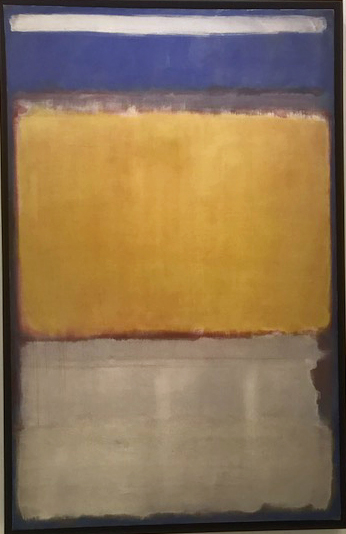
Mark Rothko "No 10", 1950, at Fondation Louis Vuitton exposition "Etre Moderne: le MoMA a Paris"
Wassily Kandinsky "Auf Spitzen", 1928, at Centre Georges Pompidou


Monday, July 31, 2017

Intimate Donald Judd


Donald Judd Writings, published in 2016, is a collection of short essays, notes and critiques written by the artist who is better known for his minimalist sculptures, designer furniture and his move to Marfa,Texas. What is striking about the book is not only its bright orange color but its thickness.
Spanning thirty five years from 1958 until 1993, the entries follow a chronological order like a diary. The earlier writings are more focused on art criticism, Judd's livelihood at the time. It is refreshing to read candid, occasionally scathing reviews, some previously unpublished. His statements like "Picasso who produced junk for forty years, and not much before" or "The brushwork in the paintings by Baselitz is thoughtless, passionless, flaccid, and is a parody of Expressionism." are short and final. ( I could not agree more with the latter!) The chapters dedicated to artists like Kasimir Malevich, Lee Bontecou, John Chamberlain among others, reflect his appreciation of their work. Both Wassily Kandinsky and Pier Mondrian appear to have had a profound influence on Judd who refers to them repeatedly.
It is not until his late fifties (mid-way into the book) that Judd becomes more personal and writes about his projects, Marfa, the Foundation Chinati, and shares intimate thoughts about his career and goals, showing some concerns about his legacy including his writings: "I am writing for the record ... I am also writing for the sake of my work." Shorter notes, like in a journal, appear to be written "on the go". Judd tackles politics, religion, architecture, art, philosophy, ..., keeps castigating art critics, collectors, curators, and expresses his mistrust of the art world in general. His overall pessimistic and disillusioned outlook can be summed up with this statement: "We are starting a new era while suffering increasing mediocrity, a time in which even the ideas of quality and knowledge are disappearing."
The dense text with little interruption can become monotonous, but the content keeps the reader's interest going. A compilation of images are relegated to the end and include photographs of Judd's and his colleagues' works, buildings in Marfa, and samples of Judd's original hand writings. Unfortunately, the small format weakens their impact.
Preserving his father's legacy, Flavin Judd oversaw the book's publication and also wrote the book's introduction.
Getting acquainted with Judd through his most intimate thoughts.


Photographs Wikimedia

Untitled box-like art "Judd's cubes", Chinati Foundation, Marfa, TX
"Untitled (DJ 85-51)", 1985, Tate Modern

Thursday, April 6, 2017

In Search of Beauty and Happiness


A random encounter with a work from Agnes Martin at the occasion of a gallery or museum visit can be a lost opportunity. Time and background knowledge about the artist and her body of work are essential to appreciate the austere compositions. In the spirit, my latest reading is Agnes Martin, a book published at the occasion of the retrospective exhibition of her work at the Tate Modern in 2015. It includes abundant photographs, excerpts from the artist's writings and thirteen essays scattered throughout the monograph edited by the co-curators Frances Morris and Tiffany Bell.

Following the introduction which defines the breadth of the exhibition, assembling works from the early to the late period of Agnes Martin's career, a biography also written by Tiffany Bell provides a concurrent history of  the artist's life and of the evolution of her art, on a background of poverty and mental illness. Frances Morris  introduces the artist's work in light of the abstract expressionist movement and of her interaction with her peers. Christina Bryan Rosenberger who wrote "Drawing the Line", a book concentrating on the early works from Martin, contributes a short piece about Islands No.4, 1961, while historian and art critic Richard Tobin explores the whole series. Rachel Barker, Tate's Paintings Conservator, presents a detailed technical analysis of Morning, 1965 and Marion Ackermann comments on Untitled #5, 1998. In her essay "In Pursuit of the Neutral: Agnes Martin's Shimmering Line", Anna Lovatt discusses the contribution of Agnes Martin to the Graphic Art and Briony Fer, her use of geometric shapes in "Who's Afraid of Triangles?". The slow discovery of Martin's works in Europe is described by Maria Mȕller-Schareck, starting with a first painting shown in Zurick in 1960. A collection of portraits selected by Lena Fritsch accompanied by informative comments, sheds some light on the artist's personal life. It includes photographs by  Diane Arbus, Annie Leibovitz and Hans Namuth. Agnes Martin's spiritual influences are approached by Jacquelynn Baas, author of Smile of the Buddha and the German artist Rosemarie Trockel contributes a short poem.
Agnes Martin's writings provide a glimpse into her inner life and the sources of her inspiration. Selected excerpts enrich the reproductions of her works. For example, On a Clear Day, 1973, a Portfolio of 30 screenprints, is introduced by a short quote:
"Art work that is completely abstract - free from any expression of the environment is like music and can be responded to in the same way. Our response to line and tone and color is the same as our response to sounds. And like music abstract art is thematic. It holds meaning for us that is beyond expression in words."... Agnes Martin, (October 15, 1975)
She also expresses her thoughts about art in the essay "Beauty is the Mystery of Life", 1989.
More quotes are found in the book:
"When you find out what you like, you're really finding about yourself... people who look at my painting say that it makes them feel happy like the feeling when you wake up in the morning - And happiness is the goal isn't it?"
" My paintings have neither objects, nor space, nor time, nor anything - no forms"
And to conclude, on the back of the book's jacket: "Beauty is the mystery of life. It is not in the eye, it is in my mind."
Through the essays from scholars, the book offers different perspectives on Agnes Martin's sometimes esoteric work. Ultimately, the artist herself provides the key to her legacy, result of a lifelong search for beauty and happiness.


illustrations: photographs from Tate's website copyright Estate of Agnes Martin 

"Morning", 1965
"Happy Holiday", 1999
"Untitled", 1965

Friday, September 30, 2016

The Story of Monochrome


Monochromes: From Malevich to the Present, by Barbara Rose is a reflection on the history of single-color works of art through essays by the author and three additional contributors, Gladys Fabre, Christopher Ho and Vincenzo Trione. More than one hundred and sixty photographs of artists' works illustrate the paperback, arranged by colors starting with black followed by red, blue, gold, silver, ending with white.
A short introduction goes back to the birth of monochromes, centuries ago in the Far East and includes a chronology of significant events, publications or works related to the subject, from 1810 to 2004. Rose's essay organized in nine short chapters is enlightening due to her wide knowledge. Following the four essays, selected writings from twenty six artists are  organized under six themes and feature texts from Kazimir Malevich to Carl Andre, Lucio Fontana, Arman, Yves Klein,
Ad Reinhardt, Donald Judd, Anish Kapoor among others. Furthermore, its stylish blue cover inscribed with gold letters and its lavish illustrations make Monochromes a great book from content to design.
Note for the New Orleanian art lovers: a painting belonging to the New Orleans Museum of Art's permanent collection, Effect of Snow at Giverny, 1893, from Claude Monet is part of the discussion, as a landmark in the history of monochrome. Chakaia Booker ( also found in the New Orleans Museum of Art's permanent collection) is represented by one of her sculptures.
Challenging at times, the reading of the book provides a review of the full scope of the monochrome, highlighting its timelessness and universality.


photographs by the author:

John Isiah Walton "Almost Clean", 2016

Julio LeParc "Movil Bleu", 1967

Lucio Fontana "Neon Structure", 1951, for the IX Triennial in Milan

Friday, January 29, 2016

Seriality to Infinity


The Infinite Line written by Briony Fer and published in 2004 is a book dedicated to a fertile period in visual art, the transition from Modernism to Postmodernism during the late 1950's until 1970. In eleven chapters, she offers enlightening discussions about seriality in art, including paintings, sculptures, installations, photographs, movies, through her vast knowledge of artists and their works.
With a dedicated topic for each chapter, Fir presentation stays focused on one subject, "the power and meaning of repetition". Starting with "Picture", moving on to "Series" and "Infinity", the progression smoothly leads to "List", "Mobility", reaching "Utopia" in the last chapter. Through her presentation of artists and their works, she makes the point and her expertise confers a scholarly quality to her discussions. She features numerous female artists like Eva Hesse, Agnes Martin, Yayoi Kusama or Louise Bourgeois and refers abundantly to the Arte Povera movement and its members. Sometimes arduous to read due to the abundance of referenced material, at the same time engrossing because of it, shedding light on Minimalism and its higher mission, the book is also filled with illustrations appropriately spread along the text.
The abrupt ending leaves the future opened to the use of repetition, ultimate mean of capturing infinity, a non-existent entity, and the addition of new chapters written about artists engaged in expressing the invisible.

photographs Wikimedia:
Untitled, Eva Hesse, 1967


Saturday, February 21, 2015

From Duchamp to Duchampian


At first look, Duchamp, A Biography, written by Calvin Tomkins is intimidating with its five hundred plus pages of dense text and black cover illustrated by Poster after Self-Portrait in Profile, 1959, from Marcel Duchamp. First published in 1996, twenty five years after the artist's death, the revised edition was printed under the auspices of the Museum of Modern Art.
A detailed description of  a major work from Duchamp, The Bride Stripped Bare by Her Bachelors, Even (The Large Glass), 1915-1923, is followed by a chronological history of the artist's life in thirty chapters, each preceded by a quote from Duchamp or one of his close friends under the title.
The maturation of the complex character unfolds through the description of his life stories, on a background of wars and a fast changing art world. In his biography, Tomkins  not only provides solid facts, but also in-depth analysis of Duchamp's writings, interactions, interests and works. The illustrations accompanying the text include all the major pieces, family photographs and portraits of the artist and his friends.
Tomkins's easy style of writing makes the reading riveting with its succession of great stories. The material for the book was gathered during a thirty years period of research, and several hours of recorded conversations between the author and the artist in 1959 making it not only a biography but an insider's history of art. To quote Tomkins, the interview with Duchamp led to his "first interest in modern art". Following his personal interaction with the artist, Tomkins helps us evaluate the breath of his legacy.
As a testimony of his influence on the art world, Duchamp, who stated that "life is more important than art",
was posthumously awarded an adjective in the dictionnary, Duchampian.


photographs public domain
Marcel Duchamp, Library of Congress
"Rose Sélavy", 1921, Man Ray

Wednesday, December 18, 2013

"what art is"


Will Arthur C. Danto give us the answer to the haunting question, "What is art?" or "Is it art?" ?

In his latest publication,  the philosopher and art critic introduces the subject with a condensed review of art history and basic philosophy in a  chapter which makes up half of the book. It could be considered a collection of essays: "Restoration and Meaning", "The Body in Philosophy and Art" are followed by a discussion of the crisis brought forth by the birth of photography and the ensuing shift in ideas about art.  Danto's mastery is fully displayed in the chapter about the philosophy of Kant as related to the work of art. I personally like Kant's idea of the "creative power of the artist" bringing "spirit" as a criteria to define a work of art.
 The future of Aesthetics, another branch of philosophy,  its politicization and subsequent marginalization is discussed as well as its importance in the the world of art.
From the start to the end, Danto refers to Marcel Duchamp and Andy Warhol, two artists whose works, respectively the "Fountain" and the "Brillo Box" have revolutionized the art world.
Danto in this book offers a concentrate of philosophy of art across centuries and cultures and when the reading is over, stimulates more thoughts and reflections about art.


"what art is", Arthur C. Danto, Yale University Press, 2013

photographs:
"Refugee", Susan Collis, 2007 (by the author)
"My Bed", Tracy Emin, 1998 (Flickr photo sharing)

Monday, September 30, 2013

Looking at Art


Art is about the intend of the artist, the result itself, the viewer and his/her interpretation of the work. The latter being heavily influenced by individual background, a knowledge of art history helps to understand the impact of a work of art and appreciate it ("like" it or not).
What Are You Looking At written by Will Gompertz caught my attention with its catchy subtitle "the surprising, shocking, and sometimes strange story of 150 years of modern art".
The author's statement in the preface makes it clear to the reader, the dialogues between artists are pure fiction and he does not provide his references. The book offers an easy chronological navigation in the world of modern art with a goal of helping the reader interpret artworks in their context.
Movements are well-defined, each the subject of a chapter, sometimes overlapping like Neoplasticism 1917-31, Bauhaus 1919-1933 and Dadaism 1916-1923.
The concepts presented in an informal language, which never becomes colloquial, are easy to grasp and mundane stories are told to cement the big history.
The duo Picasso-Braque, Malevich's fistfight with Tatlin, Duchamp buying THE "fountain"... The author is a great story-teller and transforms a possibly dry and boring subject into a pleasant reading, provoking aha moments along the way, when the relationships between movements, artists, works of art make sense.
The text is illustrated with relevant black and white figures and a section of color photographs. With an obvious deep knowledge, Gompertz manages to present his subject in a clear, entertaining manner.
At the end, he introduces us to the future with question marks. What is next, who?


photographs
"Olympia" 1863, Edouard Manet, Wikimedia
"Woman I", 1950-52, Wilhem de Kooning by the author
"My Bed", 1998, Tracy Emin, Flickr photo sharing

Wednesday, July 10, 2013

Turrell at the Bookstore


The colorful book, James Turrell: a Retrospective, published at the occasion of three exhibitions taking place conjointly at the LACMA, the Guggenheim, NYC and the Museum of Fine Arts, Houston, will overshadow the display at the gift shops this Summer with its pink, mauve to violet jacket, the artist's name spelled in red on the background.
Three hundred pages long, composed of ten chapters, the coffee table look-alike book is filled with breathtaking photographs and includes a biography, an interview with James Turrell and essays written by Michael Govan , CEO and director of LACMA, Christine Y. Kim, associate curator at the LACMA and two contributors, Alison de Lima Greene, curator at the Houston Museum of Fine Arts and E.C. Krupp, astronomer, director of the Griffith Observatory in Los Angeles.
Each chapter is printed on a different colored paper, turquoise, mustard, dark blue, violet, red... Under the chapter's title, a statement from the artist introduces the text followed by abundant photographs to illustrate the subject. We discover skylight spaces, ganzfeld effect, the architecture of space and follow the artist's path through his projects like Roden Crater in Arizona or others in far away places like Japan, Australia, Argentina...
Alison de Lima Green reminds us of Turrell's background: California in the sixties, Minimalism, the Light and Space movement and relates his interaction with numerous artists including Robert Smithson, Dan Flavin, Malevich with a special mention for Robert Irwin and Doug Wheeler, otherwise, the book is exclusively dedicated to Turrell and his work for the past fifty years. The contribution of technology to "see the light", emphasized in the last chapter brings us back to the introduction titled "Inner light, the radical reality of James Turrell" which resumes the quest of the artist.
A book filled with colors, but a visit to the museum is required to look for the light.


photographs Flickr Photo Sharing

"Gand", 1968
"Air Apparent", ASU Campus, Tempe, AZ

Wednesday, July 3, 2013

beach book


Provenance written by the investigative reporters Laney Salisbury and Aly Sujo received excellent reviews when published in 2009. The plot set in the world of gallery owners, dealers, art runners, collectors, artists, art dealers, detectives, archivists, including a Roman Catholic religious order, is dominated by the complex lead character, John Drewe "professor, physicist, man of many guises, and the brilliant mastermind of one of the greatest art frauds of the twentieth century". The non fiction story is well researched and describes the (almost) flawless scam unfolding in the three hundred pages book. From New York to Paris to London, like in a great thriller, the suspense keeps the reader engrossed, unable to put the book down till  the last word. There is also unfortunately a body.
The process of authentication of works of art is described in details and the lesson to be learned is that even provenance can be forged.


photographs Flickr Photo Sharing

"Portrait of a Woman", Elmyr de Hory in the style of Amedeo Modigliani
"Fauve Landscape", Elmyr de Hory in the style of Maurice de Vlaminck, ca. 1968

Tuesday, June 11, 2013

Colored Sketches


No need to introduce the author of Book of Sketches,(1952-1957), Jack Kerouac, who became famous after the publication of his novel On the Road in 1957.
Following the suggestion of his friend the architect Ed White, Kerouac started "sketching" with words in a pocket notebook he carried at all occasions. The published version is a small thick book filled with raw material, words building a succession of short compositions, vivid descriptions of landscapes and people. Pale pink pastel, red-pink, white, blue, cerulean blue, grey, every object from daily life is described in detail using a palette of words.

Wandering across Kansas, Colorado, Wyoming, Nebraska,... the writer is painting a succession of vignettes, like travelling in a car or a train looking through the window and catching a glimpse of deserts, mountains, "pale gold grass", "green sage", "plowed brown field", "snow in the mountain", "rose clouds",.. background, foreground, subject. The result is a poetic prose and one could take pen and brushes to draw the landmarks.
The rhythm of the words becomes furious at times or slows down like incantations.

The notes include also more private thoughts philosophical, religious or plain emotions related to the death of his brother. The statements in a few words are blunt at times and Kerouac describes the process of  sketching as "...purify your mind and let it pour the words and write with 100% honesty". It is a diary of sort and no illustrations are included. Kerouac also discusses more mundane subjects like women roles, debt and credit, protection plans and the slavery of belonging to a system. He introduces a genuine view of the hobos' world and singles out a group of  "fellaheens... a world generalization for peasants... unchanged by history or fashion" and assimilates Gauguin and Rembrandt to this group. His remarks on art are short "surrealism is a wild scatological paint blur".
His most compelling pieces are his small landscapes, "orange flame ball, green lettuce fields, brown dirt milky haze"
Kerouac, the icon of the beat generation likes short, provocative statements "people need no religion , no art, no war".

The introduction by George Condo, written in 2005 gives a new status to the small notebook by referring to Charlie Parker, Jackson Pollock, Edward Hopper, Picasso...with the last sentence "Only Jack and Vincent van Gogh told the inner truth".


"The Starry Night", Vincent Van Gogh, 1889, The Museum of Modern Art
"Lavender Mist- number 1", Jackson Pollock, 1950, National Gallery of Art
"Railroad Sunset", Edward Hopper, 1929, Whitney Museum of American Art

Monday, April 8, 2013

Sound Art


Background Noise, Perspectives on Sound Art from Brandon LaBelle published in 2006 is a path down memory lane going back to the early fifties till the new century. It also brings us on a world wide tour in approximately three hundred pages dedicated to the development of sound art. At first, the reading appears daunting, with a dense text, numerous notes and references at the end of each chapter and a few black and white photographs.

After a brief introduction to clarify the difference between sound and music, listening and hearing, the author proceeds to give a mostly chronological analysis of sound art in eighteen chapters grouped into six parts. Starting with a presentation of  John Cage's work and its impact on sound art, the author describes the evolution of sound as it becomes a tool for artists. The inclusion of sound in happenings,  Fluxus, new technologies, conceptual art, Minimalism (sculptures or sound activate the space), all promote the development of sound art. Furthermore, sound in defining the space becomes an architectural element, a material to shape for acoustic design now considered in urban development. Reaching beyond the subject of sound art, the author discusses the social and ecological impact of sound, its repercussions on the health of a community, promoting harmony within ourselves and the universe, initiating poetry and dreams.

All along, carefully selected works are discussed to illustrate the ideas developed in the different chapters and numerous artists are referred to. The dense text can be overwhelming and the author includes summaries, usually at the first person, to make the point. These are very helpful before starting another chapter.
A book to read from cover to cover once and then to keep close by as a tool for further reference.


photographs Flickr sharing: http://www.flickr.com/

"Mucilaginous Omniverse" Dimitri Gelfand and Evelina Domnitch, 2011 (standing wave that forms out of oil droplets above a water surface being radiated with sound)

"Piano Preparado" John Cage, photograph taken in 2006

"5 Horizons" Ryoichi Kurokawa, 2010, Digital Music s and Sound Art in Concert

Friday, February 8, 2013

The Business of Art

Published in 2008, the book written by Don Thompson "The $12 Million Stuffed Shark: the Curious Economics of Contemporary Art" is still very relevant and if the 12 million stuffed shark is already old news, the economics of contemporary art is more than ever a fascinating subject.

The author, avoiding technicalities clearly defines the actors, their roles and interactions: galleries, dealers, collectors, auction houses, museums, artists, a world where economics appear to have a different set of rules. The numerous stories or anecdotes, official versions of well-known rumors make the book very entertaining. The postscript is clear: it should not be used as an academic reference.

But here is a cold fact exposed in the book: art is also about money, big money. The numbers keep growing and the zeros multiplying.
Speculation? Business? The analysis of the economically driven art world is skewed by fashion, egos, cunning and ...art. The author avoids cynicism when describing with virtuosity questionable transactions where at the end everybody should make money.
A major point made in the book is about the growing slice of the market taken over by the auction houses and the increasing difficulty for galleries and dealers to compete with them. Economics in contemporary art are changing.

This book is essential to understand the business of art... which goes beyond business.


photograph Flickr

Saturday, November 3, 2012

Geometry + Unconscious= Abstract

The book published at the occasion of the exhibition titled "The Geometric Unconscious: A Century of Abstraction" at the Sheldon Museum of Art in Lincoln, Nebraska, offers interesting insights on abstract art with four essays and numerous illustrations.
A detailed overview written by Jorge Daniel Veneciano, director at the Sheldon Museum of Art, is followed by the first essay from Sharon Kennedy, curator at the Sheldon. From the early 1900's in Europe to the United States, East and then West Coast, her presentation gives a historical perspective of the  century old movement. The long list of references invites further reading.
This is followed by Peter Halley's essay: "The Crisis in Geometry", a discussion about a fundamental question, why geometry in our culture? Referring to two texts (from Michel Foucault then Jean Baudrillard), the artist discusses geometric abstract and its sociology: started in a carceral industrial world, evolving in a world of computers and reaching the ultimate, finality without purpose. The argument is solidly built with numerous references and appropriate illustrations from known and not so well known artists.
Next, Jeremy Gilbert-Rolfe presents himself, a painter. His discussion is less disciplined and the dense text lost me at times. He introduces four artists, three of them females. 

The last essay is a masterpiece written by Veneciano. It brings abstract art to its next level, the search for the spiritual and the universal.
Starting in the 60's with Ad Reinhardt, back and forth to Malevich, Kandinsky, Stella, Mondrian, the author explores the higher goals of geometric abstract and its search for purity. It is not an exercise but an ascese, which finds its roots in the occult. Joseph Steiner still influences artists like Olafur Eliasson or Tony Cragg . Veneciano brings us from the birth of geometric abstract, Cubism, to its shift from a spiritual to an intellectual quest as the movement travels West in the United States. His overall message is: "All modern abstract art functions as a catalyst for transcendent experience."

Abstract art may appear hermetic, because it is. It will help the reader to have some previous exposure to abstract to fully appreciate this book. At the end, one better understands the two pillars of abstract: geometry and unconscious.


"Untitled", Eugene Martin, 1995
"Kagu", Frank Stella, 1976
"Homage To The Square", Joseph Albers, 1965
"Throwback, Tony Smith, 1976-79

Sunday, September 30, 2012

Rothko's Thoughts by Rothko

The book written by the painter Mark Rothko in 1940-41 (maybe started as early as 1936) and published by his son Christopher in 2004 "The Artist's Reality, Philosophies of Art" is short but dense. Written by the artist to define his thoughts about art in general, art history, artists, philosophy, sociology of art, he also discusses the foundations of Beauty and Myth. Ultimately, Rothko appears haunted by the question formulated in his introduction to the chapter titled Art as a Natural Biological Function: "Why paint at all?".

The painter stays mute about his own path or works and the reader will find only a few references to abstract.
The book is a catalyst for Rothko's search and ends abruptly without a conclusion... Rothko kept painting.


photographs by the author:
"Untitled" (The Subway), 1937, Mark Rothko
"Untitled", 1949, Mark Rothko

Tuesday, August 7, 2012

YBA...not so Y

The late 1980's saw the birth of the Young British Artists movement which fired up the art scene in Britain and spread globally. A quarter of a century later, it is time to reread the book from Julian Stallabrass written in 1999: "High art lite. The rise and fall of young British art".

In ten chapters, approximately 300 pages, the author describes the cultural, economic, political landscape that allowed the thriving of artists described as preoccupied by money and a cult of personality. The book presents a negative critic of their works, intellectually flawed but accessible to the masses. The world of the collectors is represented by Saatchi whose name is closely associated to the rise of  the YBAs, manipulating prices, making and undoing artists .... In the process, the author goes in great depth to describe the history of the movement also called: "The New Neurotic Realists". The list of artists is long, some are now very famous, others forgotten. 
Whatever happened, a generation of artists put Britain on the world map and names like Damien Hirst, Antony Gormley, Tracey Emin keep making the headlines.

A must read book, sometimes lengthy, controversial because of its negativity. 


photographs Flickr
"My Bed" Tracey Emin
"Fluoroidobenzene" Damien Hirst

Tuesday, June 26, 2012

Money, Power, Beauty


In his book "The Value of Art", Michael Findley (Prestel, 2012) tackles the big question: What makes the value of a piece of art?
Using an allegory, the Three Graces, Thalia, Euphrosyne and Gayea represent  the commercial, social and aesthetic value of art. 

In the first chapter, Findlay defines basic terms like primary and secondary market, discusses factors influencing the price of a piece of art: size, media, supply, demand and the role of galleries, auction houses, artists and art fairs.
What makes a specific work of art valuable? provenance, condition, authenticity, exposure and quality.
Who are the makers and shakers? corporate art, banks, art investment funds. Are indexes, trend analysis useful? The appraisal of art varies from gallery to fair market value, auction estimate and even insurance value.
His conclusion: "buying art is an art, not a business."

In the next chapter, referring to Euphrosyne, the goddess of joy, the author describes the value of art as a social tool. The aesthetic side is last, with Aglaea and should be the most important according to the author.

A whole chapter is a historical reminder of the value of art and a projection into the years to come.

The numerous anecdotes collected during decades of dealing with artists, collectors, galleries illustrate the points made by the author who shares his experience in this entertaining book.
Beyond this, the afterword is enlightening: "The essential value of art ... is best absorbed privately and personally."  

photographs
"The Three Graces", Antonio Canova (19th Century) Hermitage Museum
"Abstract Painting 780-1" Gerhard Richter, 1992 (photograph by the author)
"Fontaine" Marcel Duchamp, 1917, Creative Commons

Monday, May 21, 2012

Ugliness


The cover of the book dedicated to the study of ugliness, with an anthology of texts, illustrations and comments by the author, Umberto Eco: " On Ugliness" forebodes the 400 plus pages dedicated to the subject.
Excerpts from ancient texts or Ian Fleming's " Live and Let Die", paintings from Mathias Grunewald or Otto Dix, the concept of ugliness is analyzed, dissected in fifteen chapters, covering the Classical World until today.

Call it morbid, disgusting, horrible, perverse, sickening, gruesome... there are not enough adjectives to qualify the horrors depicted by visuals and texts. The comments by Eco help interpret the significance of these. The author, a scholar with an encyclopedic knowledge gives an aesthetic, historical, scientific and philosophical outlook on ugliness and after digesting this book, the reader will have a grasp on the subject.
It appears that ugliness has a wider range of representation than beauty.
I just visited the Ogden Museum of Southern Art in New Orleans, and found two paintings which could be added to the illustrations.

"History of Beauty" is another book from Umberto Eco.

photographs by the author
"Judgment Day", John McCrady, 1938, permanent collection Ogden Museum of Southern Art
"Two Ladies", Benny Andrews, 1962, permanent collection Ogden Musem of Southern Art