Showing posts with label Regina Scully. Show all posts

Saturday, July 18, 2020

Alive and Well


 After a three-month hiatus, galleries in the Arts District are reopening and the traditional First Saturday Art Walk has become a day-long event to accommodate the rules of distancing with a predictable outcome: more time to contemplate, less time to socialize.
My first visit was at Octavia Art Gallery where four artists are featured for the exhibition Conceptual Creations: Collage and Assemblage. The bold red color from the objects on display in the window was an irresistible invitation to walk-in. Why Red from Robert Tannen, a gathering of his latest works, is by itself a show within the exhibition. Microwave, laptop, typewriter, rotary telephone, ..., all candidates for the dumpster, are instead preserved for eternity, embalmed in a bright red monochrome spray paint. Red for love here is for danger, emergency, an alarm about pollution, global warming and the threats they represent to the planet. Recycling is part of the solution, cloth hangers become wall sculptures or get a second life as supports for calligraphic meditative drawings. Also reflecting a Far Eastern influence, Regina Scully's compositions acquire a third dimension with  unknown pieces of objects embedded in her poetical landscapes. The Three Fates, 2020, a sculptural narrative scene, reconnects with a variety of media the artist explored in the past.
Assemblage and collage for Scott Andresen result in dreamy abstract pieces, so perfect they make us forget the industrious processes they underwent, including delicate mending with gold and silver leaf, a technique borrowed from Kintsugi the Japanese art of repairing ceramics applied to sandpaper, Andresen's medium of choice. James Henderson's works are a reflection about passing time with his selection of old photographs and pictures from vintage magazines. The mixed media layering builds a thick texture alluding at the accumulation of memories over the years.
Further on Julia Street, the visit at Callan Contemporary felt like stepping in an enchanted world. The monochrome installations from the ceramic artist Bradley Sabin recreate the magic of nature with swirls of flowers invading the gallery. The lively display keeps changing as the visitor walks back and forth, each unique flower anonymous among the flock.
Art in Doom which opened in March at Jonathan Ferrara Gallery was reviewed in "Premonitory", a post published earlier.
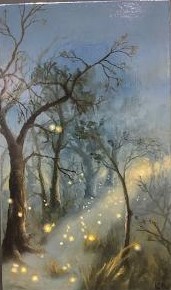
At Arthur Roger Gallery, the animals photographed by David Yarrow appear to awake from a long sleep. Walking by close-up shots of bear, gorilla, lion, confirms that gallery visits are indispensable to connect with the photographer's subjects. With more than a dozen mesmerizing new works, Troy Dugas's show offers another kind of adventure. More than a purely visual experience, his mandalas provide a meditative place to pause and reflect. When I look at Kris Wenschuh's compositions, I always wonder why the value of a painting is related to its size. The classically trained artist keeps producing small surrealist landscapes featuring icebergs, clouds, floating in blue skies, catching a certain light that evokes luminism. Twice Upon a Time, the title of the exhibition is perfectly fitting for a show which includes works from Leslie Staub known for her children's books illustrations.
July is supposed to be a slow month for the galleries... not this year!


photographs by the author:

Robert Tannen "Wood Burning Furnace with Logs", 2020
Kris Wenschuh "Trail of Light", 2020
Bradley Sabin "Coral Flower Wall Installation", 2020





Sunday, April 23, 2017

Escape at the New Orleans Museum of Art


Japonism is the term used to describe Japanese influence on European art. It flourished in the mid-nineteenth century due to a renewed trade between Japan and the continent following the seclusion era. Artists like Claude Monet with his famous painting The Water Lily-Pond, 1899Edgar Degas, Vincent van Gogh who collected Japanese prints with his brother Theo, and other Impressionist painters , were inspired by Japanese art.
The New Orleans Museum of Art just opened an exhibition: Regina Scully | Japanese Painting: Inner Journeys featuring works of the local artist presented along selected pieces of the museum's Japanese collection.
At the entrance of the dimly lit Japanese gallery, a red monochrome painting from Regina Scully, The Origins of Dreams, 2017, draws the attention under the title of the show. A wall text introduces the exhibition's brainchild along Mindscape 4, 2017, one of the artist's latest work. The display features Scully's contemporary paintings embedded among Japanese landscapes from the 17th to the 19th century. Scully's "intuitive connection with Asian art" started early in her career as seen in Providence Sketches, 1995, oils on chipboard. Upon reaching the main gallery the visitor is met by a line up of bright paintings, monochromes like Passage, 2012 and Excavation 11, 2009, or with a dominant background color for Mindscape 2 and 3, 2017, blue, orange, yellow, according to emotions and moods. From afar, they share a calligraphic abstract language, spread throughout the canvas without a focal point, allowing the eye to wander. The display which does not follow a chronological order includes Delos, 2012 and Channels, 2013, then three black and brown monochrome paintings from the Navigation series, 2009. According to Rotondo-McCord, curator of the exhibition, these inspired the project due to the analogies found between Scully's techniques, use of perspectives, space, colors, and Japanese art. Across, three paintings are in striking contrast with their vivid colors. From the Mindscape series, they were composed following Scully's exposure to hundreds of works from the Japanese collection. With the same graphic qualities than earlier paintings, they integrate new techniques like paint applied directly on the canvas with the fingertips and experiment with horizontal formats influenced by handscrolls. Near the exit, Cosmographia, 2015, a multicolored composition on a white background which could be qualified as semi-abstract, belongs to the museum's permanent collection. 

A disclaimer in the introductory wall text makes it clear: the exhibition is not about comparing Scully's paintings and Japanese landscapes. Van Gogh's direct inspiration from Japanese prints, especially Hiroshige's, was the subject of a didactic exhibition at the Pinacotheque in Paris in 2013. Each of his paintings was matched with a Japanese scene. Here, Scully's paintings are displayed in the gallery to present the contemporary artist's work in light of traditional Eastern art, allowing the visitor to wander back and forth, following the path of a quiet Japanese garden to the top of a mountain or meandering in one of Scully's busy compositions. She characterizes the different scenes as "puzzles" put together to create a journey which becomes a personal adventure for each viewer. Of course, one cannot avoid comparing the works. Scully's medium, acrylic on canvas or board, brings a different texture sometimes difficult to appreciate behind the glass. Her compositions which appear abstract at first veer to figurative when looked at closer as opposed to the idealized figurative Japanese scenery turning into abstract, but the tension between abstract and figurative is more palpable in Scully's works. Japanese landscapes are restful, quiet, serene and Scully's "scapes" are restless, chaotic, reflecting a different world. The subdued fragile colors of Japanese paintings are replaced by yellows, oranges, reds, greens,..., becoming brighter in her Mindscapes series. Moving on from her monochrome series, she now favors multicolored compositions. Just a reminder, monochrome was born from calligraphy in the East, centuries ago as described in the introduction of the book Monochromes: from Malevich to the Present written by Barbara Rose. If  human subjects appear secondary in the Japanese scenes, Scully's are filled with life, telling myriads of stories. Both are about our relationship with nature.
The exhibition generates an ongoing conversation.  


photographs by the author:

Mindscape 5, 2017
Mindscape 3, 2017 (detail)
Mindscape 2, 2017