Showing posts with label Hirshhorn Museum. Show all posts

Sunday, December 1, 2024

Next to the gift shop at Hirshhorn


What do Banksy and Basquiat have in common? Both their names start with a B, both are graffiti artists and both are famous with works reaching sky high prices. An exhibition at the Hirshhorn simply titled Basquiat X Banksy highlights the connection between the two artists who never met. Basquiat died in 1988 from a drug overdose and shadowy Banksy still very much alive, born in or near Bristol, of unknown birth date, graces buildings in various countries with his works. The latest, a series of animals, appeared in August 2024 closer to home in London. The exhibition scheduled to last more than a year is located in the basement, next to the gift shop.     

From the outset, the star of the show is Basquiat with his giant black and white portrait photograph covering a whole wall at the entrance. Under his gaze, we progress along a maze of ropes set to control the crowd (absent today) as we catch a glimpse of "Downtown 81", a movie featuring Basquiat, displayed on a small television screen above our heads. In the first room, the attraction to Boy and Dog in a Johnnypump (1982) from Basquiat is irresistible with its splashes of Caribbean colors, exuberance and size (almost 14 feet wide and 8 feet high). The lively scene of a boy with his dog drenched by the water of an open fire hydrant is filled with fun and glee. Nearby, Banksy's Banksquiat. Boy and Dog in Stop and Search (2018) of similar size, provides an update to the black boy's story. The fiery colors have vanished and the scene of two white policemen on a pale grey background frisking the child is chilling. The scared dog is cowering in fear and the busy officers (one male and one female) fully equipped with manacles and radios surround the  powerless boy, turning the playful activity into an unlawful trespassing. The two paintings made the news in recent years: the former was bought by the famous collector Ken Griffin in 2020 for 100 million, and the latter made a stir when it premiered illegally in the street outside the Barbican in 2017, in conjunction with an exhibition of Basquiat's work. Now protected by a sheet of Perspex, the piece has become a permanent resident on the outside wall of the Barbican. Its museal version made in 2018 on birch wood was auctioned at Phillips for almost 10 million in 2023. Following these two major pieces set in conversation for the first time in a museum, the twenty small framed drawings on paper or wood lent by the collector Larry Warsh require a close attention to be deciphered. Two cartoonish miniature self-portraits (?) with a caption "SAMO as an anti-art form", torn papers on cardboard covered with doodles and lists of random words lacking the poetry of the Surrealists who used the technique to stimulate their creativity, two small collages, one featuring Duchamp's portrait, the other, a warholian piece made with coupons of Chesterfield cigarette packages are accompanied in the last room by a collection of  sketches and scribbles made from 1980 to 1983 at the height of Basquiat's short career. Samples of his visual language: crown, hood, car, train, anatomic parts, symbols, can be found in his larger works. Some visitors will inevitably mumble their thoughts: "My three years old can do that". 


Basquiat's retrospective at the Musée d'Art Moderne de Paris in 2010 at the occasion of his fiftieth anniversary is still vivid in my memory, so are the show at the Ogden Museum of Southern Art during Prospect.3 and random encounters with his works. The display of framed scraps of paper from the graffiti artist who became a celebrated neo-expressionist lessens the impact of his legacy and would be better aimed at collectors, art historians and "art specialists" of all kind, than at the general public.

What about Banksy? Through his peculiar black-and-white stencil technique, the graffiti artist delivers witty political messages, often using appropriation like in this piece. His easy, catchy references, and recognizable design makes him a popular graffiti artist (with a knack for advertisement), a sort of Robin Hood of the art, offering million-dollar works for free to the passerby... works later acquired by celebrities for their private collection. 

The wall texts feel somewhat inflated: "two of today's best known artists", verbose: "Banksy honors Basquiat's legacy while calling attention to the menace of systemic racism that impacted his life and still exists for people of color in many areas of the worlds today" and the curators' attempt to categorize the drawings under headings like "found objects" or "visual language", falls short of its goal. 

Thanks to the collectors eager to share their treasures but it seems that the Hirshhorn Museum opened only its backdoor to the "two of today's best known artists".


photographs by the author:

Jean-Michel Basquiat: "Untitled (train)", 1981

                                    "Untitled (Ego)", 1983

                                    ""Boy and Dog in a Johnnypump", 1982

Banksy: "Banksquiat. Boy and Dog in Stop and Search", 2018  


Friday, May 24, 2024

More at Hirshhorn


Revolutions: Art from the Hirshhorn Collection 1860-1960, the title of a major survey of the museum's artworks omits part of its content. To celebrate its fiftieth anniversary, the Hirshhorn is not only providing a review of a century of art history through 270 of its masterpieces, it offers also a selection of paintings and photographs from nineteen contemporary artists, strategically spread throughout the seven galleries. Each work is displayed on colored walls to call for attention and is accompanied by a  text introducing the artists, almost half of them women.     

 You cannot miss the sculpture of Nicolas Party at the entrance. The massive, towering bright head of a humanoid possibly born from a computer could be replicated ad infinitum. Emotionless, of garish colors, simply called Head (2018-2022), the sculpture made me long for Party's installation Draw the Curtain (2021) wrapped around the building during its renovations. In keeping with bright colors, Cobalt Blue Dress (2020) from Amoako Boafo, artist-in-residence at the Rubell in 2019, is hung side by side with a portrait Mrs. Kate A. Moore (1884) from John Singer Sargent. The provocative setting allows to compare the fresh simplicity of Boafo's anonymous sitter to the haughty socialite, highlighting the changes in society. 


The next featured artists are photographers, each paired with a painter. The result can be baffling. Per the wall text, an abstract  photographic assemblage from David Alekhuogie about Black Lives Matter connects him to "a long history of Modernist painting" and in particular to a bird's eye view of the Eiffel Tower from Robert Delaunay. In keeping with these questionable associations, we find Barbara Kasten linked to the constructivist movement, Paul Pfeiffer with George Bellows and farther the painter Nathaniel Mary Quinn next to Picasso. Catherine Opie's series about the inauguration of President Obama would suggest that she is a photojournalist. She is best represented by her raw, sometimes difficult to look at intimate photographs of herself or outcasts. Her photographs are matched with a painting from Childe Assam commemorating the first anniversary of US entry into WWI. In gallery 5 labelled "Aftershocks" about post-war artists, Rashid Johnson's monochrome abstract Anxious Red Painting "August 18th" (2020) is deemed "stylistically having much in common with that of Jean Dubuffet". Why not Cy Twombly's red scribbles? 

Size matters. The large multimedia piece from Loie Hollowell overshadows a delicate pastel from Georgia O'Keeffe, less than a quarter of its size. Colors matter. The hues of  Ann Pibal's geometric abstract acrylic on aluminum panel "build on ...Piet Mondrian and other de Stijl artists" are skewed by the orange paint of the wall which transforms a piece of art into a decorative accessory worthy of an interior design magazine. The unfortunate effect of the colored walls is that it undermines the works like the dreamy rococo-inspired scene from Flora Yukhnovich or the moon like landscape from Torkwase Dyson


Untitled #12 (The Marsh)
(2017), a gelatin silver photograph from Davoud Bey is more than it seems. At first a large (5-foot-wide) reflecting black surface (on an orange wall), the photograph reveals a quiet body of water surrounded by hazy brushes under a moonless sky when coming closer. Immersed in the night landscape, one can imagine the terrifying journey of the enslaved persons travelling the Underground Railroad under the cover of darkness. Stepping back, I saw my own fading shadow and the work turned into a memento mori. Looking at the powerful piece I could not find its "dialogue with Arthur Dove and Marsden Hartley". The only sculpture from contemporary artists in the galleries Selfportrait nude descending a staircase at the Raval (2012) is a conceptual work from the Mexican artist Abraham Cruzvillegas featuring a ladder to nowhere made of discarded material matched with a small collotype reproduction of the famous painting from Marcel DuchampZao Wou-ki, Franz Kline and Torkwase Dyson favor black. Bird and Lava #4 (2021) from the latter is a  view of a lunar landscape crossed by floating strokes of black paint attached to short threadlike white tails and a tiny orange dot at the bottom, like a spark. The rounded canvas (8 feet in diameter) feels like looking through a telescope. The tondo reveals the skills of the artist who can create at once a meditative and narrative piece through her mastering of abstract and conceptual art.

 I may have missed a few artists, but like tasting too many wines, it becomes difficult to stay focused on each one. Curators are supposed to help us go through the maze of the exhibition and the attempt to single out contemporary artists by the colors of the walls is distracting at best. The location of their works, the comments on the wall texts, are constant reminders of the influence of past trailblazers. What makes them successful contemporary artists is that, after digesting centuries of art history, they refresh techniques and themes, own them, and make them relevant to today's world.

Should we be reminded of the influence of prehistoric cave paintings on Picasso each time we look at his bulls? 


photographs by the author:

Torkwase Dyson "Bird and Lava #04" (2021)

David Alekhuogie "34.0113°N, 118.3358°W, Crenshaw and Martin Luther King Drive" (2021)/ Robert Delaunay "Eiffel Tower and Gardens, Champ de Mars" (1922)

Loie Hollowell "Boob Wheel" (2019)/ Georgia O'Keeffe "Goat's Horn with Red (1945)

Flora Yukhnovich "Lipstick, Lip Gloss, Hickeys Too" (2022)

Monday, May 6, 2024

Highlights at Hirshhorn


Hirshhorn Museum is celebrating its fiftieth anniversary with a landmark exhibition of works from its permanent collection spanning one hundred years. Revolutions: Art from the Hirshhorn Collection, 1860-1960 assembles two hundred and eight art works selected among the more than thirteen thousand pieces mostly acquired through the bequest from the entrepreneur and avid art collector Joseph H. Hirshhorn, a migrant from Latvia. Of the one hundred and seventeen artists represented, nineteen are contemporary and emerging, underlining the ongoing mission of the museum focused on the acquisition of late-twentieth century and contemporary art while seeking diversity with the inclusion of women and nonbinary artists. The title of the year-long exhibition hints to the rapidly evolving political and cultural landscapes of the period reflected through a selection of pivotal works. The second story of the circular building is a fitting venue for the challenging exhibition organized in seven sections each introduced by a wall text.

Head  (2018-2022), a garish figurative sculpture from the Swiss contemporary artist Nicolas Party is set like a sentinel at the entrance and the show starts on a rousing sight, two portraits side by side. Mrs. Kate A. Moore (1884) from John Singer Sargent, a commission, features the Parisian socialite  while Cobalt Blue Dress (2020) from the Ghanaian artist Amoako Boafo, one of his friends. The purposely provocative display triggers thoughts about the very distinct techniques of the figurative paintings and furthermore about status, power, beauty,... In the glass cabinet across, works from renown artists like Henri Matisse, Auguste Rodin, Pablo Picasso, illustrate the transition from figurative to abstract in sculpture. Well-known pieces from Constantin Brâncuși, "the patriarch of modern sculpture" who famously stated in 1927 "Art- There still hasn't been any art- art is just beginning", are prominently displayed. The show goes on at a dizzying pace with a succession of mostly paintings and a few photographs covering the walls, and cabinets in the center for the sculptures sometimes hanging from the ceiling (i.e. Calder). All the heavyweights are represented in the galleries labelled "Modern Beginnings", "Abstraction and Construction", "Vital Forms": Pablo Picasso, Joan Miró, Gabriele Münter, Winslow HomerWassily Kandinsky, Marsden Hartley,... straddling two continents from Europe to America, in mainly chronological order with a futile attempt at arranging them by movements. Futurism with Gino Severini, orphism Robert and Sonia Delaunay, surrealism Max Ernst, figurative, abstract, the visit soon becomes a blurred succession of works of art. 


A visual overload hit me when I reached the fourth gallery introduced by a vague and ambiguous title "Local Visions". Regional artists? Washington color school? Starting with a modestly sized painting from Georgia O'Keeffe, the collection of works gives a glimpse into a prolific time in American art. Thanks to the gallerist and photographer Alfred Stieglitz, Georgia O'Keeffe who later became his wife had her first exhibition at 291, the famous gallery, so did Marsden Hartley. His portrait of a hunky bather and a landscape of Mt. Katahdin in 1941 sum up his later years spent in Maine (a painting of his German years is found in Gallery 2). Of course, Arthur Dove and Milton Avery, the "American Matisse", also promoted by Stieglitz are included in this section which concentrates on American Modernism. Even a Mexican artist, Rufino Tamayo, who was shunned in his country for his political leaning, became acquainted with the group and gained fame in New York City then in Mexico. The sculptor David Smith was a friend of Avery and nine of his sculptures including the rustic monochrome red Agricola I (1951-1952) are shown with two of Dorothy Dehner's, his wife. A quintessential portrait from Alice Neel is almost overlooked among the busy display. 291 became a beacon of avant-gardism for European and American artists, and if all the above names are found in history books, outsiders like Grandma Moses and Horace Pippin are usually discovered at the occasion of a museum's visit. The quint scene from Moses contrasts with Pippin's who did not get to see Paris and depicts a nightmarish episode of the war in the French trenches. Jacob Lawrence is a story teller with four lively tableaux about parks, Harlem, a watch maker or a game of pool. His works animate the walls leading to Lorie Anderson's site specific installation, unavoidable although not part of the exhibition.

On the other side, the art history lesson continues with a significant display of fragile pieces from Jean Dubuffet set in a glass cabinet next to six portraits from Willem de Kooning made in the late fifties and early sixties. This time the featured sculptor is Alberto Giacometti and his sculptures surrounded by paintings from Jackson Pollock and less known Janet Sobel are taking over the room. Abstract expressionism is in full swing in the next gallery with Lee Krasner, Helen FrankenthalerJoan Mitchell and their male peers, Hans Hofmann, Morris Louis , Barnett Newman, Franz Kline. It is fitting to find paintings from the "post-expressionists" Cy Twombly, Jaspers Jones and Robert Rauschenberg together in the last gallery as their professional and romantic life intertwined.

At the end of the visit, in awe, replete with images, I could not think. However with some hindsight, it seems that the cursory wall texts are barely adequate for an exhibition of this scope and duration. In view of the rich collection, could the works be rotated at least every six months? The statement on the museum's website: "Together, these gifts constitute one of the most important collections of post-war European and American art in the world. Today the Hirshhorn collection comprises more than13,130 artworks.", makes it frustrating to see so little of so much. 

One more thing, it seemed to be a cool idea to embed the works of nineteen emerging and contemporary artists, however it quickly became a source of confusion and distraction in the already busy show.

Anyway, it is another story... (next post)      


photographs by the author:
-Milton Avery "Sally and Sara", 1947
-Hans Hofmann "Flowering Swamp", 1957
-Amoako Boafo "Cobald Blue Dress", 2020 and John Singer Sargent "Mrs. Kate A. Moore", 1884

Thursday, November 30, 2023

Simone Leigh at Hirshhorn


Satellite (2022), a massive sculpture at the entrance of the Hishhorn Museum and Sculpture Garden on the southern plaza is an irresistible invitation to the exhibition simply titled Simone Leigh. Spanning twenty years, the first survey of the artist's career made its debut at the ICA Boston a few months ago, and the selection for the show includes three new sculptures, a number of artworks exposed at the 59th International Art Exhibition of the Venice Biennale, and early key pieces. Simone Leigh has received international recognition with her practice primarily focused on a Black female audience. In 2022, she was the first black woman artist invited to represent the United States at the famous contemporary art show. The thirty works exposed in the galleries include sculptures in bronze, ceramics, and videos.


Following a non chronological order, the exhibition starts with Cupboard, 2022, an imposing grass skirt made of raffia. Of perfect shape, huge, reaching the floor and toppled by a cowrie shell evoking female genitals, the piece which belongs to the Glenstone Museum close-by in Maryland, is a great introduction to the show about the role and status of Black women. The matronly figure called "cupboard" alludes to domesticity, shelter and sustenance. Further, the visitor can find a gilded version also called Cupboard, 2022,  this time with a generously breasted bust on top of a pannier skirt decorated with palms. Early in her practice, Simone Leigh made ceramics an art form and recently discovered bronze with  Brick House (2019), found on the High Line in NYCher first sculpture in the medium. Her creative process remains the same as she keeps modeling her sculptures in clay at the foundry before they are cast in bronze. My first encounter with one of her bronze was in New Orleans where Sentinel (Mami Wata) (2020-2021) was erected on Egality Circle formerly Lee Circle at the occasion of the fifth edition of the Prospect New Orleans Triennial. Her more recent sculptures seen for the first time include VesselBisi and Herm (2023). Tall, slender, ebony black, semi-abstract, they also have in common female attributes and are displayed as a group in the middle of the exhibition. Herm is clearly the female version of a Greek herm, boundary marker traditionally featuring the head of Hermes, god of fertility, on top of a squared column decorated with male genitals. Leigh's sculpture can also be interpreted as a veiled reference to a hermaphrodite with its gracile leg emerging at the back of the male post. Vessel, a uniped human creature with a standing up canoe-like shape for body and a head of mixed African-Caucasian traits with a retro hairdo, left me perplexed. The title, Bisi, gives the key to the third sculpture, a portrait of Bisi Silva, a Nigerian curator-mentor encountered during Leigh's trips to Africa. A simple shape, half a cylinder,  creates an empty space, a place to hide, a refuge for comfort. The naked torso on top supports a smooth head without eyes or ears, emotionless, like goddesses in primitive sculptures. Leigh's first portrait, Sharifa, 2022, (Sharifa Rhodes-Pitts) is approximately nine feet tall and is a full length representation of the scholar of African-American  history, friend of the artist. She appears deep in thoughts, head slightly bent, eyes wide-open looking inward. Proudly bare-breasted with her arms falling along her full-length skirt from which one foot emerges, she exudes pride, strength and determination. 


Ceramics remain the foundation of Leigh's practice and about ten of her earlier and more recent works in  the medium are on display. Usually of smaller size, they introduce blazing colors like the yellow of the untitled portrait made in 2023. Eye-catching bright blue Martinique (2022), a tall monochrome sculpture, refers to a painful history: slavery during the Napoleonic era. The headless torso on top of the cylindric skirt is also a reminder of more recent events during which the statue of the empress Josephine, born on the island, was beheaded in 1991 and totally destroyed in 2020. Jug (2022), a white monochrome stoneware piece is a direct reference to the face jugs made by Black American potters from Edgefield County, South Carolina. Oddly, a white and black film (24:00 minutes) is projected in an area of heavy traffic, without seating. Conspiracy, 2022, a collaborative project between the sculptor and the filmmaker Madeleine Hunt-Ehrlich  premiered at the Venice Biennale. In a dark room, Breakdown (2011) is a nine minute compelling solo performance by Alicia Hall Moran about Black female hysteria. A third video from Simone Leigh and Chitra Ganesh titled after a poem composed by Gwendolyn BrooksMy Dreams, My Works Must Wait Till After Hell (2011) is about resilience of Black women in the face of adversity. The back of a reclining torso with a head buried under a pile of stones manages to be sensuous with the play of light on the black skin as a faint slow breathing reveals life. The end of the exhibition feels rushed. A small but powerful sculpture of a head almost faceless covered with handmade rosettes, symbols of manual labor, is faced by a glass cabinet filled with rows of sharpened teeth in memory of a man from Congo brought to America and put on display at the Bronx Zoo. The two works (respectively 2011 and 2001-04) deserve a more prominent spot earlier in the show. 

Jugs, cowrie shells, raffia, vernacular objects evocative of African cultures have become Leigh's primary resources for her practice, reflecting the artist's background. Born in Chicago of Jamaican descent, she studied philosophy and ethnography. Both nurtured her enduring interest in African and African American art, and consequently her practice. Multimedia artist she is better known for her ceramics and now bronze sculptures found in museums and public places. Her latest abundant production concentrates on Black women with a wider theme about colonization, race, feminism, through oversized goddess-like sculptures. They depict cross-cultural blends of Black women, remote, introverted and emotionless, which may make it difficult to connect with. 


photographs by the author:

1-"Herm", 2023

2-"Overburdened with Significance", 2011

3-"Satellite", 2022


Friday, October 7, 2022

The year of women artists at Hirshhorn


                In 2009, the curators at the Centre Pompidou in Paris took the bold decision to fill the venue  with works selected from the permanent collection of the Musée National d'Art Moderne, solely created by women artists. elles@centre pompidou which took place from May 2009 until February 2011 was a revelation for visitors like me. More recently in 2021, Women in Abstraction showcased the ongoing interest in gender themed exhibitions extending lately to smaller museums like the Musée du Luxembourg with Pioneers: Artists in the Paris of the Roaring Twenties, a show about the influence of women artists between the two World Wars. This Fall, the Hirshhorn in Washington D.C. is catching up with an exhibition of works selected from its permanent collection. Put It This Way: (Re)Visions of the Hirshhorn Collection "unites almost a century of work by 49 women and nonbinary artists". Located on the third floor, it assembles paintings, sculptures, collages, photographs, videos and installations spread in the galleries of the circular building.  


Organized by themes, the exhibition starts with "Eye, Body", a salient subject exploring voyeurism, violence, objectification of women, isms related to race and gender, through diverse works including Display Stand with Madonnas, 1987-1989, a towering accumulation of Virgin Marys from Katharina Fritsch. Further, Billie Zangewa in  A Vivid Imagination, 2021, represents a lonely matriarchal figure set in her backyard garden invaded by an ill-defined threatening white shape, fostering a feeling of doom. A major work from Carolee Schneemann Eye Body: 36 Transformative Actions, 1963-1973, feature photographs of the naked artist surrounded by attributes like snake, ropes, tarp, feathers, broken mirrors, and more. During her performances, the artist offers her body to the visitor's gaze in tableaux recorded by Erró. Pain and trauma inspire the next works, from a video featuring Ana Mendieta in the nude, pouring blood on herself then rolling in white feathers to Cecily Brown's painting "à la Soutine", Hoodlum, 2000-2001, inspired by her surroundings in New York City's Meatpacking district. Throwing soil from a plantation on a white wall to represent a map of the United States sums up the performance from Kiyan Williams filled with historical references. Senga Nengudi's R.S.V.P X, 1976/2014, like a drawing in space, enlivens a corner of the gallery where the elegant sculpture seems ready to dance. Adding to its aesthetic element, the piece made of panty hoses filled with sand and rose petals alludes to the resilience of women's body during pregnancy. Did Nengudi hint also at their psychological resilience? Conceptual art allows us to speculate.                                                 Following the somewhat tense works, "Nature and Abstraction" offers a break with a stunning triptych from Joan Mitchell. Size, vibrancy of colors, vigor of the brush, makes it an ode to nature and life. This also describes two paintings from Alma Thomas nearby. The cocoon-like sculptures made of alabaster, wood, silk, metal, from Lee Bontecou and Barbara Hepworth have a motherly side while Jay DeFeo's drawing and Carlotta Corpron's photographs capture the play between light and darkness to produce abstract landscapes. Ultimately, the contemplation of nature becomes a spiritual journey conveyed through Arcanum #2, Helen Lundeberg's painting. Oo Fifi, Five Days in Claude Monet's Garden, Parts 1 and 2, 1992, videos from Diana Thater, provides a cheerful transition with its exuberant colors contrasting with the muted hues of the works in the next gallery labelled Poetry of Perception, starting with a meditative painting from Agnes Martin. The realm of poetry, a way to express the intensity of emotions, encompasses also works of art like sculptures, paintings, which can trigger intense feelings. However the minimalist pieces on display generate little of these: Untitled (LeWitt)) #1, 2016, from Liz Dechenes inspired by Sol LeWitt, Night Naiad, 1977, a totemic piece from Anne Truitt or Untitled (Orange Oval), 2019, from Eva LeWitt stir little emotions. Jennie C. Jones in Light Grey with Middle C (variation #2), 2013, adds a musical element to the visual experience, referring to the most abstract of the arts. Following this first part of the exhibition, a large space provides a place to relax on comfortable sofas while reading the very relevant posters from Guerilla Girls splashed on the walls. 


"Stress Position" could be the title for Sondra Perry's installation (Graft and Ash for a Three Monitor Workstation, 2016) introduced by an invitation to pedal an exercise bicycle while watching videos of the artist's avatar. The following works are more or less related to the theme, a painful subject to reflect upon: "How does stress condition our physical spaces, bodies, and possibilities for freedom?... evident here are the ways in which marginalized bodies must continually persist in the face of resistance, pressure and even violence." The conceptual work from Eva Hesse Vertiginous Detour, 1966, sums up the long wall text while two homey photographs from Deana Lawson leave us speculate about a darker side to their story. "Earth Knowledge" includes two artists represented by installations, Dana Awartani from Saudi Arabia and Michelle Stuart associated with the Land art movement. "Shape Shifters" organized around Louise Nevelson's Dream House XXXII, 1972, features also three smaller works from Betye Saar and a portrait from the pioneer Niki de Saint Phalle. The exhibition concludes with an installation from the New Orleans born artist Zarouhie Abdalianthrenody for the unwilling martyrs, 2021, a final unsettling lament.

The diversity and abundance of works displayed is a testimony of the prolific creativity of women artists and the show provides a glimpse into the growing permanent collection: "Over the past five years 35% of Hirshhorn purchases artworks... made by women and non conforming artists. Last year alone, this number was nearly 60%." This commitment by the Hirshhorn Museum gives us the occasion to discover younger artists and savor revisiting famous ones. Long wall texts have become an unavoidable component of exhibitions, skewing the traditional relationship between artist, work of art and viewer. Under the museum's auspices, the printed statements become the official interpretation of the works of art with adds-on for "kids", possibly addressed to young teenagers (but set at a height for a six year old), robbing them of their emotions, imagination and creativity. 

 The clearly stated goal of the exhibition is not only to look at works from women artists but also consider the role of the museum in promoting them and emphasize "the significance of gender in creating and perceiving an artwork, the effects of categorizing artists by gender". This brings up ongoing concerns about the "ghettoing" of women artists. While museums have sponsored art by women, the art market is still trying to catch up. Regarding the viewers' bias, it may vary according to their personal experience. About the artist? Of course their gender influences and enriches their work.  

The year-long exhibition leaves plenty of time to visit and revisit. The only regret, the collection could be rotated over the coming months to display more works of art from women and nonbinary artists.


photographs by the author:

Rosalyn Drexler "Put It This Way", 1963

Senga Nengudi "R.S.V.P. X", 1976/2014

Guerilla Girls "Women in America Earn Only 2/3 of What Men Do (from Portfolio Compleat:1985-2012)", 1986/exhibition copy 2022

Saturday, June 11, 2022

Thirty Seconds


The long line of visitors to see One With Eternity: Yayoi Kusama in the Hirshhorn Collection at the Hirshhorn makes me wonder. What are they looking for? A taste of eternity? An artsy surrounding for another selfie? After a two-year wait to open, the abbreviated version of the previous exhibition Yayoi Kusama: Infinity Mirrors in 2017 is significant due to the selection of works which feature the artist's iconic symbols including phalluses, dots, pumpkin, and span her practice with two infinity rooms recently acquired by the museum.

Born in Japan, Yayoi Kusama lived through a traumatic childhood and relates her art to the psychological traumas she was exposed to as a child. She moved to New York City in the early sixties where she enlivened the art scene with her provocative happenings, writings, photographs, installations, overall being fashionably outrageous among her peers, with wit, determination and passion. Upon her return to Japan in the seventies, her fame dwindled while she checked herself into a facility for mentally ill persons permanently. However, she never stopped working in her studio located nearby and since the eighties her career has flourished, bringing her international recognition. Now in her nineties, she is still active as an artist.  

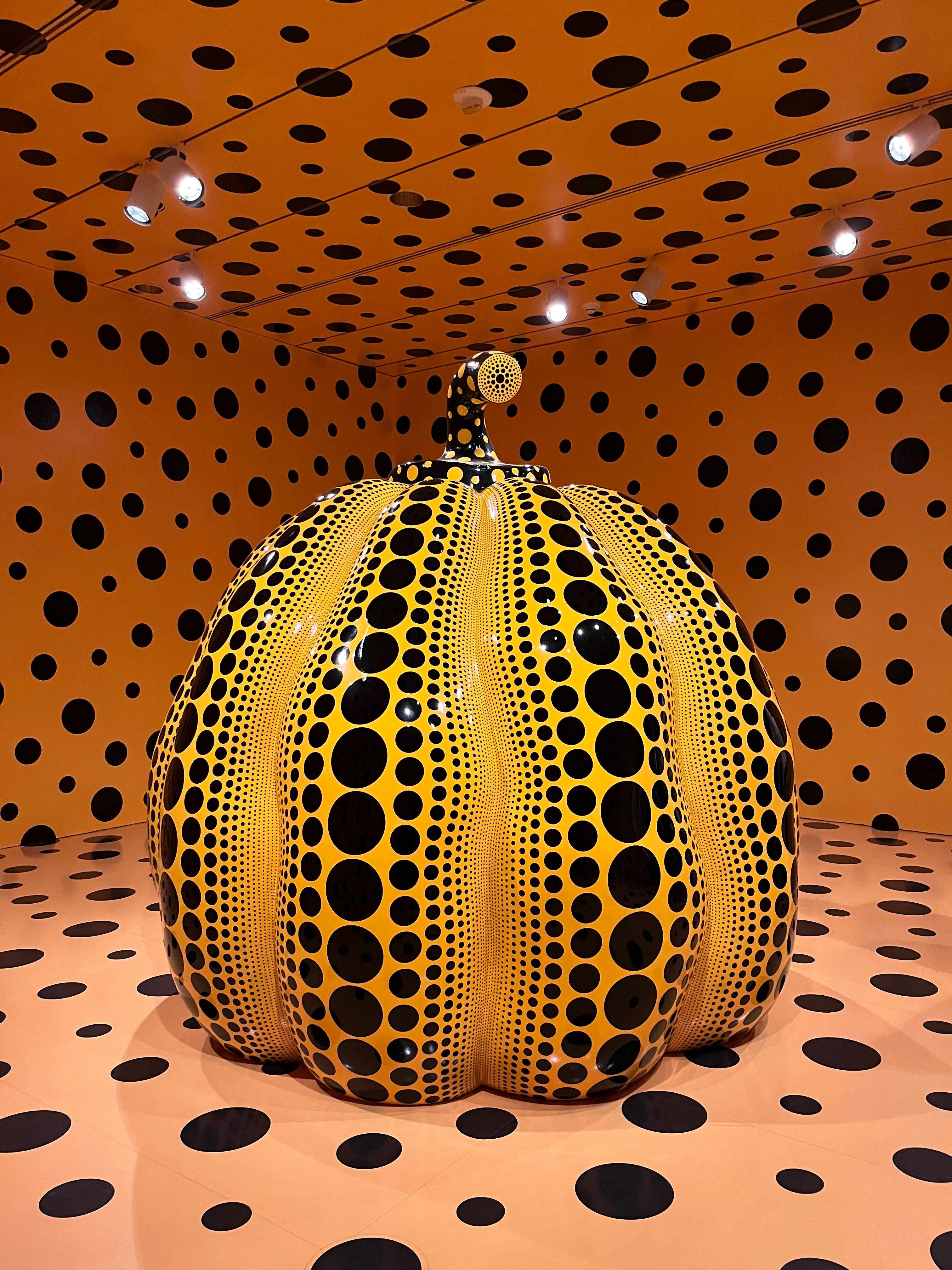
The first work, Pumpkin, 2016, is more than an outsized yellow gourd with a patterned black dotted exoskeleton sitting comfortably on its wide saggy base. It is a quiet presence in the middle of a square orange colored room including floor and ceiling, decorated with dizzying black dots of various sizes. The fiberglass sculpture coated with enamel, symbol of serenity amidst an hallucinatory world filled with black dots, hints at the artist's longing, and ultimately represents an ideal self-portrait. 

Chatting, looking at their cell phone while waiting to enter Infinity Mirror Room-Phalli's Field, 1965/2017, visitors seem to ignore the rousing poem from Kusama addressed "To the Whole World" and the texts about the artist and her works spread on the red walls of an antechamber-like space. With the last line still in my mind ("Revolutionist of the world by Art"), I walk in the installation: door closes... thirty seconds. The guard has a chronometer. Floating on a thick carpet of white phalli decorated with red dots like corals on a seabed, hundreds of me reflect in the mirrors, getting smaller and smaller until they fade in a black spot, lost in the void of infinity. Surrounded by "myselves" I try to capture this intense stolen moment which I expect to be otherworldly, transcendent, sublime. Time for one or two unavoidable selfies and... out. Still somewhat discombobulated, I regain my footing back in line, ready for the next room. 

"Infinity Mirrored Room- My Heart is Dancing into the Universe", 2018, offers a walk through a small dark space filled with black paper lanterns illuminated by colored lights shining through translucent holes. Immersed in waves of blue, violet, red, orange, yellow, green,... a cacophony of colors glowing through dots of all sizes, I feel like experiencing a psychedelic nightmare or looking at a broken kaleidoscope. I hesitate to take a step forward, confused, my rods and cones in disarray, even the floor reflecting the lights appears uneven. Two minutes... time is up. Close to an attack of claustrophobia, I leave the kinetic light show and reach the last room where a metallic dark coat covered with plastic roses set on a hanger is the only piece on a white wall. The monochrome sculpture, a sort of relic, evokes Kusama's episodes of hallucinations. The anticlimactic finale to the short exhibition is not the end of the visit which reverberates long after. 


In line with the flow of visitors there is little time to meditate! Getting a whiff of infinity at best, the viewer transformed into a consumer may feel frustrated but Kusama's work reaches beyond the museum. Inspired by her relentless fight with mental disease which has taken over her life, art has become the mean to conquer and share her fears, hallucinations, obsessions, and transcends a trivial design, a dot, to create a world of infinity and spirituality.  Her practice reaches a large audience attracted by its pop art side and/or its otherworldly aspect. One of my unforgettable visit was at Musée des Beaux-Arts de Nancy in the East of France where Fireflies on the Water, 2002, is a permanent installation. Without time constraint, alone, immersed in the quiet infinity mirrored room I connected with the artist who stated: "I felt as I had begun to self-obliterate, to revolve in the infinity of endless time and the absoluteness of space, and be reduced to nothingness."  


photographs by the author:

"Pumpkin", 2016

"Infinity Mirror Room-My Heart is Dancing into the Universe", 2018

"Infinity Mirror Room-Phalli's Field", 1965/2017


Friday, June 22, 2012

All Lights On The Hirshhorn


The show at the Hirshhorn must be popular. Scheduled to end May 13, it is still on and brings crowds the day of my visit. Suprasensorial: Experiments in Light, Color and Space is spread throughout the museum. Starting on the top floor, a huge neon sculpture from  Lucio Fontana hangs above the escalator like a shining message drawn by the wand of a magician. Unfortunately, the ceiling is too low, and the lines from the beams intercept the sensuous curves. I turn around, try another spot, to no avail, the intrusive background spoils the magic scribble. The sculpture was first shown at the Milan Triennial in1951 displayed in a more appropriate setting, the grand staircase of a contemporary art gallery.

A walk through Jesús Rafael Soto's Blue Penetrable BBL is another experience, visual as well as tactile. The blue nylon strings shiver and whisper, disturbed by the visitor who emerges on the other side, from the sea? the sky? a forest?  The intense blue falls and fades on the floor.

Painful auditory stimuli come from a tent-like structure and people walk out with glazed eyes, shaking their heads. A quick look reveals cushions on the floor, a dark space with giant images projected on the wall... my ears cannot take the cacophony and I walk by Cosmococa No. 1: Trahiscapes from  Hélio Oiticica.

Carlos Cruz-Diez shares an enchanted world in Chromosaturation, a work full of adventures in color. The immaculate space feels like a surgical suite ( the visitor has to wear shoe covers to preserve the spotless floor). Bubblegum green, red, blue, orange, mauve, pink... reflect on the walls, ceilings, floors, define sharp angles and lines and fade as the visitor walks through the three rooms. One feels like breathing, bathing in color, possessed by an urge to grab a handful of green, yellow, orange, but it is already gone, a fleeting illusion. The artist created a fifth element: color and provides a path from the material to the immaterial.

In contrast, Light in Movement from Julio Le Parc is black and white. In a dark room, mirrors and spotlights produce animated shadows on the wall. The speed of the images combined with the rotation disorients the visitor and creates a dizzying effect.
   
The exhibition ( minus the pool, MOCA in 2010) requires a direct interaction between visitors and works. The artists have reached their goals. 

photographs by the author:
"Neon Structure for the IX Triennial of Milan", 1951, Lucio Fontana
""Blue Penetrable BBL", 1999, Jesús Rafael Soto
"Chromosaturation", 1965, Carlos Cruz-Diez