Thursday, September 9, 2010

The High...

... is the Museum of Art in Atlanta. Named after the High family who donated the land on Peachtree Street. The High is located in Midtown and is easy to spot: a congregation of white buildings added over the years.


Richard Meyer (1934), who favors the color white, designed a 135,000-square-foot building in 1983. Two new buildings were added in 2002 to expand the museum's size to 312,000 square feet. The architect for this project is Renzo Piano (1937).
The color white is the only common feature between the buildings. The curvy building from Meyer otherwise clashes with the angulous shapes from Renzo Piano. Piano's style, who built the Menil Collection in Houston, is recognizable, but due to its scale, the buildings looks like vast, windowless, graceless hangars. The one level museum in Houston, also white, has a mediterranean flavor and the system of panels to filter the sunlight brings an extra nautical or aerial touch. Adding to the coldness of the High is the grey cement courtyard as opposed to the fresh green lawn in Houston.


Walking through the entrance, the visitor is surprised by the brightness of the surroundings and the vast space of the atrium which spreads from the first floor to the skyway level, white with a touch of blue through the glass ceiling (the day of the visit).

At each level, balconies overlook the central area, and a gently inclined walkway brings the visitors to the different levels.

The three buildings (the Stent Wing, the Wieland Pavillion, the Anne Cox Chambers Wing) are connected by glass bridges.


To the left, "Mouth #15" Tom Wesselman, 1968


There is no shortage of space for the permanent exhibition. Large walls and wood floors, the setting is ideal. However, the visit was short due to the lack of interesting collections. European, American paintings, sculptures, crystal, furnitures...the collections are sparse and made of minor works .


The goal of my visit was to see the temporary exhibition "Dali: The Late Work". The works were crammed on the walls or in the corners. The rooms were packed, full of visitors brought by this unique exhibition showing some rarely seen works. They were unable to take the few steps back and forth necessary to appreciate the visual effects of some of the paintings (for example: "Fifty Abstract Paintings") and feel the full impact of the monumental compositions like "Santiago El Grande". The temporary exhibition was not given the space it deserves.


The High has a lot of space, what about the content?


"The Shade" a sculpture from Rodin is a gift from the french governement to the High. 106 Atlanta arts patrons who died in an airplane crash at Orly airport in Paris in 1962.


"House III" Roy Lichtenstein, 1997 decorates the side of Meier's building.


photographs by the author


Monday, September 6, 2010

"Academic Surrealist or Surrealist Academician"

The High Museum of Art in Atlanta presents a well publicized exhibition titled: "Dali: the Late Work.". On display are the works produced during four decades (1940's till the 1980's) by the prolific artist. It could be called his post-Surrealist period ( he was banned from the Surrealist movement in 1934).

The first room is an introduction with photographs from Philippe Halsman showing the artist in various poses. The photographs from the series "The Cosmic Dali" are well-known with "Dali Atomicus" (1948), "Mid Summer Night's Mare" (1949) among others, a total of fifteen photographs to wet our appetite.

The second room is occupied by ten small paintings executed between 1930 and 1940, at a time when Dali was part of the Surrealist movement. Theses paintings represent for me the Dali I know the best. I came to see the late works.

Finally, the visitor reaches the subject of the exhibition. The gigantic canvasses, including "Madonna of Port Lligat" 1950, "Santiago El Grande" 1957, "Christ of St John of the Cross" 1951, "Assumpta Corpucularis Lapilazulina" 1952 have not been displayed in the United States since the 50s. A mixture of Surrealism and Classicism, they define the religious period of the artist. Dali mixes his own symbols (horns from rhinoceros, eggs from ostriches) and religious symbols. Gala, his wife becomes the virgin Mary. Pope Pius XII encouraged Dali to pursue his search for religion, the painter became an iconoclast in the process.

The technique of the artist is flawless. For the "Christ of St John of the Cross" , he uses chiaroscuro. The special angle looking at Christ from above makes the viewer feel like being God looking at the crucified subject who himself is looking down to the fishermen, representing us, the viewers.

The visit continues with Dali's preoccupations: genetic, atom, the search for eternity are the subjects of the works, lithogaphs, prints, paintings. He mixes art, science and some charlatanism.


A small room is dedicated to Dali, the illustrator: "Don Quixote", "Ten recipes for Immortality", "The divine Comedy" . These lithographs are well known, a reminder of the quality of the artist. The prints are technical masterpieces.

Random portraits of famous personages can be seen in a corner, also, in the same area, a few jewels and Dali's game of chess, his experimentation with holography, two videos for tired visitors, more photographs from Halsman. This section of the exhition does not flow well. It is just "put together".


Dali is also the precursor of Pop art. "Portrait of my Dead Brother" 1963, "Fifty Abstract Paintings" 1963, "The Sistine Madonna" 1958 are crammed with among other works the sculpture titled: "White Eagle" 1974. Unfortunately, the space is very crowded, and this visual experience is hampered by the size of the room.

And then, it is over. The special Dali store is right there, one can buy fake mustaches, cups with Dali's portrait, jewels...

As a whole I was deceived by the exhibition...not by Dali. The rarely seen works deserved a better setting. The High Museum of Art is not short of space and could have used three times the square footage for this exhibition to give it its full impact. It would also allow a better flow of the crowd.
Dali, Don Quixotte


photographs are reproductions from the book: " Dali: The Paintings" from Robert Descharmes and Gilles Neret, made by the author

1. "St. James of Compostela", 1957
2. "Landscape at Port Lligat", 1950
3. illustration for "pages choisies de Don Quichotte de la Manche" by Joseph Foret, 1957


Thursday, August 5, 2010

Blue mountains

This Summer, what about a trip to... Knoxville, TN.

The Dogwood Festival is in full swing, bringing artists from different backgrounds: musicians, sculptors, actors, painters.


Knoxville is putting on a show. Marketplace is filled with visitors and the crowd applauds a piece of Shakespeare played by local comedians. Downtown is thriving.


Sculptures are lining the streets and the parks.


Crowds of parents and children are making family pictures next to the sculptures, finding a background, a space to inhabit.


This is a giant step for this city which appears to ignore the economic downturn.

"Tower of Remembering" Robert Pulley
"Gilding the Lily" Duke Oursley
"Threaded" Isaac Duncan"
"Wrapped around you" Davis Whitfield
"Prism Arc with Folded Circle" Carl Billingsley
"The Storyteller" Mike Rolg

photographs by the author


Saturday, July 10, 2010

Listen to Jazz and look at paintings


Music from Ted Nash and the Lincoln Center Jazz Orchestra inspired by paintings: "Portrait in Seven Shades".

The musician selected seven painters including Monet, Dali, Matisse, Picasso, Van Gogh, Chagall and Pollock. Seven videos were made at the MOMA, they can be viewed on YouTube.


No comments, just listen...and look.

Thursday, July 8, 2010

(FOLK) ART

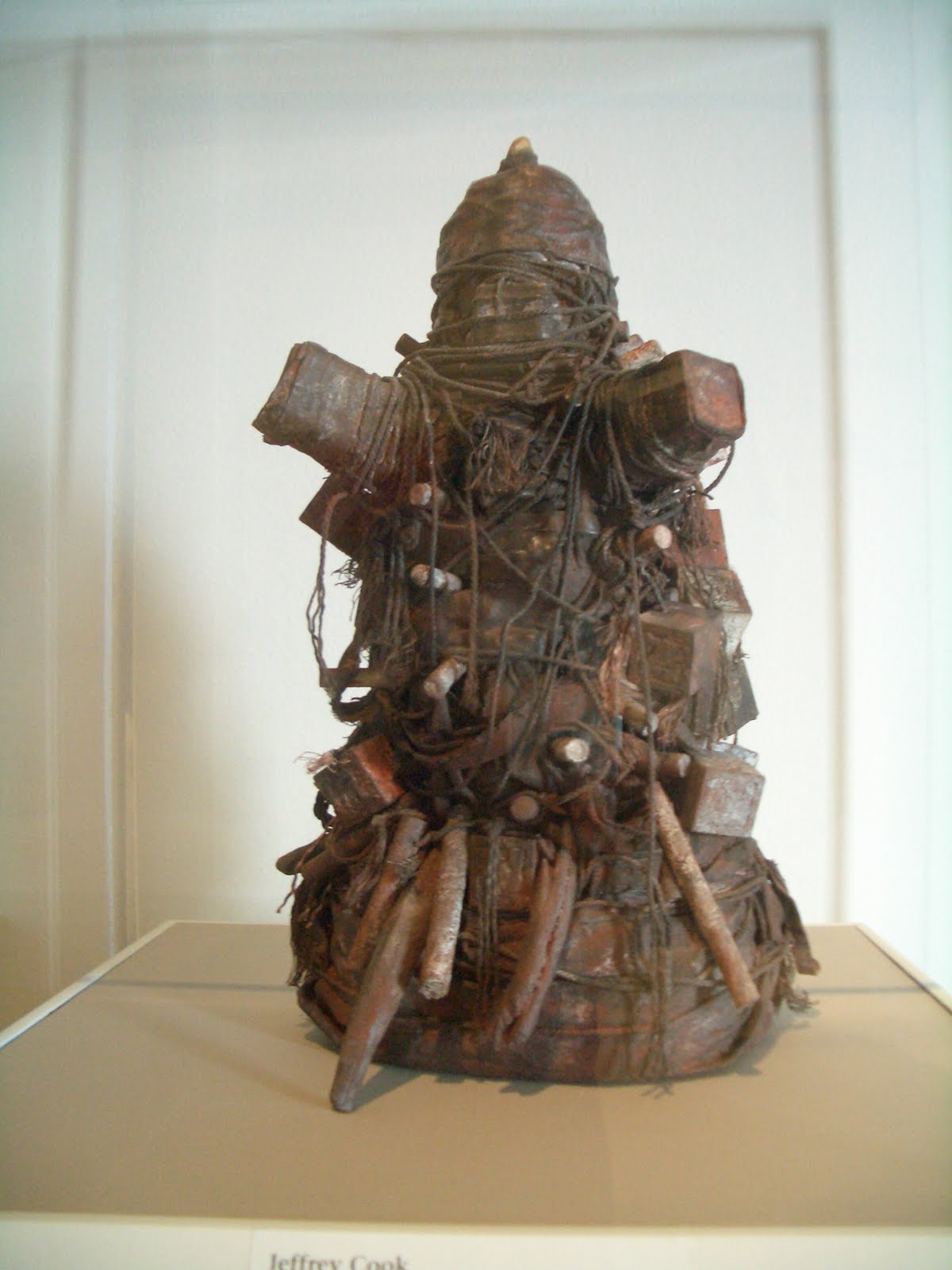
The exhibition at NOMA titled "Swamp Tours: Exploring the Louisiana Contemporary Collections" made me reflect on the subject of Art versus Folk Art.

It is a medley of works bringing together "unusual and unexpected acquisitions" from the NOMA.
The artists represented include David Butler, Clementine Hunter, Lynda Benglis, Noel Rockmore, Ida Kohlmeyer, Jeffery Cook... and more. There is art and folk art. Well, where do we draw the line?
I tried to find the elements of folk art, is it its utilitarian, decorative? Is it it's reflection of more primitive mythology and fears? Does it represent a smaller community?

Art work is intellectually driven, significant, representing a society, a civilization.

It is also the viewer.


It is a fascinating subject and I am not to write a thesis,... just thinking... This exhibition is very interesting indeed , sometimes whimsical. A flavor you would not find anywhere else, complete with the gourmet turtle soup I had for lunch at the museum's cafe.


photographs by the author

Sunday, June 27, 2010

Forty

This Summer, the NOMA presents 40 artists with two characteristics in common, they are women and from Louisiana. The works cover the period from 1965 till 2010. The two rooms dedicated to this exhibition appear cramped, filled with sculptures and paintings.
There is art for every taste, Surrealist, Realist, Abstract... from known and not so well known artists.

The exhibit is interesting because of its diversity, which also makes it difficult to absorb.


Among all the artists, I noticed the work from Jesselyn Benson Zurik (1916), "the Madonna of the Chair", 1980. It is an interesting minimalist sculpture but it is already a late work for the Minimalist movement.


Another original work from Ida Kohlmeyer retains the attention. "Mythic Throne", 1986, combines painting and sculpture. One can find a flavor of New Orleans but also an early combination of high and low art which made Takashi Murakami well known in the 90s till the present.


Rayne Bedsole is represented by a collage of a silhouette againts a dark background. Her works make me dream. I especially like her boats, symbols of voyages, including the ultimate voyage. Her use of symbolism blends the Mythology of different cultures to create works telling the universal story of Mankind.


One of the limitations of such exhibition is that it presents a very narrow window of some artists career. For example, Lynda Benglis, a prolific artist, who expressed herself with strong messages to fight for women's representation, deserves a better display than one sculpture.


Of course, one of Lin Emery 's kinetic sculpture "River Tree" was at the center of the room. Her metal sculptures, with nature as the subject, are well-known in New Orleans.


Even with some informations about the artists printed next to the works, this exhibition stays superficial. Using a musical term, the works are too discordant to be appreciated in such closeness. One can ask the goal of the curator: to show a great number of women artists in Louisiana? Unfortunately, it just resembles another end of the year College or art school exhibition.


photographs by the author

Wednesday, June 16, 2010

Black holes and spaceship

Lee Bontecou at the MOMA fills an entire room with three sculptures and a dozen of works on paper. This is the latest exhibition of the artist titled: "Lee Bontecou: All Freedom in Every Sense" which covers 30 years of the artist's career.
The room is centered around a mobile which occupies most of the space with its moving shadows.
The wall sculptures, which became the artist's signature in the 50s are made of steel and canvas taken from discarded conveyor belts. They are ominous with this black hole. The works are untitled to leave the imagination of the viewer wander.

These works represent the post-war period of the artist, when using discarded material was still a novelty.

The mobile (1980-1998) took 18 years to complete. It looks maybe like a vessel from outer space, some alien composition but contrary to the wall sculptures dark and threatening, it came from a happy fairy tale. I found it very decorative, elegant but with a message somewhat weaker.

Overall the exhibition did not meet my expectations, too few works were displayed to represent the artist. An overview of her works is available in this article.


photographs by the author